AI automation cost has four parts for a midsize company: finding the work worth automating, building it, running it, and your own people's time. The build is the largest published line at The Gnar Company, but a range quoted by a vendor tells you little until you size the project from your own hours and volume.
This post starts with the first cost a CEO faces, which is deciding what to automate and proving the saving before anyone builds. It then walks through each line, shows how to size the project, and says when not to fund it yet.
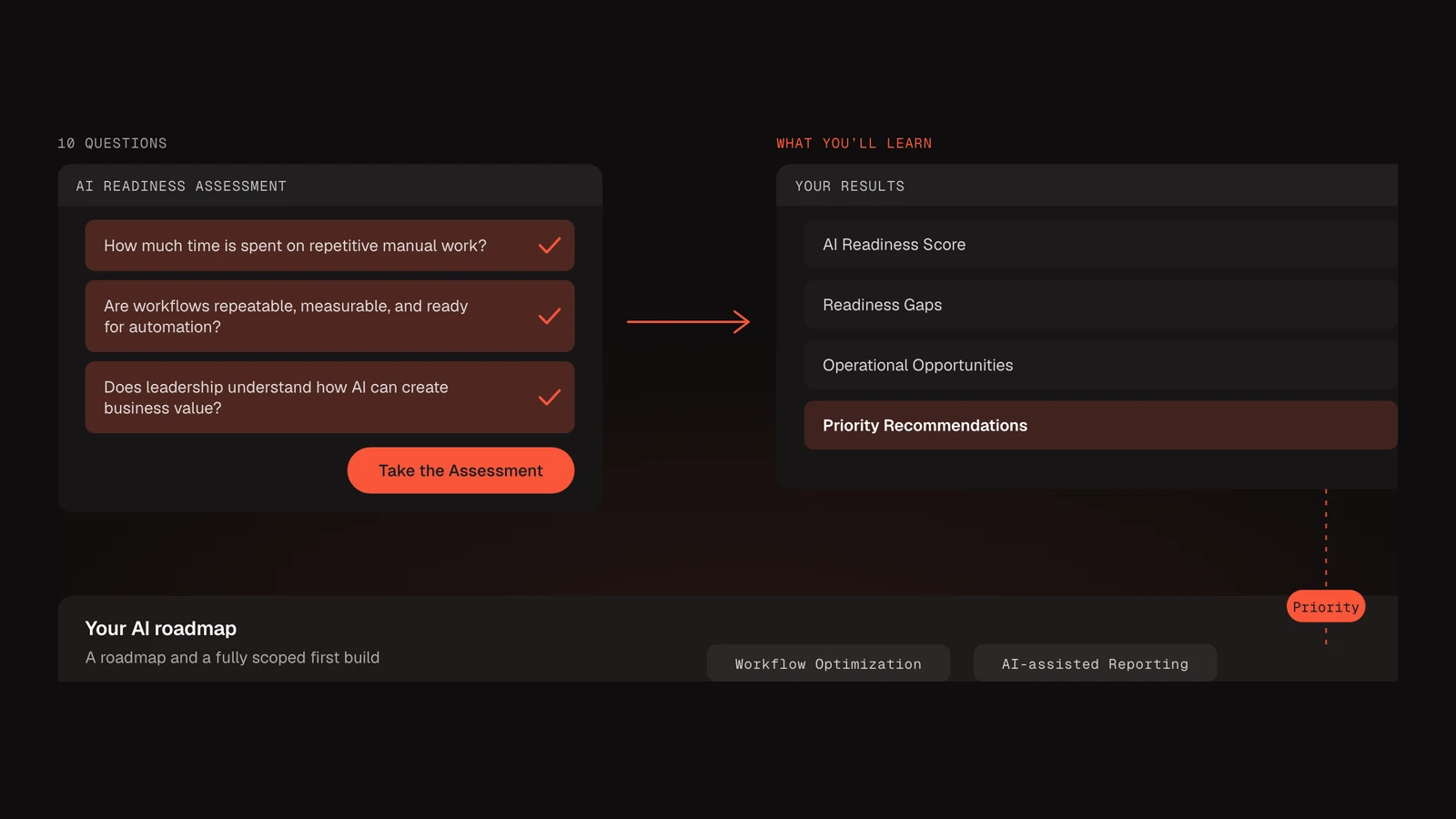
The Gnar Company, a Needham, Massachusetts custom software firm, publishes the numbers it can: Discovery from $20,000 and four weeks, ending in a fixed price for the build. If you are building the case for a board or a CFO, our AI strategy work covers the same ground at the company level.
What does AI automation cost end to end?#
An AI automation project costs money in four places, and they hit the budget in this order: finding the work, building it, running it, and the time your own people spend along the way. Add a fifth line for hidden costs, which are the surprises that land on top of the other four.
| Cost line | What it covers | How it is priced | Who controls it |
|---|---|---|---|
| Find the work | Interviews, mapping, ranking, and the saving math | Discovery at Gnar: $20,000 for four weeks or $30,000 for six weeks. Compass, a fixed-price review, has no published price | You and the firm, before any build |
| Build | Software, integration to systems you keep, data preparation | At Gnar, typically $150K to $300K+, as a fixed milestone price | Scope, set in the plan |
| Run | Hosting, monitoring, support, and usage fees for the AI model | Maintain from $1,000 a month at Gnar, plus a token bill that grows with volume | Your volume and the model you pick |
| Your people's time | Interviews, data cleanup, testing, and an owner after launch | No published number, because you count it from your own payroll | You |
| Hidden costs | Rework, change requests, a second system you did not plan to touch | Fixed price puts the overage on the firm. Hourly work puts it on you | The contract you sign |
Agency quotes and guides often show much lower and wider ranges. Those are the sellers' own claims, so this post does not repeat them. A range is only useful if you can compare total AI cost against the saving you can recover. Use a range only after the vendor tells you which of the five lines it includes.
Which pricing models do AI automation agencies use?#
Automation agencies sell on four pricing models: fixed price, hourly rates, a monthly fee or retainer, and pay for results. Pay for results is a form of value-based pricing, since you pay for the value delivered rather than hours or scope. The model decides who carries the risk if the work takes longer than expected, and how much control you have over scope and spend, so it matters as much as the number. Here is what each one means for you, and which one each Gnar offer uses.
| Pricing model | What it means for the buyer | Where the risk sits | Gnar offer that uses it |
|---|---|---|---|
| Fixed price | One agreed amount for a defined scope | With the firm, if the scope was written down well | Discovery is a fixed price. Builds carry a fixed milestone price, with any overage on Gnar |
| Hourly rates | You pay for the time spent, however long it takes | With you, since every extra hour is billed | Embed, which is billed time and materials. Discovery, Build, Forge and Maintain are not |
| Monthly fee or retainer | A standing amount for an ongoing service | Shared, since you pay each month whether or not you use all of it | Maintain, a monthly fee from $1,000 |
| Pay for results | You pay only if the result is found | With the firm | Compass, which has its own published offer, covered below |
Hourly rates suit work you cannot scope yet, but they are the wrong fit when you need a number for a CFO, because the number moves. When an agency quotes a small pilot, ask which model it is and what happens if the work runs long.
What should you pay to find the work first?#
You should pay for the cheapest step first, the one that tells you whether the build is worth buying. At The Gnar Company that step is Discovery or Compass, and the reason is on the Counter Culture Coffee case study.
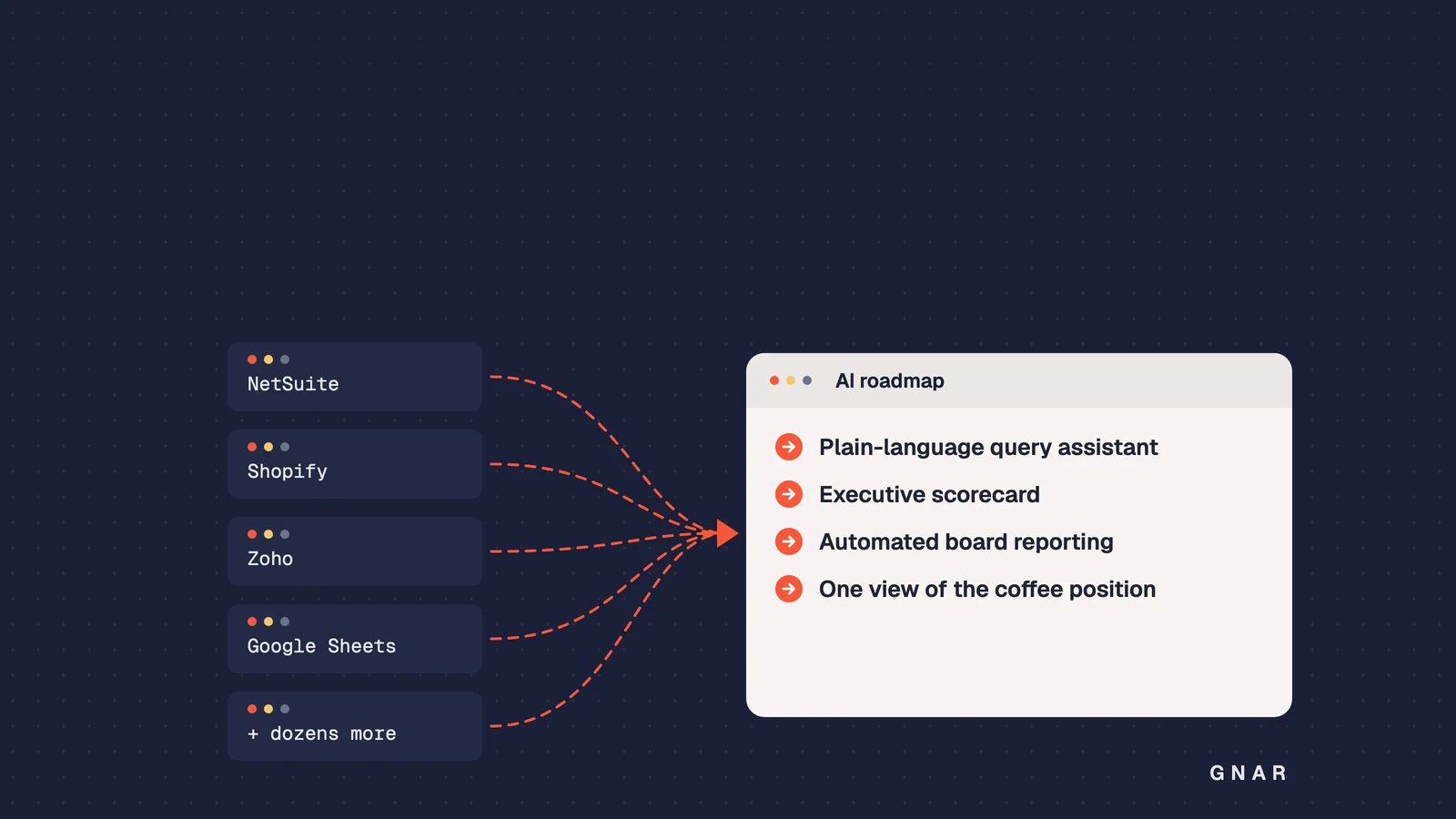
Counter Culture's roadmap identified 79 AI and automation opportunities across 7 capability areas, drawn from 15+ interviews. Every one was scored across five dimensions, including ROI and data readiness, then ranked and sequenced. The case study states $1.5M in potential savings identified across the top 10 initiatives.
Two details in that case study matter for your budget. First, scoring counted only recoverable value, and weak data readiness capped an opportunity's score regardless of its upside. Second, coffee procurement initially looked like a market-timing opportunity, and a full year of contract data showed the team was already managing that well, so the recommendation shifted on paper, before any build.
The case study also says many of the gains come from NetSuite capabilities Counter Culture already owns, with AI reserved for reconciliations and accrual worksheets. Some savings may need only a configuration change.
The method is in our post on how to find AI opportunities in your business processes.
What does the build cost, and what moves the number?#
The build is where most of the AI automation cost sits, and four things move it: how many systems it must connect to, how much data preparation it needs, how many workflows it covers, and how many approvals and edge cases a person handles today. At The Gnar Company, builds typically run $150K to $300K+, a range published on the Discovery page. The plus sign means some run higher, and Discovery is where your project gets its own number.
Integration is the first driver. A tool that reads one inbox is a different project from one that also checks your ERP and writes back to it. Data preparation is the second: if the same field means different things in different years, someone has to fix that before an AI model can use it. Workflows and edge cases are the third and fourth. One workflow with a clear rule is small, and a process with 40 exceptions is not, so count the exceptions before you ask for a price.
The RAND Corporation's report on why AI projects fail points at the same places. It reports that by some estimates, more than 80 percent of AI projects fail, and notes that this figure comes from other estimates, not from RAND's own measurement. Its interviews name root causes that map to cost lines. Stakeholders often misunderstand what problem needs to be solved. Organizations often lack the data to train an effective AI model. And organizations might not have adequate infrastructure to manage their data and deploy completed models. Missing data and missing infrastructure are budget lines, and a quote that leaves them out is incomplete.
Scope creep is the fifth driver, and a fixed milestone price is the usual defense. Connecting an extra system should be priced as a milestone of its own. At Gnar each milestone carries a fixed price, agreed before work starts, with any overage on us.
What do API costs look like once it runs?#
Usage fees for a custom AI tool are usually small next to the build, and they scale with volume, so it helps to work from actual numbers. You pay for tokens, the small pieces of text the model reads and writes, at a rate per million. Anthropic's pricing page lists Claude Sonnet 5.5 at $2 per million input tokens and $10 per million output tokens.
Here is an illustration, using our own arithmetic on those published rates. The inputs are made up, not a Gnar client number. Say a tool reads 10,000 documents a month, and each one uses 3,000 input tokens and 500 output tokens.
- Input: 10,000 documents times 3,000 tokens is 30 million input tokens. At $2 per million, that is $60 a month.
- Output: 10,000 documents times 500 tokens is 5 million output tokens. At $10 per million, that is $50 a month.
- Total: $110 a month, before any discounts.
Four things change that number, all from Anthropic's page. The Batch API gives a 50 percent discount on both input and output tokens for work that can wait, which would cut the example to $55 a month. Cache reads, meaning text the model has already seen, cost 0.1 times the base input price on most models. Claude Haiku 5.5, a smaller model listed on the same page at $0.10 per million input tokens and $0.50 per million output tokens, would run the same example at $3 plus $2.50 a month, for $5.50 a month in total, if it can do the job. And the page says models from Claude 4.7 on use a newer tokenizer that produces approximately 30 percent more tokens for the same text. On our example, 30 percent more tokens means about 39 million input tokens at $78 a month and 6.5 million output tokens at $65 a month, for $143 a month in total.
The lesson is that running cost grows with volume and context length. At 10,000 documents a month the token bill is small. An agent that reads long files all day, across a large team, is a different story, and you should ask for its monthly running cost before you sign. For the full method, including caching and how to set a low, base and high range, read our three-year cost model for a Claude build.
What are the ongoing costs after launch?#
Ongoing maintenance has five parts: hosting, monitoring, support, model changes, and changes in the systems your tool connects to. These are the real world cost categories that show up after launch. The first three are steady. The last two arrive without warning, which is why a standing relationship is worth pricing in.
- Hosting. The place the tool runs, with a monthly bill even when nothing changes.
- Monitoring. Someone has to see that it is running and that its answers still look right, and you need to agree who responds, and how fast, when it fails.
- Support. When a user hits a case it does not handle, someone fixes it.
- Model changes. Prompts that worked on one AI model can drift on the next.
- Upstream changes. Your ERP, your email system or a partner's file format changes, and the tool breaks.
At The Gnar Company, Maintain starts at $1,000 a month for hosting, monitoring, support and a standing relationship, a price published on the Gnar Forge page. Add the token bill from the last section to get your monthly running cost. You can skip a support plan, but then you need to say who in your company owns these five jobs.
That question, who owns it after launch, decides whether the tool is still used a year later. Our post on AI workflow automation for operations teams shows one emailed order before and after, including who holds the tool once it is live.
How much of your own team's time does it take?#
No vendor can price your own team's time for you. Build it from five items.
- Interviews. The people who do the work have to explain it. The Counter Culture roadmap came from 15+ interviews.
- A named owner. One person who answers questions, makes calls and accepts the result.
- Data cleanup. Someone who knows the data has to say which records are right.
- Testing. The people who do the work today try the tool on real cases and report what it gets wrong. The prompts, instructions, exceptions and handoff rules should be written down as they test.
- Change management. Someone tells the team what changes in their day and what does not.
To count it, take hours per person per week times weeks, for each person, then multiply by their hourly cost or loaded cost from your own payroll. Training the team and managing the change count here too, because adoption depends on them. We publish no dollar figure for this line.
How do you size the project and the ROI?#
Size the project from your own real numbers before you look at any vendor range.
- Volume. How many items per month does the process handle?
- Minutes per item. How long does a person spend on one?
- Error rate and what an error costs. A wrong order, a late invoice or a re-ship each has a price.
- Systems touched. Every system you keep is a connection to build.
- Data quality. Is there one source of truth, or five spreadsheets?
- A named owner. Who is accountable for the result?
- Recoverable savings only. Count a saving only if the freed time or avoided error turns into real money. Counter Culture's scoring counted only recoverable value, and so should you.
- Build cost against the first-year saving, and against the three-year total cost of ownership. The three-year view includes running cost and your people's time.
Here is an illustration with made-up numbers, not a Gnar client result. Say your team handles 4,000 emailed orders a month, and each takes 6 minutes to key in. That is 400 hours a month. If a person costs you $40 an hour, loaded, the work costs $16,000 a month, or $192,000 a year. If half of that time turns into work you would otherwise hire for, the recoverable saving is $96,000 a year.
Now compare. Start with the difference between the current manual cost and the projected running cost, then judge the ROI. A build in the $150K to $300K+ range is larger than one year of that saving, so the three-year view decides, along with whether the volume is growing. If the saving were $20,000 a year, the investment would not pay back, so the answer would be no. To turn this into a case a board will accept, see how to build an AI roadmap the board will fund.
How do you find the numbers with Gnar, and what is guaranteed?#
Gnar has two ways to get your numbers before you commit to a build. Discovery and Design is $20,000 for four weeks or $30,000 for six weeks, and it ends in a Milestone Project Plan with a fixed price for your build, so the build price is fixed per milestone, with any overage on us. You get that plan whether or not you build with The Gnar Company, so you can take it to anyone. The build it scopes typically runs $150K to $300K+.
Here is how Gnar's guarantee reads, word for word. Three commitments on every build engagement: a fixed milestone price with any overage on us, a guaranteed outcome meaning the software works as specified or we fix it, and a twelve-month bug-free warranty. It covers Discovery, Build, Forge and Maintain. It does not cover Embed. On Compass, Immerse and Integrate, ask us.
Compass is a separate offer with its own terms. Like Discovery, it lets a company price the first build before committing to it. Its page describes it as a fixed-price review that finds where AI saves your company money, built for US companies over $10 million a year, and quotes this line: "If we don't find at least $350,000 a year in savings, you don't pay." It ends with the first build scoped at a fixed price, with its projected ROI. Building any of it is a separate decision, made later, with us or anyone else. Compass publishes no price, so we do not quote one. You can read it on the Compass page.
When should you not fund AI automation yet?#
Do not fund an AI build yet if any of these is true. Each one is a reason the money would be wasted, and each has a cheaper next step.
- No one owns the result. Name an owner first. Without one, the tool launches and nobody uses it.
- The process changes every month. Automating a moving target means rebuilding it every month. Evolving requirements are a poor fit for automation now, so settle the process first.
- The data lives in spreadsheets with no source of truth. RAND names missing data as a leading cause of failure. Counter Culture's rule is a good model: master data is edited only in its system of record, and every other system reads from there.
- You cannot state the saving in dollars. If the number is a feeling, run the cheap step that turns it into math.
- Your own engineers have the capacity and the direction. Then do it internally. Gnar's own answer when a buyer says they have people for this is that often you should use them, and we will say so on the call.
- The first step is configuration of a system you already own. Counter Culture found this. Configure first, and build only what is left.
If you hit any of RAND's three causes, an unclear problem, missing data or missing infrastructure, the next dollar goes to fixing that, or to a small pilot on one workflow. Test it on normal cases, exceptions and failure points before a wider rollout. Pick a workflow with a clear rule and a named owner, and set the success number before the work starts.