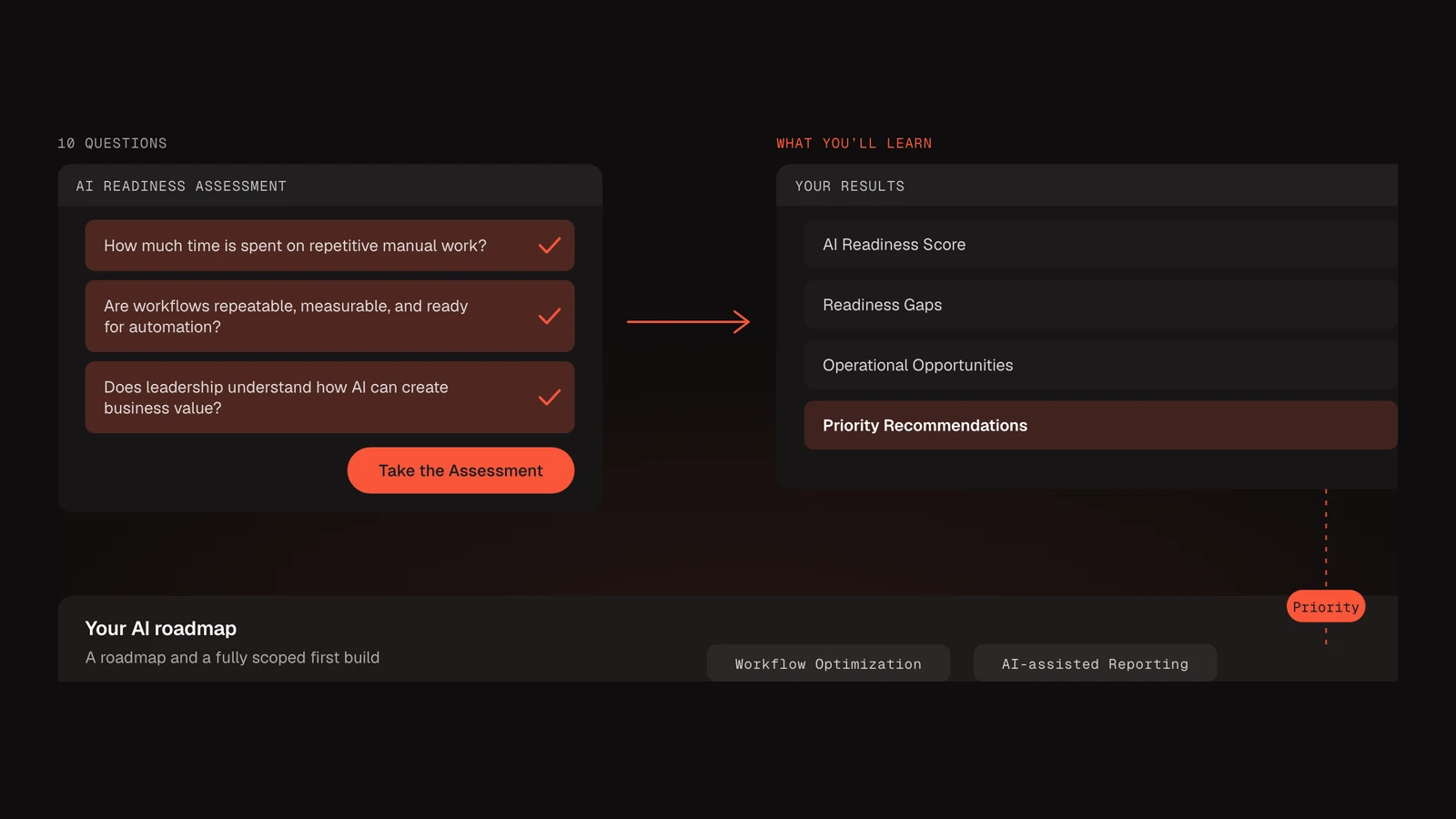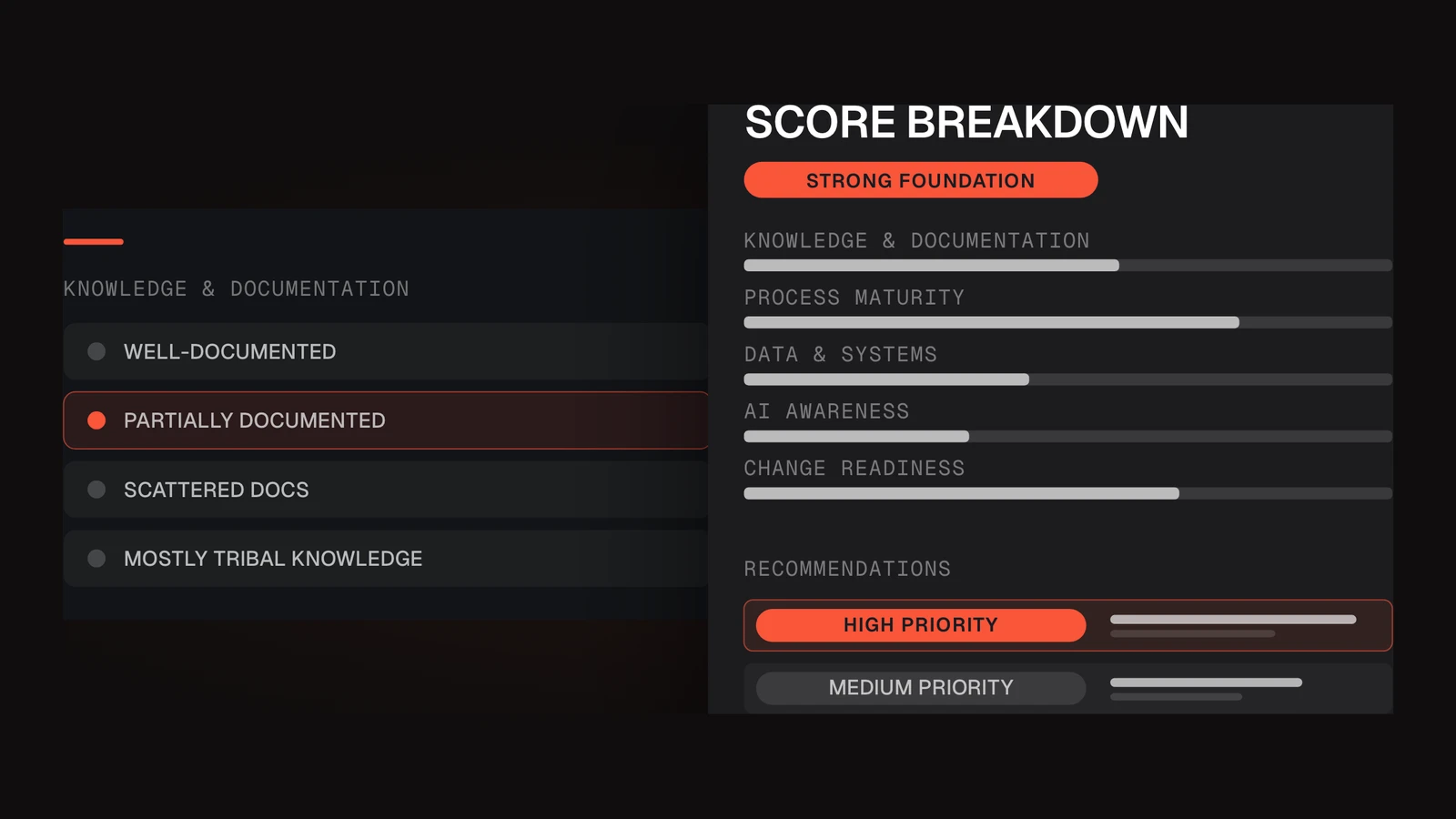
To find the AI opportunities in your own business, start with the work itself. Interview the people who do it, map your systems and where the data moves, list every idea, score each one the same way, check the data behind it, and then put the work in order.
That is how we run AI strategy work at The Gnar Company. We map your processes, rank AI opportunities, and define an implementation roadmap. We sell this work, and the case below is one of our engagements.
The steps below follow one real engagement from start to finish. Counter Culture Coffee sells direct to consumers and to businesses, and runs on NetSuite, Shopify, Zoho and dozens of other tools. Its case study has the numbers we use throughout.
This guide is for the CEO of a mid-market distributor, manufacturer or logistics company who keeps hearing about AI and has no list of where it would pay in their own company.
What is business process discovery, and why does it come before AI?#
Business process discovery is the work of finding out how your business actually runs, step by step, across people, systems and data. It comes before AI because an AI project can only automate or speed up work you can describe. If nobody has written down how an order moves from email to invoice, nobody can say where AI fits in it.
The UK government's service manual (last updated 21 June 2021) says that before you commit to building a service, you need to "understand the problem that needs to be solved", and that you "should not start building your service in discovery". Interviews and a systems map are one way to study a process. For a mid-market company where much of the work happens in email and spreadsheets, they are a practical place to start.
At Gnar, the engagement starts from one question: where will AI pay off, and what has to be true first? The second half of that question matters as much as the first.
Step 1: Interview the people who do the work#
Start with interviews, and include the people who do the daily work as well as the leaders who manage it. Leaders know the goals. The people at the keyboard know where the time goes, which steps are retyped and which reports nobody trusts.
For Counter Culture Coffee, a senior Gnar strategist led the work, with weekly working sessions alongside leadership. The team ran 15+ interviews with leadership, department heads, and the operators who run the day-to-day, across finance, operations, coffee procurement, sales, marketing and data.
Questions that surface opportunities:
- What do you type in by hand that already exists somewhere else?
- Which report do you rebuild every week or every month?
- Which questions can only one or two people answer?
- What do you check twice because you do not trust the number?
Write the answers down by team. The same pain often shows up in three departments under three names.
Step 2: Map every system and where the data moves#
Map every system the business uses and trace how data moves between them. The map shows where AI can plug in and where it would be reading data that is copied, stale or split across tools.
At Counter Culture Coffee, the team mapped every system and data flow end to end, with NetSuite at the center. The systems map grouped more than 60 tools by function, then traced how each one connects to the core systems. Two findings shaped everything after:
- NetSuite was the hub. Commerce, fulfillment and retail EDI already flowed into one system of record, which gave AI a natural place to plug in.
- Many tools worked from exported data. Outside the core connections, most tools stood alone or relied on exports, which is why spreadsheets carried so much of the load.
Your map does not need special software. A spreadsheet with one row per tool, its owner, what data it holds, and where that data comes from and goes is enough to start.
Step 3: List every opportunity, without filtering yet#
List every idea for AI or automation that came up in the interviews and the map, before you judge any of them. Filtering too early drops the ideas that look small but would pay well, and keeps the ones that sound impressive.
Counter Culture Coffee's list reached 79 AI and automation opportunities, catalogued across seven capability areas. Workflow and task automation led with 17, followed by insight generation and analytics (14) and generative content and marketing (13).
Write each idea in one line: who does the work today, what the AI would do, and what data it needs. That line is what you will score in the next step.
Step 4: Score every opportunity the same way#
Score every idea on the same measures, in the same way, so the ranking comes from the measures you agreed on before anyone argued for a favorite. Pick a short list of measures, define each one in a sentence, and score every idea against all of them.
In the Counter Culture Coffee engagement, every opportunity was scored on the same five dimensions:
| Dimension | In plain words |
|---|---|
| Financial ROI | How much money does this make or save? |
| Operational efficiency gains | How much time does it give back to the team? |
| Implementation complexity | How hard is it to build and run? |
| Data readiness | Is the data it needs complete and trusted? |
| Cultural readiness | Will the team that owns the work use it? |
Two rules made the scoring honest. Scoring counted only recoverable value, meaning value the business could actually get back. And weak data readiness capped an opportunity's score regardless of its upside.
Step 5: Check the data before you build anything#
Check whether the data behind each top idea can be trusted before anyone builds. An AI assistant is only as reliable as the data it reads, and it has no way to know which of two similar fields is the right one. Fix that before the build. An AI readiness assessment should test exactly this: which fields are complete, owned and trusted.
At Counter Culture Coffee, a second map, of which system is the source of truth for each data set, found the data foundation largely sound in the hands of the system experts who know it, but in need of guardrails before wider use across the company. A handful of master data sets lived in spreadsheets or in more than one system. That meant manual retyping and reports that did not always match.
The recommendation was to give each of those data sets a single home in a core platform, NetSuite or Zoho, based on which team owns and uses it most, and retire the duplicate copies. The rule behind it is worth copying: master data is edited only in its system of record, and every other system reads from there.
Governing a trusted set of NetSuite data, with agreed definitions and clear ownership, was identified as the key to three complex builds at once: a plain-language query assistant, an executive scorecard and automated board reporting.
Step 6: Put the work in order#
Put the ranked ideas into an order the business can follow: remove the barriers first, then start quick wins for internal champions, the staff inside the business who lead the first projects, while the larger automations get built. A ranked list with no order tends to stall, because every team assumes its project comes first.
Counter Culture Coffee's plan set the same order: remove barriers first, then quick wins for internal champions, while Gnar builds the larger automations.
Give every item an owner, a cost and an expected return, as Building an AI roadmap the board will fund lays out. In that engagement, 34 projects were ready to start and 8 were already underway, led by five internal champions from IT, finance and operations using Claude.
What kind of work is a good candidate for AI?#
Work is a good candidate for AI when people retype information that already exists, rebuild the same report on a schedule, or answer the same questions from the same documents. Those signals show up in interviews long before anyone names a tool.
| Examples of what you might hear in interviews | The kind of AI or automation it points to |
|---|---|
| "I copy orders from email into the ERP" | Reading and entering documents automatically |
| "I rebuild this report every month" | Automated reporting from the system of record |
| "Only one person knows which field to use" | A plain-language query assistant on governed data |
| "We reconcile these by hand at month end" | Help with reconciliations and worksheets |
| "We write the same customer email over and over" | Drafting from templates and past answers |
Anthropic, which makes Claude, tracks how Claude is used, and maps that use to work tasks, in its Economic Index. Its January 2026 report found that some occupations, like data entry keyers, are much more heavily affected by AI than task coverage alone would suggest. Its March 2026 report found that business sales and outreach automation, such as B2B lead qualification research and customer data enrichment, at least doubled its share of API use in three months.
Both reports measure how Claude is used. They show where people already apply AI. Use them as a prompt for your own list of repeated work.
Not every candidate needs AI. In the Counter Culture Coffee engagement, many of the gains in the month-end close come from NetSuite capabilities the company already owns, with AI reserved for reconciliations and accrual worksheets. Check what your current systems can do before you build anything new.
What if the data says the idea is wrong?#
When the data says an idea is wrong, change the idea and follow what the data shows. A good discovery tests its own assumptions, and some of the most useful findings are ideas that turn out to be the wrong project.
At Counter Culture Coffee, coffee procurement first looked like a market-timing opportunity. A full year of contract data showed the team was already managing that well. So the recommendation shifted to what would help most: a single, real-time view of the coffee position across contracts, importers and warehouses.
That view gives buyers one place to see contracts, importers and warehouse inventory. It also lays a foundation for demand planning later.
What should you have at the end?#
At the end of the work you should have a ranked list with a score, an owner and a place in the order for every opportunity you plan to pursue, a map of your systems and data, and a first step everyone agrees on. A slide deck of ideas with no scores and no owners is not finished.
Counter Culture Coffee left with $1.5M in potential savings across the top 10 initiatives, each with a score, an owner, and a place in the sequence. Of the identified projects, 27 grow revenue, 29 free up capacity, 13 cut costs and 10 strengthen control.
In the words of Joe Prewett, CEO of Counter Culture Coffee: "The Gnar team did an outstanding job mapping our tech stack, evaluating the strength of all the connections, and looking for opportunities for strengthened data integrity and, of course, productivity (from big to small). The engagement gave us a roadmap that we're using to flow into our 3‑year plan."
What should you ask before you start?#
Ask who will do the interviews, how ideas will be scored, and what happens after the list is done, before you start the work yourself or hire anyone. The answers decide whether you end with a plan the business can follow or a list nobody owns.
- Who will we interview, and does the list include the people who do the daily work?
- Will every system and data flow be mapped, or only the main ones?
- What measures will score each idea, and does weak data cap the score?
- Who owns each item on the final list?
- What is the first step, and when does it start?
- Who builds the first project, and is it the same team that wrote the plan?
- What does the guarantee cover, if there is one?
At Gnar, the team that wrote the strategy ships it. The strategy and training phases of Gnar's AI strategy and fluency work are advisory and are not under the guarantee. Gnar Discovery and Design is a separate service from the AI strategy work this post describes: a structured product design engagement for a software build that ends with a guaranteed build price. The build carries Gnar's guarantee: "Three commitments on every build engagement: a fixed milestone price with any overage on us, a guaranteed outcome meaning the software works as specified or we fix it, and a twelve-month bug-free warranty. It covers Discovery, Build, Forge and Maintain. It does not cover Embed. On Compass, Immerse and Integrate, ask us."
If you want a first read before any of this, Gnar offers a free AI Readiness Assessment or a free Claude workshop.