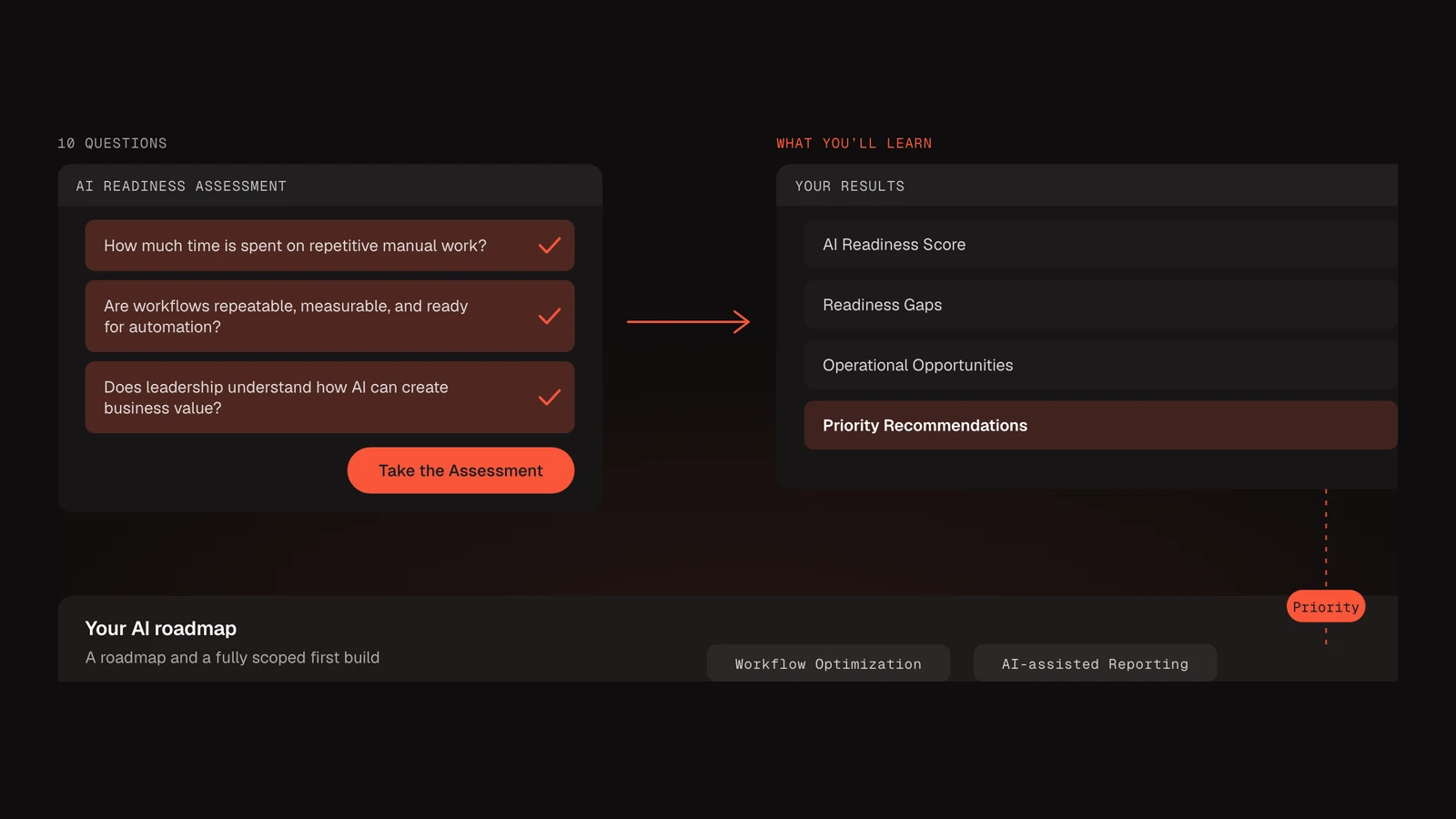
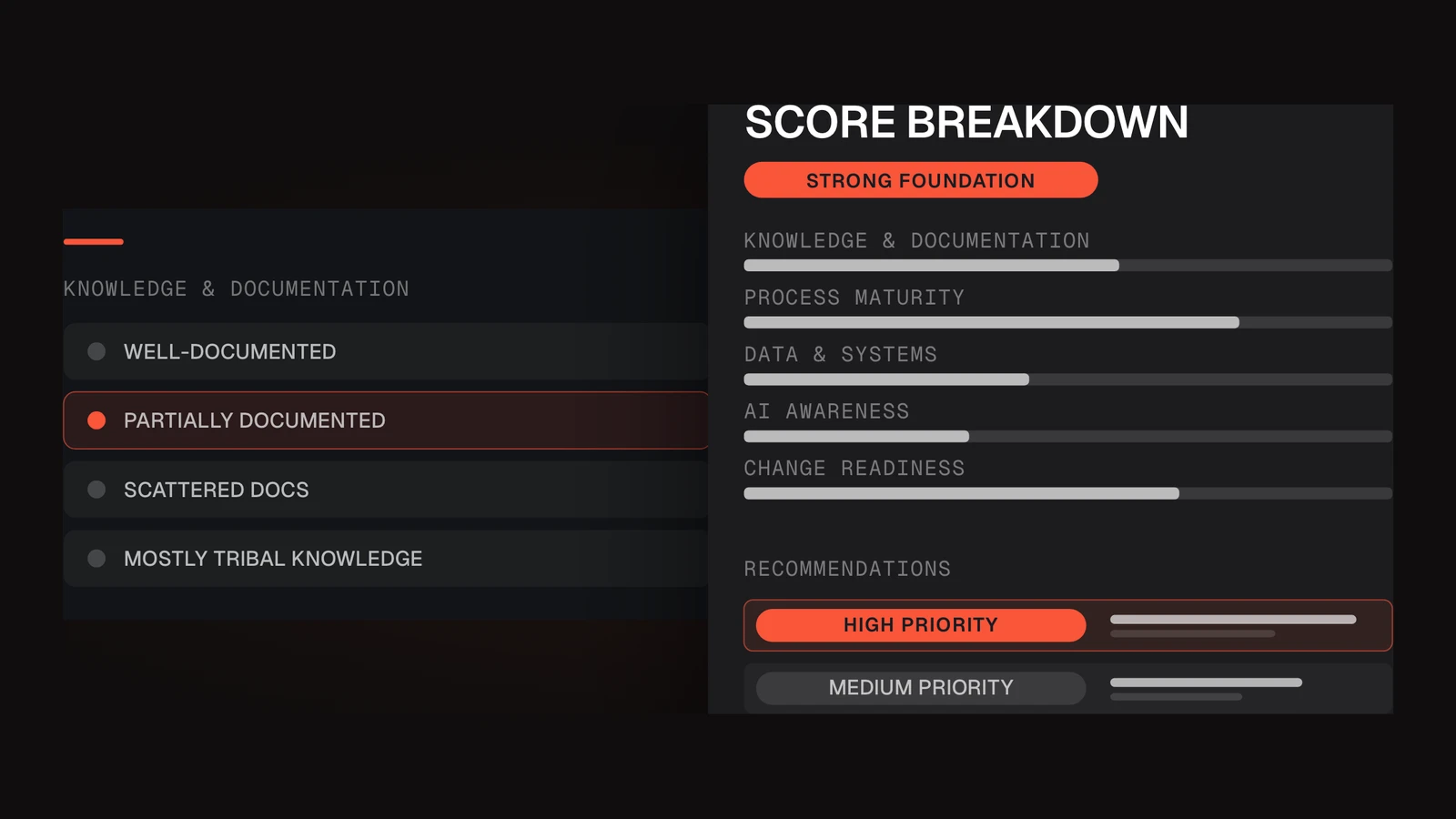
An AI readiness assessment should check six things: where your business knowledge lives, how repeatable your workflows are, how much time goes to manual work, whether your systems and data are connected, whether your leaders agree on what AI is for, and whether your team is ready to change how it works. It should end with a ranked list of opportunities as well as a score.
Large published frameworks, such as Microsoft's, add pillars like governance and security. This post is for a mid-market company, such as a distributor with an ERP, a few spreadsheets the business depends on and a small IT group. The Gnar Company offers a free 10-question AI Readiness Assessment built around these six areas, and runs AI strategy engagements, with interviews, for companies that need a firmer answer.
What is an AI readiness assessment?#
An AI readiness assessment checks whether a business is prepared to put AI to work, and where it should start. A short version is a self-check: a set of questions a leader answers in a few minutes. A full version adds interviews with the people who do the work, a map of the systems and data, and a ranked list of where AI would pay off.
The two kinds answer different questions. A self-check tells you roughly where you stand. A full assessment tells you what to do first, what it would take, and what to leave alone. Use both, in that order.
What should an AI readiness assessment cover?#
A useful assessment covers six areas: knowledge, workflows, manual work, data, leadership and adoption. For each one, it should ask a plain question and then ask to see the evidence behind the answer. The table below uses the six areas Gnar's assessment evaluates and the question each one asks, with the evidence a buyer should ask to see.
| Area | The question | Evidence to ask for |
|---|---|---|
| Knowledge and documentation | Does critical business knowledge live in documentation or in employees' heads? | Written procedures for the work AI might touch |
| Process and workflow maturity | Are workflows repeatable, measurable, and ready for automation? | A step list for each candidate workflow |
| Operational efficiency | How much time is spent on repetitive manual work? | Hours per week, by task and team |
| Technology and data readiness | Are systems connected and data accessible enough to support AI initiatives? | A map of systems and where each data set lives |
| Leadership alignment | Does leadership understand how AI can create business value? | A short list of goals leaders agree on |
| Organizational adoption | How prepared is your team to adopt new tools, processes, and ways of working? | Named people who will own each change |
Large frameworks overlap with these areas and add others. Microsoft's AI Readiness Assessment takes about 45 minutes and covers seven pillars, including governance, security and model management. For a mid-market company, the six areas above are a practical starting point.
Is your data ready?#
Your data is ready when each important data set has one home, the fields mean one thing, software can read it without a person pulling a file by hand, and people trust the numbers it produces. When this area falls short, the fix usually has to come before any AI gets built.
Cisco's 2025 AI Readiness Index found that 19 percent of companies overall have fully centralized data, against 76 percent of the companies it ranks as most ready.
Check these:
- One home per data set. Customers, items and prices are each edited in one system of record.
- Fields people agree on. Two reports from two systems give the same number for the same question.
- No spreadsheet shadow copies. Nobody keeps a spreadsheet that is more current than the system.
- Readable by software. The data can be read through an API or a scheduled feed, with no person pulling a file by hand.
- Known owners. Each data set has a team that fixes it when it is wrong.
At Counter Culture Coffee, pulling a reliable number from its deeply customized NetSuite often depended on the few people who knew exactly which fields to use. That is the kind of finding a self-check cannot surface on its own.
Are your workflows ready?#
A workflow is ready for AI when it runs the same way most of the time, someone can write its steps down, and you can measure how long it takes and how often it goes wrong. Workflows that change every time, or live only in one person's head, need to be written down before they can be automated. At Counter Culture Coffee, Gnar scored all 79 opportunities on the same five measures, including financial ROI and implementation complexity, so every opportunity was compared on the same footing.
Check these:
- Written steps. Someone can write the workflow as a list a new hire could follow.
- Volume. It happens often enough that small savings add up.
- A baseline. You know the hours it takes today and the error rate.
- Clear inputs. You know what arrives, such as emails, PDFs or spreadsheets, and from whom.
- A checkable result. A person can look at the output and say whether it is right.
Two of the six areas in the table, process maturity and operational efficiency, cover this ground. Together they point to the work worth automating first: frequent, written down, and measurable.
Does leadership agree on what AI is for?#
Leadership is aligned when the executives can name the same two or three business goals AI should serve and agree on how they will measure them. Without that, departments tend to pick their own tools.
Cisco's 2025 index found that 58 percent of companies overall have a well-defined AI strategy, against 99 percent of the most AI-ready group.
Check these:
- Shared goals. Leaders name the same business outcomes, such as fewer hours on order entry or a faster month-end close.
- A sponsor. One executive owns the AI work and the budget for it.
- A measure. Each goal has a number that will show whether it worked.
- A limit. Leaders agree on what AI will not be used for, at least for now.
Is your team ready to change how it works?#
Your team is ready when the people whose work will change know what is coming, have someone inside who will lead each change, and have a plan for training. At Counter Culture Coffee, the roadmap named five internal champions.
Cisco's 2025 index found that 35 percent of all companies have a full change management plan, against 91 percent of the most AI-ready group.
Check these:
- Named owners. A person inside the business owns each change and has the time to lead it.
- Early involvement. The people who do the work are interviewed before anything is built.
- Training time. Time is set aside on the calendar to learn new tools.
- A first win. One small project the team can see working before larger ones start.
What should you have at the end?#
At the end of a full assessment, you should have a ranked list of opportunities with the math behind each one, a clear view of what has to be fixed first, and the first project scoped well enough to decide on. A score alone does not tell you what to do next.
Gnar's AI strategy engagement describes its own output this way: a strategy, a roadmap and a fully scoped first build, grounded in stakeholder interviews, process mapping and five-dimension opportunity scoring.
Ask for these before you sign:
- A ranked list. Every opportunity scored the same way, with the reasoning shown.
- Data findings. Which data sets need a single home or cleanup first.
- A first project. Scoped with what it would cost and what it should return.
- Owners. A named person inside the business for each next step.
- What to skip. Ideas that looked good and were dropped, with the reason.
An assessment that dropped nothing gives you no way to see what it actually tested.
Do you need a quick self-check or a full assessment?#
Start with a self-check to get your leadership team on the same page, then do a full assessment before you commit budget to a build. A self-check is fast and free but cannot see your data or talk to your people. A full assessment can.
| Kind | What it involves | What you get |
|---|---|---|
| Gnar's AI Readiness Assessment | 10 questions, free | An AI Readiness Score, gaps and opportunities |
| Microsoft's AI Readiness Assessment | About 45 minutes, seven pillars | Guidance matched to your answers |
| A full assessment | Interviews, a systems map, data checks and scoring | A ranked list and a first project to decide on |
Before any money is spent, the questions in 5 questions to ask before investing in AI help a leadership team agree on goals, and checking whether your team is ready for AI in two minutes covers the self-check.
What a full assessment turned up at Counter Culture Coffee#
Counter Culture Coffee, a specialty roaster, wanted AI to support its growth and needed to know where to start. Gnar's AI strategy and roadmap engagement there held 15 or more interviews, mapped more than 60 tools, and checked whether the data was ready. Its conclusion was that the data foundation is largely sound in the hands of the experts who know it, but needs guardrails before wider use.
The case study shows several of these checks at work:
- Knowledge. Reliable numbers often depended on the few people who knew which NetSuite fields to use.
- Data. Some reference data, like the rotating coffee lineup, lived in spreadsheets and was entered into other systems by hand.
- Scoring. All 79 opportunities were scored on the same five measures, and weak data readiness capped an idea's score regardless of its upside.
- What changed. The team tested an early idea about the timing of coffee purchases against a full year of contract data, found the team was already managing purchase timing well, and shifted the recommendation to a single view of the coffee position.
- Owners. The roadmap named five internal champions, with 34 projects ready to start and 8 underway.
The findings were presented to Counter Culture's board. A full assessment should end with a decision the leadership team can make with the evidence in front of it.