An AI roadmap the board will fund starts from goals the board already tracks, ranks every AI idea on the same measures, puts a cost, an expected return, a risk and a named owner on every line, and ends with one decision for the board to make. Most of that work happens before anyone writes a slide.
If your board has asked for an AI plan by next quarter, the plan has to answer money questions as well as technology ones. The Gnar Company's AI strategy engagement produces a board-grade AI roadmap and a fully scoped first build.
What does a board want from an AI roadmap?#
A board wants to know what the money buys, what it returns, what could go wrong, who is accountable, and what it is being asked to approve now. A roadmap that answers those five questions for each line is one a board can fund.
In the NACD 2025 board practices survey of public company boards, 62.33 percent of the 146 respondents said their board set aside agenda time for a full-board discussion of AI. Only 8.90 percent said their board had approved an annual budget toward AI projects, and 6.16 percent said their board had set metrics for management reporting.
Far more of those boards set aside time to discuss AI than have approved an annual budget for it. A roadmap that brings its own costs, returns and metrics closes that gap for the people in the room.
Step 1: Start from goals the board already tracks#
Start the roadmap from the business goals the board already reviews, such as margin, working capital, order accuracy or the cost of the month-end close. Each AI idea then has to connect to one of those goals. Ideas that connect to none of them go to the bottom of the list.
Write the goals at the top of the roadmap in the board's own words. At Counter Culture Coffee, a faster month-end close was one finding of the roadmap, with many of the gains coming from NetSuite capabilities the company already owned. For a distributor the goal might be order accuracy. For an insurer the goal might be the cost to handle a claim and the time to quote.
This step also sets the measures for the rest of the plan. If a goal is "lower the cost of the month-end close", every idea under it needs a number in hours or dollars that shows how much it moves that cost.
Step 2: Interview the people who do the work#
Interview the leaders and the people who do the work, and map every system and data flow they touch. Leaders often do not see the daily routines where AI could help, such as retyping orders or rebuilding the same report every week.
At Counter Culture Coffee, Gnar held 15 or more interviews with leadership, department heads and the operators who run the day-to-day, across finance, operations, coffee procurement, sales, marketing and data. Every system and data flow was mapped around NetSuite, the company's ERP.
For each interview, write down the tasks done by hand, how often they happen, which systems they touch, and who would have to agree to change them. That list becomes the raw material for the roadmap.
Step 3: How should you rank AI ideas?#
Rank every idea on the same measures, and show the scores. A board can challenge a ranking it can see. Counter Culture's opportunities were scored on financial ROI, operational efficiency gains, implementation complexity, data readiness and cultural readiness, and weak data readiness capped a score regardless of its upside.
| Measure | What the board learns from it |
|---|---|
| Financial ROI | What the idea saves or earns, counting only recoverable value |
| Operational efficiency gains | How much time or effort it takes out of a team's week |
| Implementation complexity | How hard it is to build and connect to current systems |
| Data readiness | Whether the data it needs is trusted and in one place |
| Cultural readiness | Whether the team that owns the work will use it |
Counting only recoverable value keeps the totals believable.
Step 4: In what order should the work happen?#
Order the work in three phases: remove the barriers first, then run quick wins that internal champions can own, and build the larger automations alongside them. This order lets the board see early results while the bigger projects get going, and it puts the data work on the page where the board can see it.
| Phase | What happens | Why it comes here |
|---|---|---|
| Remove barriers | Fix the data and ownership problems other projects depend on | Later projects fail without it |
| Quick wins | Small projects led by internal champions | Early results the board can see |
| Larger automations | Builds that touch several systems or teams | They run alongside the quick wins and depend on the data work |
This is the sequence Counter Culture's roadmap used.
Step 5: Give every line a number, an owner and a risk#
Every line on the roadmap needs four things: an expected return in dollars or hours, a cost, a named owner inside the company, and the main risk with how it will be handled. A board can approve a line with all four. A line missing any of them invites a question the presenter cannot answer.
For the risk column, a common reference is the NIST AI Risk Management Framework, released in January 2023 for voluntary use and now being revised. A mid-market roadmap does not need to adopt it in full. It helps to name, for each line, what data the AI will touch, who approves its output, and what happens when it is wrong.
Keep the owner column real. An owner is a person with the authority to change how the work is done and the time to lead it. At Counter Culture, the quick wins were assigned to five internal champions from IT, finance and operations.
Step 6: Ask the board for one decision#
End the roadmap with one clear decision, usually to fund a first project that is already scoped, with its cost and expected return stated. A board can approve a defined first step at the next meeting. A request to fund the whole roadmap at once is usually harder to approve and harder to measure.
Gnar's AI strategy engagement produces a fully scoped first build alongside the roadmap. The first project should be small enough to finish and measure, and it should sit early in the sequence from Step 4.
State when you will come back. For example, report the first project's result against its number at the next board meeting, and ask for the second decision then.
What Counter Culture's roadmap found#
Counter Culture Coffee, a specialty roaster, wanted AI to support its growth without adding back-office overhead. Gnar's AI strategy and roadmap engagement found 79 AI and automation opportunities across seven areas, scored and sequenced them, and the findings were presented to Counter Culture's board.
The case study lists what the roadmap found:
- Value by type. Of the identified projects, 27 grow revenue, 29 free up capacity, 13 cut costs and 10 strengthen control.
- A total with owners. The roadmap shows $1.5M in potential savings across the top 10 initiatives, each with a score, an owner and a place in the sequence.
- One data fix behind three builds. Governing a trusted set of NetSuite data, with agreed definitions and clear ownership, makes three complex builds possible at once: a plain-language query assistant, an executive scorecard and automated board reporting.
- A tested idea. Coffee procurement first looked like a market-timing opportunity, and a year of contract data shifted the recommendation to a single view of the coffee position.
- Ready and underway. 34 projects were ready to start and 8 were underway.
Joe Prewett, Counter Culture's CEO, said the engagement "gave us a roadmap that we're using to flow into our 3-year plan."
What goes on the one page the board reads?#
Put the goals, the ranked list, the sequence, the numbers and the ask on one page, and keep the detail in an appendix. Counter Culture's top 10 initiatives each came with a score, an owner, and a place in the sequence, so give every line on the page those three, along with the cost, expected return and main risk from Step 5.
Use this as the outline for that page:
- The goals. Two or three business goals the board already tracks.
- The ranked list. The top opportunities with their scores and the measures behind them.
- The sequence. Which phase each line sits in, and why.
- The numbers. Cost, expected return, owner and main risk for each line.
- What was dropped. One or two ideas that were tested and set aside, with the reason.
- The ask. The one decision for this meeting, and when you will report back.
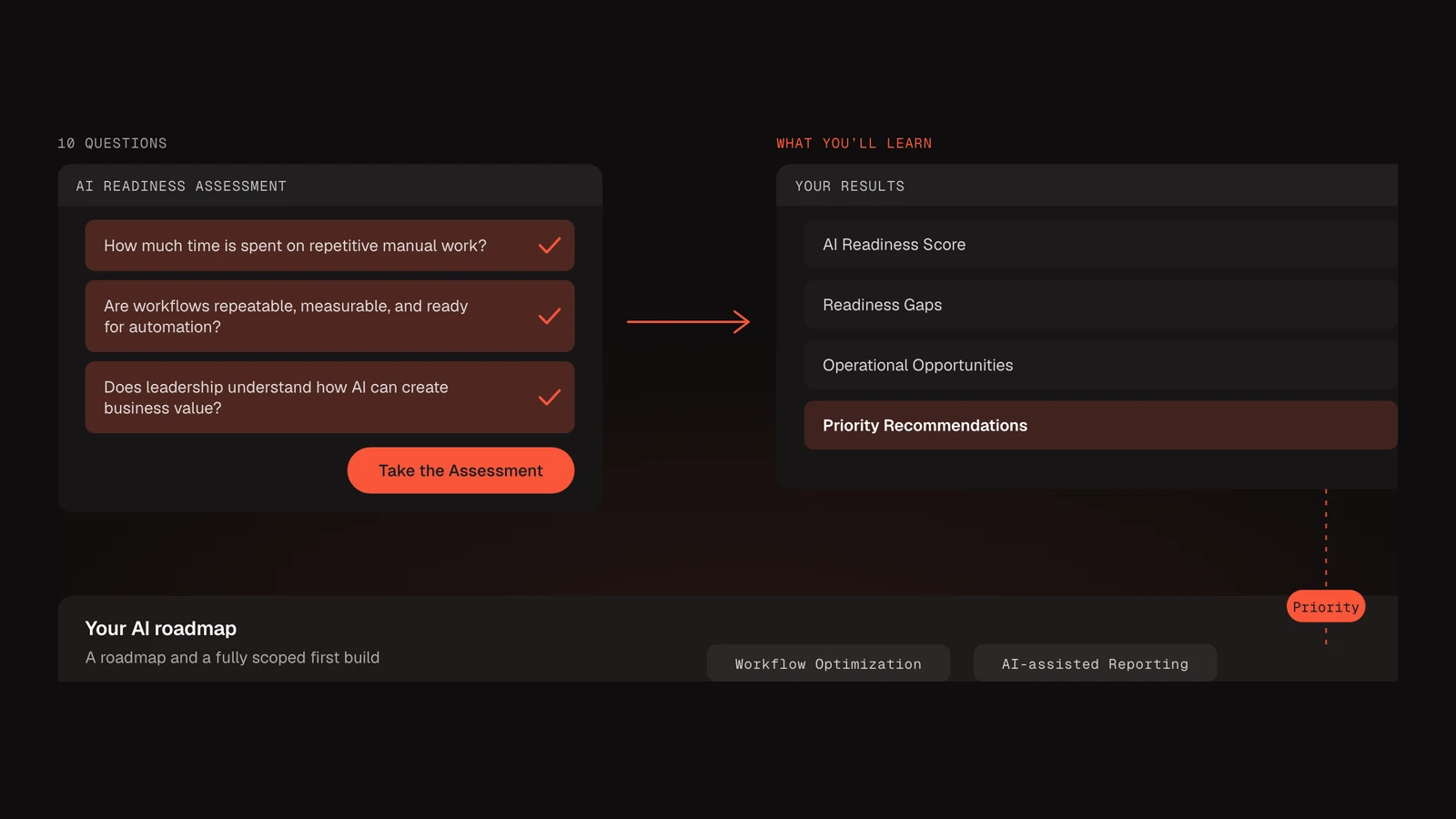
If you have not checked where your company stands yet, a short readiness check helps before the roadmap work starts. Gnar's free AI Readiness Assessment is ten questions, and our post on what an AI readiness assessment should cover explains what a fuller assessment adds.