AI pilots stall for a short list of reasons, and most of them have nothing to do with the AI model. The number was never agreed, the data is incomplete, the tool cannot reach your systems, or nobody owns it once the pilot team moves on. This guide is for the COO who has three pilots and no production system. It shows how to find which cause blocks the AI pilot to production step for each one, and who fixes each cause.
It matters because the question is already coming. Gartner's survey of 2,002 CIOs and technology executives, published on October 19, 2026, found that only 13% said their enterprise had realized significant or transformational value from AI so far. If your board asks "what did we get for this?", you are in the large group, not the small one.
The Gnar Company builds the part that comes after the prototype, and its AI strategy and fluency work puts it in one line: "The prototype works. Getting it into production is a different job, and it is the one we do." The rest of this guide is general advice you can use with or without us, and it says when you do not need us.
What is the AI pilot to production gap?#
The AI pilot to production gap is the distance between a pilot that works for the people watching it and a system that runs in daily operations with a number the CFO accepts. A pilot can stall in two ways. It never goes live, or it goes live and nobody can show a return.
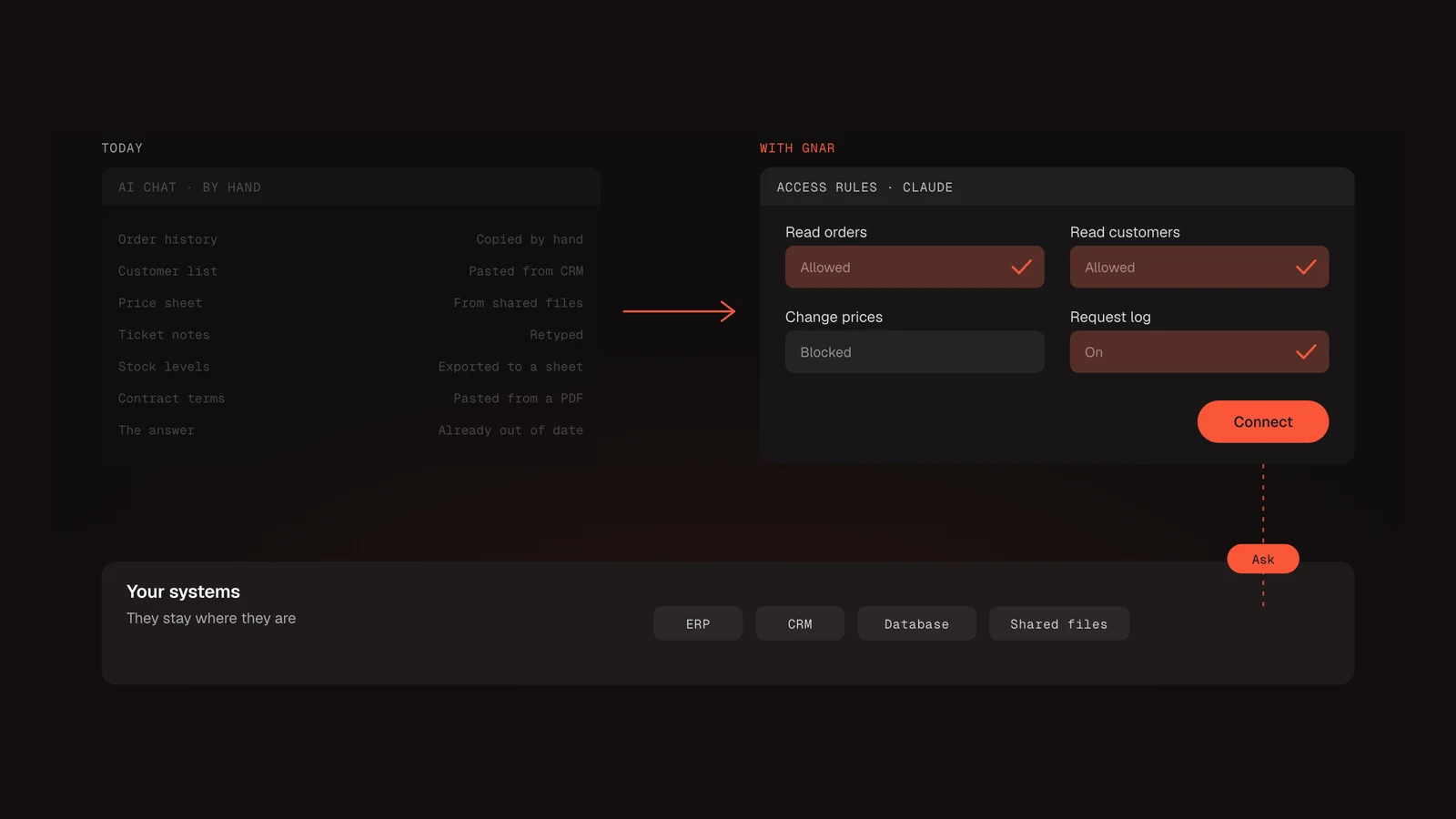
The first kind looks like a demo that people liked and nobody uses. A vendor showed a working assistant, a team built a test, someone bought seats. None of it touches the orders, invoices or customer records where your people work, so they paste things into a chat by hand and the pilot stays a side project.
The second kind looks busy. People use the tool, and they say it helps. But nobody wrote down a baseline before it started, so there is nothing to compare against. McKinsey's State of AI in 2026 survey, published August 25, 2026, shows the same split. Eighty percent of respondents said AI improved their individual productivity, yet only 37 percent attributed at least some EBIT impact to it. A good feeling on one desk is not a result on the income statement.
Keep the two kinds apart, because they have different fixes. A pilot that never went live needs connections and an owner. A pilot that went live without a number needs a baseline, a stop rule and a CFO who signs the measure.
How often do AI pilots fail to pay back?#
Often, but the figures count different things in enterprise AI surveys, so check what each one measures before you repeat it. The best recent numbers come from surveys of executives, and they agree on the shape: most organizations have AI activity, and few have a return they can point to.
Here is what each source counted:
- Gartner, October 19, 2026: 13% of 2,002 CIOs and technology executives said their enterprise had realized significant or transformational value from AI. The same release says the likelihood of use case success "remains one-in-five."
- Gartner, September 1, 2026: only 22% of organizations had scaled AI across multiple business units or adopted an AI-first approach. The 1,303 respondents all came from organizations with annual revenue of at least $50 million, which is close to a mid-market COO's world.
- McKinsey, August 25, 2026: 37 percent attribute at least some EBIT impact to AI. About 6 percent are high performers, meaning they attribute at least 5 percent of EBIT to AI and call its impact significant. That share has stayed flat.
- BCG, October 24, 2024: in a survey of 1,000 executives, 74% of companies had yet to show tangible value from AI, and only 26% had the capabilities to move beyond proofs of concept.
Two older figures travel without their caveats. RAND's 2024 report says that "by some estimates, more than 80 percent of AI projects fail." That is an estimate RAND quotes from elsewhere, not RAND's own finding, and the report covers AI and machine learning projects broadly, before generative AI was common in companies. Gartner's July 2024 forecast was that at least 30% of generative AI projects would be abandoned after proof of concept by the end of 2025. It is a forecast, not a measured result. Gartner gave poor data quality, inadequate risk controls, escalating costs and unclear business value as the reasons.
Use the 2026 surveys when you talk to your board. They are recent, they name their sample, and they say what "value" meant.
Why do AI pilots stall before production?#
AI pilots stall because of six causes, and each one points to a different fixer. RAND's root causes study, built on interviews with 65 experienced data scientists and engineers, identifies five causes of AI project failure, and several of them overlap with the table below. It says misunderstandings about the intent and purpose of the project are the most common reason for AI project failure.
The table below adds one cause RAND does not list, the missing stop rule, which Gartner's 2026 survey supports. Read it as a checklist for each pilot you run.
| Cause | What you see in your pilot | Who fixes it |
|---|---|---|
| The problem was never agreed in numbers | People disagree on what success means, and no baseline exists | You and your CFO, before any build work |
| The data is incomplete or sits in spreadsheets | The AI gives confident answers that staff correct by hand | Whoever owns the data, with engineers who can fix the structure |
| The AI cannot reach your ERP, CRM or files | People paste records into a chat | Engineers who can connect the AI to your systems |
| Nobody owns it after the pilot team moves on | The pilot slips off every agenda | You, by naming one person |
| Nobody wrote a stop rule | The pilot is extended again and again | You and your CFO |
| The job did not need AI | A plain rule or a setting in your ERP does the same work | A short review before more money goes in |
RAND identifies misunderstanding the problem, insufficient training data, inadequate infrastructure for managing data and deploying models, and applying AI to problems beyond its capabilities. Its fifth cause is chasing the latest technology instead of a real problem for users.
Notice how little of the table is about the AI model. Gartner's Alicia Mullery said it plainly in the October 2026 release: "Volume is not value." She described a reckoning for organizations that lack the fundamental disciplines, "such as defining use-case value ahead of time and establishing criteria for when to walk away."
Gnar's forward deployed engineers page makes a related point about the work itself: "AI projects usually stall because the steps, the software and the data all need fixing. One person can't fix all three. A team can." That is Gnar's own description of its approach, and a team may not be what you need if your people already cover all three.
Is it the data, the connections or the owner?#
Run this AI pilot to production check on each pilot, one at a time. Do it with the pilot's lead in the room, and each failed answer maps to one fix. Answer yes or no. Do not answer "mostly."
Number
- Is there a baseline written down from before the pilot started (hours per week, cost per order, error rate)?
- Did your CFO agree in writing which number decides the pilot?
If either answer is no, the fix is a measurable outcome. Stop adding functions until it exists.
Data
- Can someone point to the exact fields the AI reads, and say which of two similar fields is the right one?
- Does the AI read from the system of record, or from a spreadsheet someone exported last month?
If either answer is no, you have a data readiness and data quality problem. No amount of prompting fixes it.
Connections
- Does the AI see your orders, customers or files directly, with no copy and paste?
- Are seeing a record and changing a record separate permissions, and does a person approve changes?
- Is every lookup and change logged?
If any answer is no, the missing piece is workflow integration with access controls and human oversight.
Owner
- Is one named person responsible for the result after the pilot team leaves?
- Has anyone tested the tool on your own past cases, including the odd ones, and will they rerun those tests when the model changes?
- Is there a written rule for when you stop?
If any answer is no, you have an operating model problem: nobody runs it, checks it or ends it.
Count the failures per pilot. A pilot with one failure in one group is a quick fix. A pilot with failures in three groups is a rebuild, and you should say so to your board now, before the next review.
Gnar's pages describe the connections test in plain terms. Its enterprise AI integration page says an AI that cannot see your orders, customers or files means "people paste them into a chat by hand." The same page says you choose what the AI can see and change, and every lookup and change is recorded. Its data page says: "Every AI system reasons from data. We audit what you have, fix what is incomplete or structured wrong, and build that foundation before we build anything else."
Which of your three pilots should you keep?#
A successful pilot is one that cleared the number you agreed in advance. Keep the pilot whose failed checks are few, whose business value you can measure and whose owner you can name. Narrow the one with a good result in a small area. Stop the one that fails the number and the data checks together. That gives you a decision per pilot instead of one verdict on "AI."
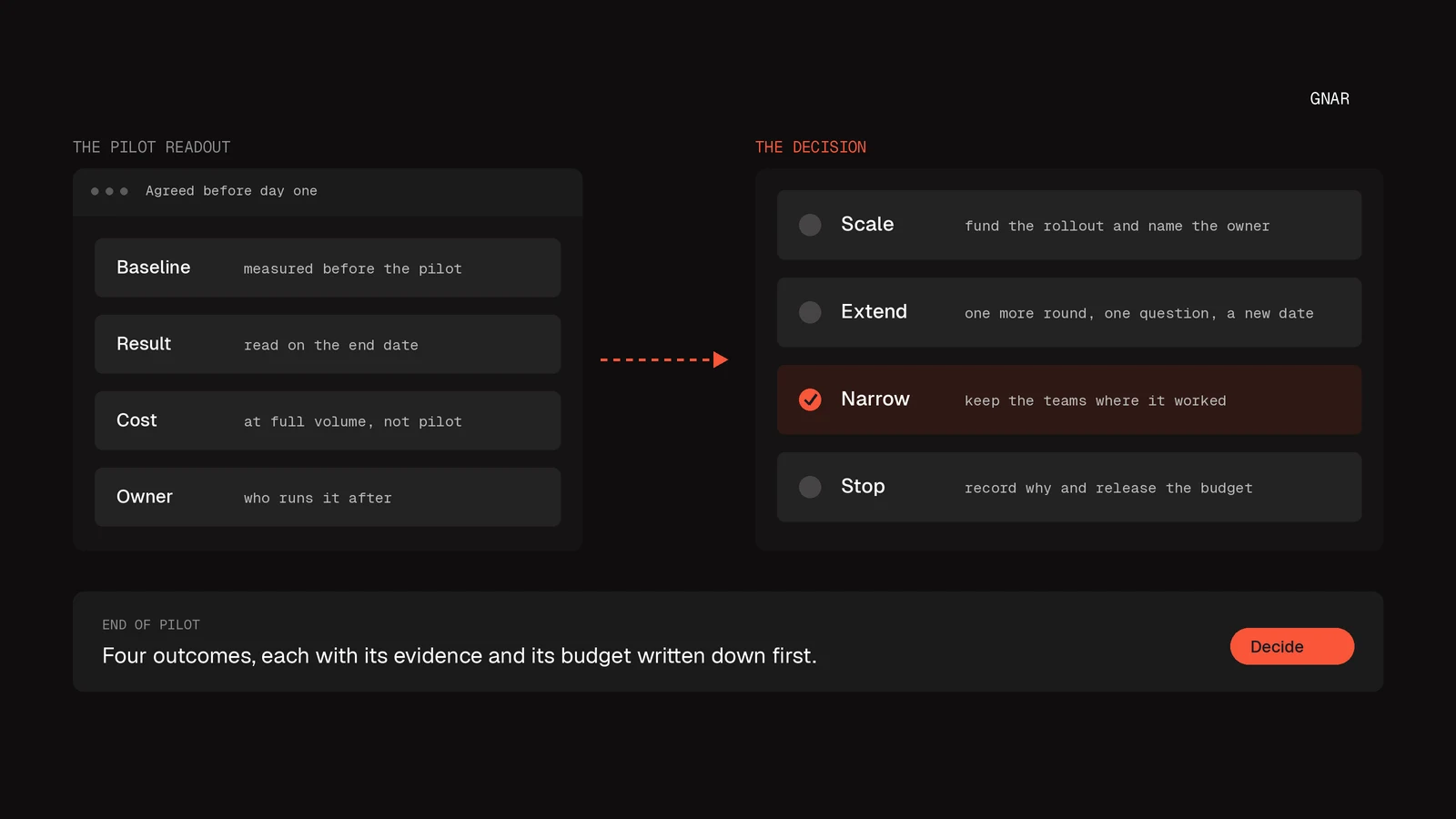
The full four-decision method (scale, extend, narrow or stop) is in what to decide at the end of an AI pilot, and this guide does not repeat it. What it adds is the reason to decide at all. Gartner's October 2026 release found that organizations with guidelines for when an AI pilot should not move to production are 2.3 times more likely to be vanguards, meaning CIOs who deliver better business outcomes and report high CEO-perceived AI value. Those with guidelines for abandoning low-value AI initiatives already in production are 2.6 times more likely. Only 31% and 17% of CIOs, respectively, reported having those practices.
So the stop rule is not pessimism. It is the habit that most separates the leaders in Gartner's data from everyone else.
One worked example shows how scoring changes a decision. In its Counter Culture Coffee case study, Gnar ran 15+ interviews, mapped every system and data flow, and identified 79 AI and automation opportunities across 7 capability areas. Each one was scored on five dimensions: financial ROI, operational efficiency gains, implementation complexity, data readiness and cultural readiness. Weak data readiness capped an opportunity's score regardless of its upside.
The process also killed an idea. Coffee procurement first looked like a market-timing opportunity. A full year of contract data showed the team was already managing it well, so the recommendation shifted. The case study reports $1.5M in potential savings across the top 10 initiatives, with 34 projects ready to start and 8 already underway, led by five internal champions. These are findings of a roadmap, not delivered savings, and the engagement was advisory.
What gets one pilot into production?#
One pilot gets into production when you pick a single job, connect it to the real systems, test it on your own past cases, log every action, name an owner and price the run cost. That is the whole list. It is short because the work is mostly plumbing, and plumbing is where AI pilot to production efforts usually fail.
Work through it in this order:
- Pick one job. Choose the pilot with the clearest number and the fewest failed checks. Gartner's Tina Nunno said organizations see the greatest quantifiable value from "less common, strategically selected use cases that are closely aligned to their unique business needs."
- Fix the data it reads. Name the fields, name the system of record and clean what is incomplete. Gnar's AI strategy and fluency page calls this the step most implementations skip.
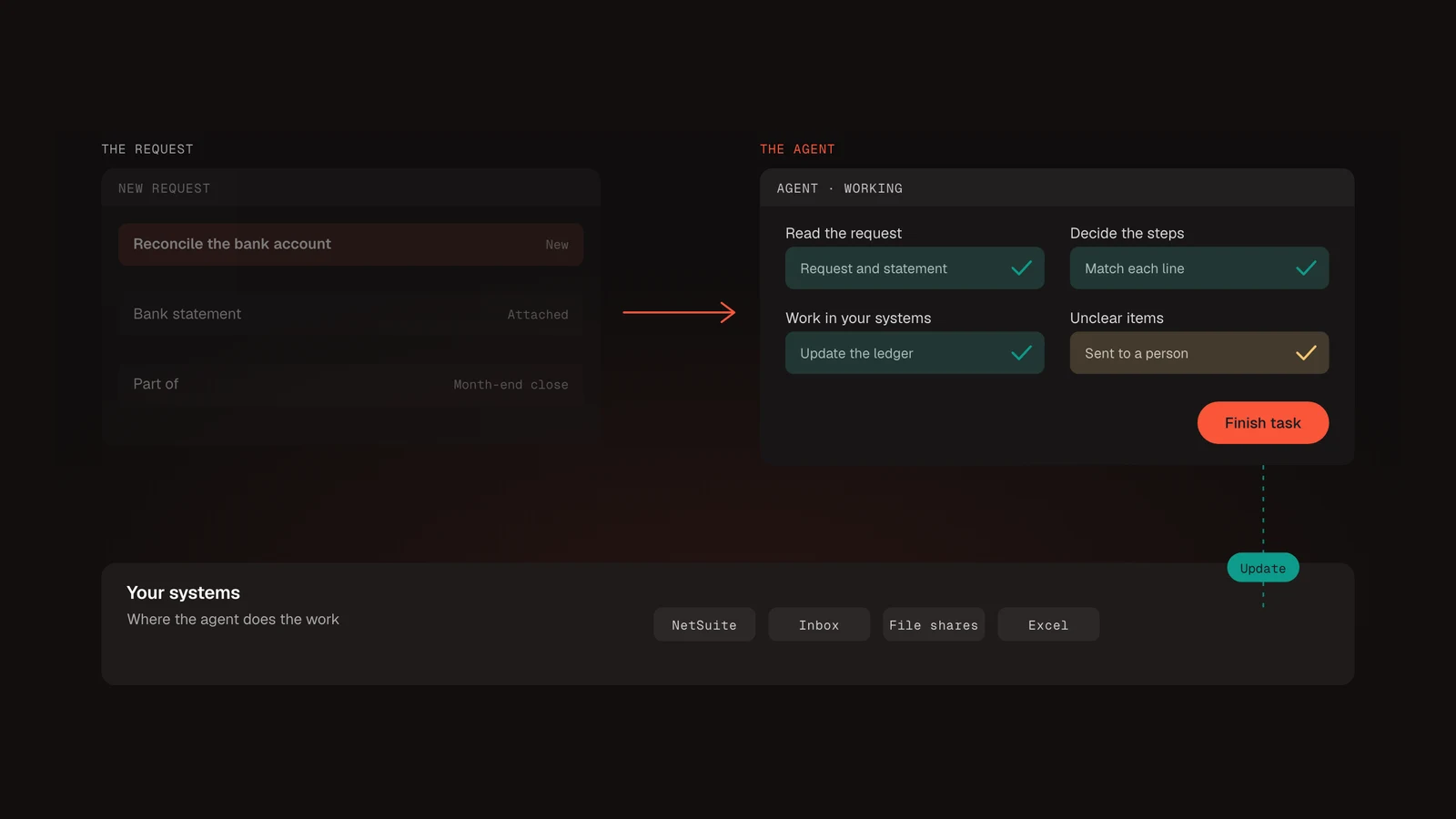
- Connect it to your systems. The AI should read your ERP, email and files directly. Keep reading and changing as separate permissions, and route every change through one checkpoint a person can approve. Gnar's enterprise AI integration work is built this way.
- Test it on your own past cases. Use real orders and real exceptions, and rerun the tests every time the model or the instructions change. Gnar's custom AI agents page describes these tests, which engineers call evals.
- Log everything and name the owner. Production AI needs both. Every action the AI takes in your systems should be logged, so someone can check what it did. One named person answers for the result.
- Price the run cost. Gartner's Mullery said AI costs are "probabilistic and determined at run time." So the pilot's bill is not the production bill, and it is the production bill that decides whether you can scale AI. Ask for the cost at full volume before you approve the move.
If your pilot is an agent that takes actions, AI agents from demo to production covers that path in detail. This guide stays on the COO's question, which is why the pilot has not paid back.
McKinsey adds a point about change management. Its high performers "fundamentally redesign workflows that are enabled by AI rather than insert AI into existing ones." If the pilot drops a new tool into an unchanged process, expect low user adoption no matter how well the tool works.
Who can fix AI pilots that have not paid back?#
The right fixer for an AI pilot to production job depends on which cause is stopping the pilot, and on whether your own team has the capacity to fix it. There are four realistic choices, and each fits a different situation.
| Who fixes it | Fits when | Does not fit when |
|---|---|---|
| Your own engineers | They have the capacity, the access to your systems and a direction from you | They are already behind on the roadmap, or nobody on the team has connected AI to an ERP |
| Your software vendor's services team | The pilot lives inside that vendor's product and the problem is a setting or a module | The pilot crosses several of your systems |
| An AI consultancy that writes a plan and leaves | You need a ranked list and a business case, and you have engineers to build it | You need something running, because the plan stays a plan |
| A team that builds inside your systems | The data, the connections and the process all need work, and you have no spare engineers | Your own team can already do it |
Gnar's honest limit is the last row: "If your own team has the capacity and the direction, you do not need us." Gnar says it will tell you that on the call.
Where you do want help, here is what The Gnar Company does. Its AI page is built for leaders "whose pilots stalled and whose AI spend hasn't compounded", and it starts "where the pilots stopped" and aims "straight at a return you can defend to the board." The strategy work uses stakeholder interviews, process mapping and five-dimension opportunity scoring across ROI, implementation cost, data readiness, reasoning risk and behavior-change cost. The same team that wrote the strategy then builds and deploys the first automation, so something real runs at the end. The page says it plainly: "Most AI strategy stops at a slide deck. Ours ends with a roadmap your team can run and an automation running in your environment, not a PDF that gets archived."
Gnar's forward deployed engineers are senior U.S. engineers who join your team's daily work. Their page says the AI connects to your ERP and your team's tools, and it runs in your own accounts, "not a demo on someone's laptop." For the broader question of when this model makes sense, see when you need a forward deployed engineer.
On price, the first step is Gnar Discovery and Design, published in two tiers: $20,000 for four weeks or $30,000 for six weeks, each ending with a build plan that carries a fixed price. The Discovery page says the build that plan scopes is typically $150K to $300K+, so the plan, not a guess, sets your number. The Discovery page lists what each tier delivers.
The guarantee has a scope, and it is not blanket: "Three commitments on every build engagement: a fixed milestone price with any overage on us, a guaranteed outcome meaning the software works as specified or we fix it, and a twelve-month bug-free warranty. It covers Discovery, Build, Forge and Maintain. It does not cover Embed. On Compass, Immerse and Integrate, ask us." The AI page adds that the strategy and training phases are advisory and are not under the guarantee. Counter Culture's roadmap was strategy work, so it is not a guaranteed result.
What measurable outcomes should the board see?#
The board should see one job running in your systems and a number your CFO signed before it started. A slide deck about AI strategy does not count. At the next review, bring five items instead.
- One job in production. One named process runs on live data in your own systems, not a demo.
- A baseline and a result. The number your CFO agreed, before and after, from the same source.
- The stop rule. The written test for when the pilot ends, and what happens to the budget if it trips.
- The owner's name. One person, not a committee.
- The run cost. What the job costs per month at real volume, not what the pilot cost.
Gartner's September 2026 data shows why this discipline pays. High performers, which it defines as companies that constantly track the return on AI initiatives, treat AI as a portfolio of value and regularly reallocate or discontinue underperforming initiatives, reported positive returns in 81% of their AI initiatives. Low performers did not know the rate of return for 29% of theirs. Roughly 11% of organizations were entirely unaware of what their function spent on AI in 2025. As Nunno put it, "Without disciplined measurement tied directly to business outcomes, organizations risk wasted resources and unmet expectations."
This is the buyer's checkpoint, not a delivery promise from anyone. If a vendor tells you when your return will arrive, ask what it is based on. And if you want the board to fund more, how to build an AI roadmap the board will fund covers the ask.
Questions to ask before you hire help#
Ask these eight questions before you sign anything with a firm that offers to fix your pilots. They separate a team that gets an AI pilot to production from one that writes a better report about why it stalled.
- Who owns the result after launch, and what is their name on your side and ours?
- Can the work run in our own accounts and connect to our ERP, CRM and files?
- What does the AI get to see, what can it change, and who approves a change?
- How will you test it on our own past cases, and when do those tests rerun?
- What is in writing on price, and what is the overage rule?
- Which parts are advisory and not under any guarantee?
- Who is responsible for data quality, and how will we know it is ready?
- What does your team do if our own engineers could do this themselves?
A good answer to the last question is "then do it yourselves." If you hear that, you have found someone who will tell you the truth.
Finally, write down what you will do with each of your three pilots before the next board meeting. Keep one, narrow one, stop one. Whichever you keep, make it the first one that has a number, an owner and a stop rule. That is the AI investment worth protecting.