A Claude API cost estimate multiplies the input and output tokens an app uses by Anthropic's list price per million tokens. For a CFO approving a custom app built on Claude, the useful version is a dated three-year range with low, base and high cases. This guide works one illustrative app, with its inputs stated as assumptions, to that range, and covers prompt caching, batch processing, long context, token growth and model retirements. It matters because API usage is billed every month the app runs, and volume, prompts and models all change over three years.
The Gnar Company is a Claude Select Services Partner, which means Anthropic has vetted us to build with Claude. On Gnar's custom AI agents page, the answer to which models the agents run on is "By default, Claude, made by Anthropic." The same page says "The discovery sprint ends with a guaranteed price for each stage of the build."
The model bill is a separate line from the build price, and it runs every month after launch. As general advice, approve it as a range over the life of the app. The range below is built on Anthropic's list prices as of November 2026. It does not forecast what Anthropic will charge later.
How does Claude API pricing work per million tokens?#
Claude API pricing is per million tokens (MTok), with separate prices for input tokens, output tokens, cache writes and cache hits. Anthropic's pricing page says "All prices are in USD" and "Billing is based on actual monthly usage." Its FAQ defines the unit plainly: "Tokens are pieces of text that models process."
The same FAQ adds that "How many tokens the same text produces depends on the model’s tokenizer, the language, and the type of content."
What do output tokens and input tokens cost on each Claude model?#
As of November 2026, Anthropic's pricing page lists four models at the top of its model pricing table. They are Claude Fable 5.2 at $8 input and $40 output per MTok, Claude Opus 5.5 at $4 and $20, Claude Sonnet 5.5 at $2 and $10, and Claude Haiku 5.5 at $0.10 and $0.50 for prompts up to 100,000 tokens. For each of the four, the output price is five times the input price. The table shows each model's input and output price per MTok and the page's own line on what the model is for.
| Claude model | Input / output per MTok | What the pricing page says it is for |
|---|---|---|
| Claude Fable 5.2 | $8 / $40 | For demanding reasoning and long-horizon agentic work |
| Claude Opus 5.5 | $4 / $20 | For long-running agentic coding and knowledge work |
| Claude Sonnet 5.5 | $2 / $10 | The best combination of speed and intelligence |
| Claude Haiku 5.5 | $0.10 / $0.50 for prompts up to 100,000 tokens | For high-volume, latency-sensitive tasks such as classification, extraction, and routing |
The page lists older models below these, under "Additional models", each with its own prices. As general advice, choose the model family first, because every other price line depends on it.
The example in this guide uses Claude Sonnet 5.5. These are its list prices as of November 2026, including the lines the arithmetic below uses.
| Claude Sonnet 5.5 line | List price per MTok |
|---|---|
| Base input tokens | $2 |
| Output tokens | $10 |
| 5 minute cache write | $2.50 |
| 1 hour cache write | $4 |
| Cache hits and refreshes | $0.10 |
| Batch input tokens | $1 |
| Batch output tokens | $5 |
What inputs does a Claude API cost estimate need?#
A Claude API cost estimate needs seven inputs: tasks per month, model calls per task, fixed prompt tokens, task tokens, output tokens, the model, and the share of calls that read the fixed prompt from cache. As general advice, write each one down with where it came from, and measure the usage inputs again in a pilot.
| Input | What it covers | Where the number comes from |
|---|---|---|
| Tasks per month | Invoices, tickets or orders the app handles | Your own system's history |
| Calls per task | Model calls the app makes for one task | The app's design, then pilot logs |
| Fixed prompt tokens | Instructions, rules and tool definitions sent on every call | Anthropic's token counting endpoint |
| Task tokens | The document and context for one task | Token counts on real past cases |
| Output tokens | The reply, including any thinking | Pilot usage data |
| Model | The Claude model and its list prices | Anthropic's pricing page, dated |
| Cache hit rate | Share of calls that read the fixed prompt from cache | Pilot usage data |
As general advice, check two of these inputs closely. First, tool definitions are input. The pricing page says tool use requests are priced on "The total number of input tokens sent to the model (including in the tools parameter)." For Claude Sonnet 5.5, it lists 286 tokens for the tool use system prompt with the auto or none tool choice.
Second, thinking is output. Anthropic's extended thinking page describes a usage field "which reports how many of the billed output tokens were internal reasoning." So the output tokens per call in your estimate include thinking as well as the visible answer.
How do you count tokens before the app exists?#
As general advice, count tokens with Anthropic's token counting endpoint on real past cases before anyone writes a cost estimate. The token counting page says it lets you "Count the tokens in a message before you send it to Claude." It also says "Token counting is free to use but subject to requests per minute rate limits based on your usage tier."
The page also says "The token count is an estimate. In some cases, the actual number of input tokens used when creating a message might differ by a small amount."
As general advice, count a sample that includes your long and odd cases as well as typical ones. A supplier invoice with forty line items uses more tokens than one with two. Take the average and the high end from the sample. The high end feeds the high case later.
Count against the model you plan to run. The token counting page says "Recount prompts against the model you plan to use rather than reusing counts measured against earlier models." It gives the reason: "Claude 4.7 and later models and Claude Mythos Preview use a newer tokenizer. The same input text produces approximately 30 percent more tokens than on earlier models."
What does long context cost, and why do input tokens grow per turn?#
Long context costs the standard per token price on Claude 4.6 and later models except Claude Haiku 5.5. Input tokens also grow per turn, because each request carries the conversation so far. Anthropic's pricing page says "Claude 4.6 and later models (except Claude Haiku 5.5) and Claude Mythos Preview include the full 1M token context window at standard pricing." It gives an example: "A 900k-token request is billed at the same per-token rate as a 9k-token request."
Claude Haiku 5.5 is the exception. The page says it "is priced by prompt length: a request whose prompt is over 100,000 tokens pays higher prices." On Claude Haiku 5.5, a prompt over that line pays $0.50 per million input tokens and $2.50 per million output tokens.
The second effect is growth inside one conversation. Anthropic's context windows page says "As the conversation advances through turns, each user message and assistant response accumulates within the context window, and previous turns are preserved completely." It describes each turn's input phase as "all previous conversation history plus the current user message".
The same page says the context window can hold "up to 1M tokens, depending on the model". As general advice, count tokens on a full conversation from a pilot as well as on its first message. A long conversation sends its earlier turns again as input with every later request.
What are the Claude API costs for one month of an illustrative app?#
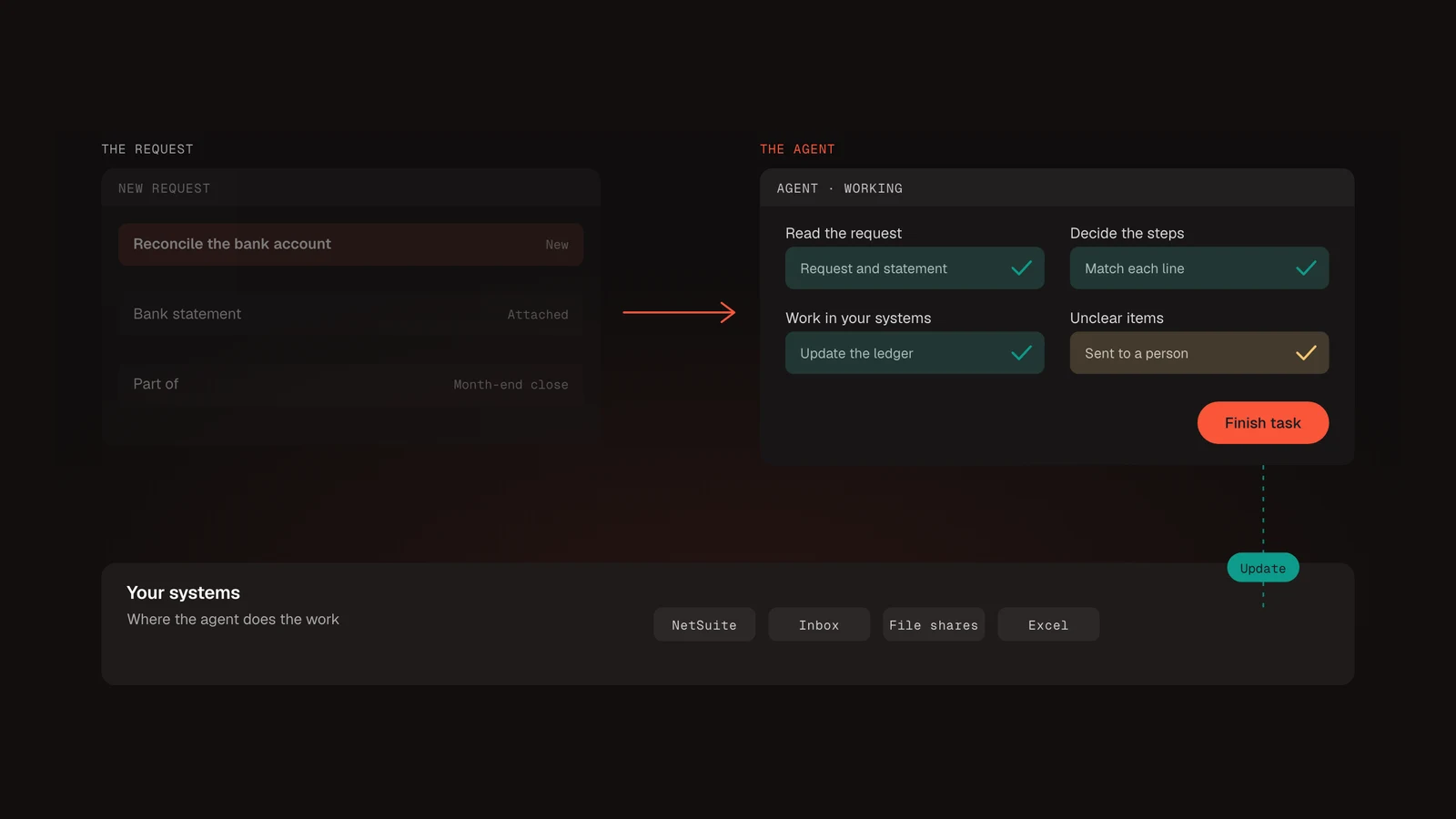
One month of the illustrative app below costs $1,800 at Claude Sonnet 5.5 list prices with no prompt caching. The app is an AI agent that codes supplier invoices to general ledger accounts. It is illustrative, not a client, and every input is an assumption chosen to show the arithmetic.
These are the base inputs for year one.
- Tasks: 10,000 supplier invoices a month.
- Calls per task: 4 separate model calls per invoice, each sent without earlier turns, so 40,000 calls a month.
- Fixed prompt: 15,000 tokens per call of instructions, coding rules and tool definitions.
- Task tokens: 5,000 tokens per call of invoice text and vendor history.
- Output: 500 tokens per call, including thinking.
- Model: Claude Sonnet 5.5 on the Claude API, standard processing, global routing.
Without caching, every call sends 20,000 input tokens at the base price.
| Line | Arithmetic | Monthly cost |
|---|---|---|
| Input | 40,000 calls x 20,000 tokens = 800 MTok, x $2 | $1,600 |
| Output | 40,000 calls x 500 tokens = 20 MTok, x $10 | $200 |
| Total | $1,600 + $200 | $1,800 |
Input is about 89 percent of this month ($1,600 of $1,800). Three quarters of each call's input (15,000 of 20,000 tokens) is the same fixed prompt, sent 40,000 times. Prompt caching prices that repeated prompt differently.
How much does prompt caching change the estimate?#
Prompt caching cuts the illustrative month from $1,800 to $732 at a 95 percent cache hit rate. Cached reads of the fixed prompt cost $0.10 per MTok instead of $2. The saving depends on calls arriving close together. Anthropic's prompt caching rules decide when a call reads the cache and when it writes it again.
Anthropic's pricing page describes what caching is for: "Instead of reprocessing the same large system prompt, document, or conversation history on every request, the API reads from cache at a fraction of the standard input price." As general advice, the fixed prompt in a cost estimate is the part to cache.
These are the rules that move a cost estimate, from Anthropic's prompt caching page and its pricing page.
- Writes cost more than base input. A 5 minute cache write is "1.25x base input price" and a 1 hour write is "2x base input price".
- Hits cost a fraction. A cache read is "0.1x base input price on most models". On a model at 0.1x, a cached token costs 90 percent less than a base input token. The pricing page lists 0.025x for Claude Fable 5.2, and 0.05x for Claude Opus 5.5 and Claude Sonnet 5.5. For Claude Sonnet 5.5 that is $0.10 per MTok.
- The cache lasts minutes. "By default, the cache has a 5-minute lifetime. The cache is refreshed for no additional cost each time the cached content is used."
- The prefix must match exactly. "Cache hits require 100 percent identical prompt segments, including all text and images up to and including the block marked with cache control."
- Short prompts do not cache. On the Claude API, the minimum cacheable prompt length is 512 tokens for Claude Sonnet 5.5, and "Shorter prompts cannot be cached, even if marked with cache_control."
The pricing page also says "Caching saves money after a small number of cache reads", which is "after one cache read" for the 5 minute cache and "after two cache reads" for the 1 hour cache.
For the illustrative app, assume 95 percent of calls read the 15,000 token prompt from cache. The other 5 percent write it again, after a gap of more than five minutes.
| Line | Arithmetic | Monthly cost |
|---|---|---|
| Cache writes | 2,000 calls x 15,000 = 30 MTok, x $2.50 | $75 |
| Cache reads | 38,000 calls x 15,000 = 570 MTok, x $0.10 | $57 |
| Task tokens | 40,000 calls x 5,000 = 200 MTok, x $2 | $400 |
| Output | 40,000 calls x 500 = 20 MTok, x $10 | $200 |
| Total | $75 + $57 + $400 + $200 | $732 |
At an 80 percent hit rate, the same month costs $948. Writes rise to 8,000 calls ($300), reads fall to 32,000 calls ($48), and the other two lines stay at $400 and $200.
The hit rate is an assumption. As general advice, measure the real hit rate in a pilot. The caching page says the response reports "cache_read_input_tokens: Number of tokens retrieved from the cache for this request", so the hit rate can be read from usage data.
How do you set the low, base and high cases?#
As general advice, set the three cases by changing only the inputs you are unsure of: volume growth, tokens per call and the cache hit rate. Hold the model and Anthropic's November 2026 list prices fixed in all three. Then the gap between low and high shows the uncertainty in your own usage. The three cases hold Claude Sonnet 5.5 and its November 2026 prices fixed for three years, and the model changes section below treats a model change as its own line in the plan.
| Case | What changes | Why it is plausible |
|---|---|---|
| Low | Volume flat at 10,000 invoices a month for three years; 95 percent hit rate | The process stays the size it is today |
| Base | Volume up 20 percent a year (10,000, 12,000, 14,400); 95 percent hit rate | The business grows and the app takes more of the work |
| High | Volume up 50 percent a year (10,000, 15,000, 22,500); 80 percent hit rate; tokens per call up 25 percent from year two | More work, longer rules and more vendor history, and calls spread out |
The token growth in the high case is its own assumption. As general advice, allow for it, because each rule, tool or example added to the fixed prompt is paid on every call. In the high case, year two and three calls carry 18,750 fixed prompt tokens, 6,250 task tokens and 625 output tokens. At an 80 percent hit rate, that is $1,185 a month for every 10,000 invoices ($375 writes, $60 reads, $500 task tokens, $250 output).
What does the three-year range look like?#
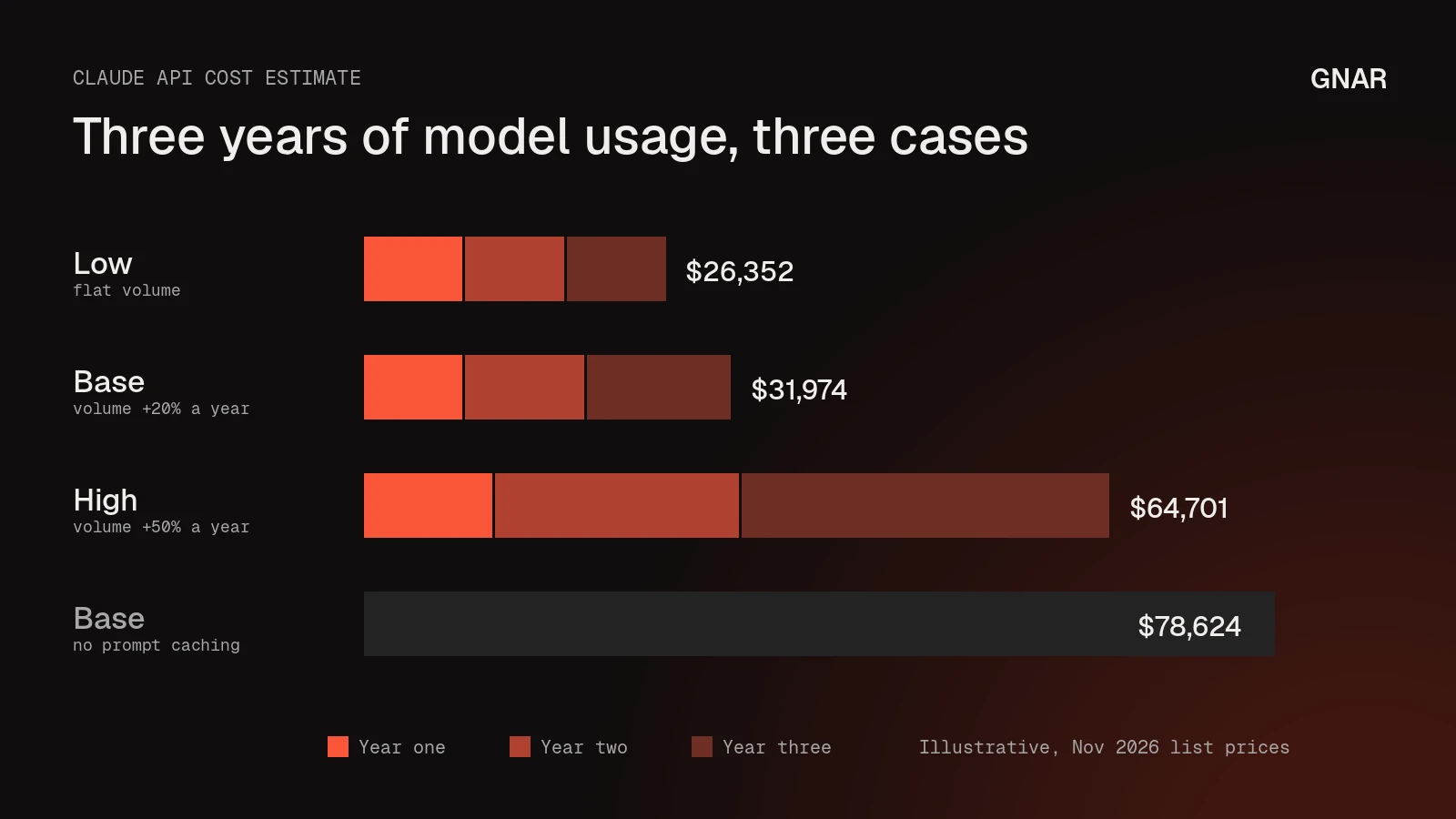
For the illustrative app, the three-year model bill runs from $26,352 in the low case to $64,701 in the high case. The base case is $31,973.76, about $31,974. Each year below is the monthly cost times 12, times the year's volume as a multiple of 10,000 invoices.
| Case | Year one + year two + year three | Three-year total |
|---|---|---|
| Low | $8,784 + $8,784 + $8,784 | $26,352 |
| Base | $8,784 + $10,540.80 + $12,648.96 | $31,973.76 |
| High | $11,376 + $21,330 + $31,995 | $64,701 |
The working behind each row:
- Low: $732 x 12 = $8,784 a year, three times.
- Base: $8,784 in year one, then $8,784 x 1.2 = $10,540.80, then $8,784 x 1.44 = $12,648.96.
- High: $948 x 12 = $11,376 in year one. Then $1,185 x 1.5 x 12 = $21,330, and $1,185 x 2.25 x 12 = $31,995.
Run the base volumes with no caching and the total is $78,624. That is $1,800 x 12 = $21,600 a year, times 1 + 1.2 + 1.44 = 3.64. That is more than the high case. In this example, whether caching works moved the total more than volume growth did. As general advice, the caching design is worth a line in the build plan for that reason.
How do model changes affect a three-year estimate?#
Model changes affect a three-year estimate because the model you price today may be retired inside the window. Its replacement can have different prices and a different tokenizer. Anthropic's model deprecations page says "As safer and more capable models launch, Anthropic regularly retires older ones."
The same page says "Requests to models past the retirement date will fail." It also says Anthropic gives "at least 60 days’ notice before model retirement for publicly released models." As of November 2026, it lists the tentative retirement date for Claude Sonnet 5.5 as "Not sooner than September 28, 2027". That date falls inside a three-year model that starts in November 2026.
The page's history includes this example. "On September 30, 2026, Anthropic notified developers using Claude Sonnet 4.5 of its upcoming retirement on the Claude API." The retirement date is November 30, 2026, and the recommended replacement is Claude Sonnet 5.5.
Today's pricing page lists Claude Sonnet 4.5 at $3 per MTok input and Claude Sonnet 5.5 at $2. The per token price is lower, but the tokenizer changed between them. The pricing page says the newer tokenizer "produces approximately 30% more tokens for the same text" and that "Claude Sonnet 4.6 and earlier models use the previous tokenizer."
Here is an illustration of what that does to one prompt. Take 10,000 input tokens on Claude Sonnet 4.5: 10,000 x $3 per MTok = $0.03. If the same text came to 13,000 tokens on Claude Sonnet 5.5: 13,000 x $2 per MTok = $0.026. The price per token fell by a third. The cost of the same text fell by about 13 percent. The page says "The exact increase depends on the content and workload shape", so recount your own prompts.
As general advice, put one model change into the three-year plan as an engineering task with a cost. Price the new model only when you can count tokens on it. On Gnar's custom agents page, the line on this is "When a model is retired or you switch models, the tests run again before the new one goes live."
What costs sit outside the token bill?#
Tools, data residency, the cloud route and engineering upkeep sit outside the token prices in the tables above. Each one is a line in the three-year model when the app uses it. Anthropic's pricing page lists these prices for them, as of November 2026.
- Web search: "Web search is available on the Claude API for $10 USD per 1,000 searches, plus standard token costs for search-generated content."
- Code execution, when used without web search or web fetch: "Each organization receives 1,550 free hours of usage per month." Beyond that, "Additional usage beyond 1,550 hours is billed at $0.05 USD per hour, per container."
- US-only inference: "For Claude 4.6 and later models, specifying US-only inference through the inference_geo parameter incurs a 1.1x multiplier on all token pricing categories, including input tokens, output tokens, cache writes, and cache reads."
- Web fetch: "The web fetch tool is available on the Claude API at no additional cost. You only pay standard token costs for the fetched content that becomes part of your conversation context."
- Claude Managed Agents: session runtime costs "$0.08 USD per session-hour", on top of tokens.
The route changes the bill too. For Claude Models on Google Cloud (Google managed) and Amazon Bedrock, the pricing page sends readers to those clouds' own pricing pages, such as Amazon Bedrock pricing. Claude Platform on AWS and Claude in Microsoft Foundry bill in Claude Consumption Units (CCUs). For both, the page says Anthropic rates token usage at the standard rates and "applies any negotiated discount". It then converts the result to CCUs "at $0.01 USD per CCU". When the app will be bought through a cloud, price it with the route you will buy through.
Engineering upkeep is the last line. As general advice, budget for someone to rerun tests, update prompts and handle the model change described above. On Gnar's custom agents page, the step after launch reads "We can keep it running for you and rerun the tests each time it changes."
How does API billing work next to a Claude subscription?#
API billing is separate from a paid Claude subscription, so an app built on the Claude API gets its own bill for token usage. Anthropic's help center article on API billing says "A paid Claude subscription enhances your chat experience, and the Claude API is billed separately." It adds that "Claude Max, Ultra, and Team plans include monthly credits for the Claude API."
The same article describes the Claude Console as "our developer platform providing API keys and access to Claude models for building applications and integrations." The Usage export described later breaks usage down by API key and model. As general advice, give each app its own API key so its bill can be read on its own.
Anthropic's pricing page covers how the bill is paid: "Major credit cards are accepted for standard accounts." It adds "Enterprise customers can arrange invoicing and other payment methods." On new accounts, it says "New users receive free credits to test the API."
Two more lines on that page affect a three-year model. On volume discounts, it says "Volume discounts might be available for high-volume users. These are negotiated on a case-by-case basis." It also says "Standard usage tiers use the pricing shown in Model pricing." As general advice, use list prices in the range until a negotiated rate is signed.
Spend limits sit on top of the bill. Anthropic's rate limits page says "Each of the Start, Build, and Scale tiers carries a monthly spend cap." It also says "Organizations on the Custom tier have no monthly spend cap; limits are arranged with their account team." As general advice, if your tier has a cap, check it against the high case before launch.
Can the Batch API or a smaller model lower the range?#
The Batch API halves token prices for work that can wait, and a smaller model lowers the per token price. Each one has a condition. The pricing page says "The Batch API allows asynchronous processing of large volumes of requests with a 50 percent discount on both input and output tokens." It also says "Batch API and prompt caching discounts can be combined." The batch processing page says for batch requests "cache hits are provided on a best-effort basis."
The condition for batch is timing. Anthropic's batch processing page says "Batches expire if processing does not complete within 24 hours." The illustrative invoice agent assumes invoices are coded as they arrive, so the range above does not use batch. As general advice, a job that can wait a day, such as an overnight run, is the kind of work to test on batch.
The condition for a smaller model is quality on your own cases. Anthropic's pricing page lists Claude Haiku 5.5 input at $0.10 per MTok for prompts up to 100,000 tokens. Prompts over 100,000 tokens pay $0.50 per MTok. Anthropic's guide to choosing a model also names a lever inside one model: "Tuning effort is often a better lever than switching models."
As general advice, test the cheaper option on the same past cases as the current one before it enters the low case. A lower price that fails more invoices moves cost into the team that fixes them.
When should you re-check the estimate?#
As general advice, re-check the estimate on a fixed date and whenever a trigger fires. Set the first date after one full month of live use, then once a quarter. The triggers are a deprecation notice for your model, a change on Anthropic's pricing page, and actual monthly cost outside the low to high band.
Published prices and price plans do change. Anthropic's pricing page carries this note on Claude Sonnet 5: "The $2/$10 per million input/output token pricing for Claude Sonnet 5, announced at launch as introductory pricing through August 31, 2026, is now the standard price." Amazon Bedrock's pricing page says "Starting October 7, 2026, cache read pricing for Claude Sonnet 5.5 is reduced by 50% from the prior rate." As general advice, a note like either one is a trigger to recompute the range.
The data for the check already exists. Anthropic's pricing page says "Usage tracking is available in the Claude Console." The model deprecations page describes an audit you can run: "Go to the Usage page in Claude Console. Click Export." It says the export lets you "see usage broken down by API key and model."
At each check, compare four numbers with the assumptions in the range: tasks per month, input tokens per call, output tokens per call and the cache hit rate. When one is outside its range, update that input and recompute all three cases. Change the date on the model to the day you checked the prices.
Where does The Gnar Company fit?#
On an AI agent build, The Gnar Company's work starts with the discovery sprint. After launch, Gnar can keep the agent running if you want it to. Gnar's custom agents page describes the sprint this way: "We map the job step by step: what the agent reads and which systems it works in." On testing, it says "We test each agent on your own past cases first, so you see it work before it touches live records."
As general advice, those same past cases are the sample a token count needs, and the job map gives the calls per task. The page also says "Senior U.S. engineers build the agent, its connections and its tests in your company’s own cloud account, such as AWS." Its step after launch says "You own the agent and its code."
The build price is a separate number from the run cost. The Gnar Discovery and Design page says "Every Discovery engagement ends with a Milestone Project Plan that breaks your build into clear phases, each with a fixed price." It adds "This becomes the basis for your Build phase, typically $150K to $300K+."
If your own team has the capacity and the direction, you do not need us. The method above can be run in a spreadsheet with Anthropic's pages. On a Gnar build, the terms are published: "Three commitments on every build engagement: a fixed milestone price with any overage on us, a guaranteed outcome meaning the software works as specified or we fix it, and a twelve-month bug-free warranty. It covers Discovery, Build, Forge and Maintain. It does not cover Embed. On Compass, Immerse and Integrate, ask us."