An AI train the trainer program teaches a small group first, and then that group teaches everyone else. The first group needs real practice with the tool on its own work, written material the next group can reuse, and hours set aside to teach. Where this post gives advice without a named source, it is general advice.
The Gnar Company is a Claude Select Services Partner. Its AI training for engineering teams runs as a cohort program called Immerse, which its page sums up as "Four weeks, one mentor, your code".
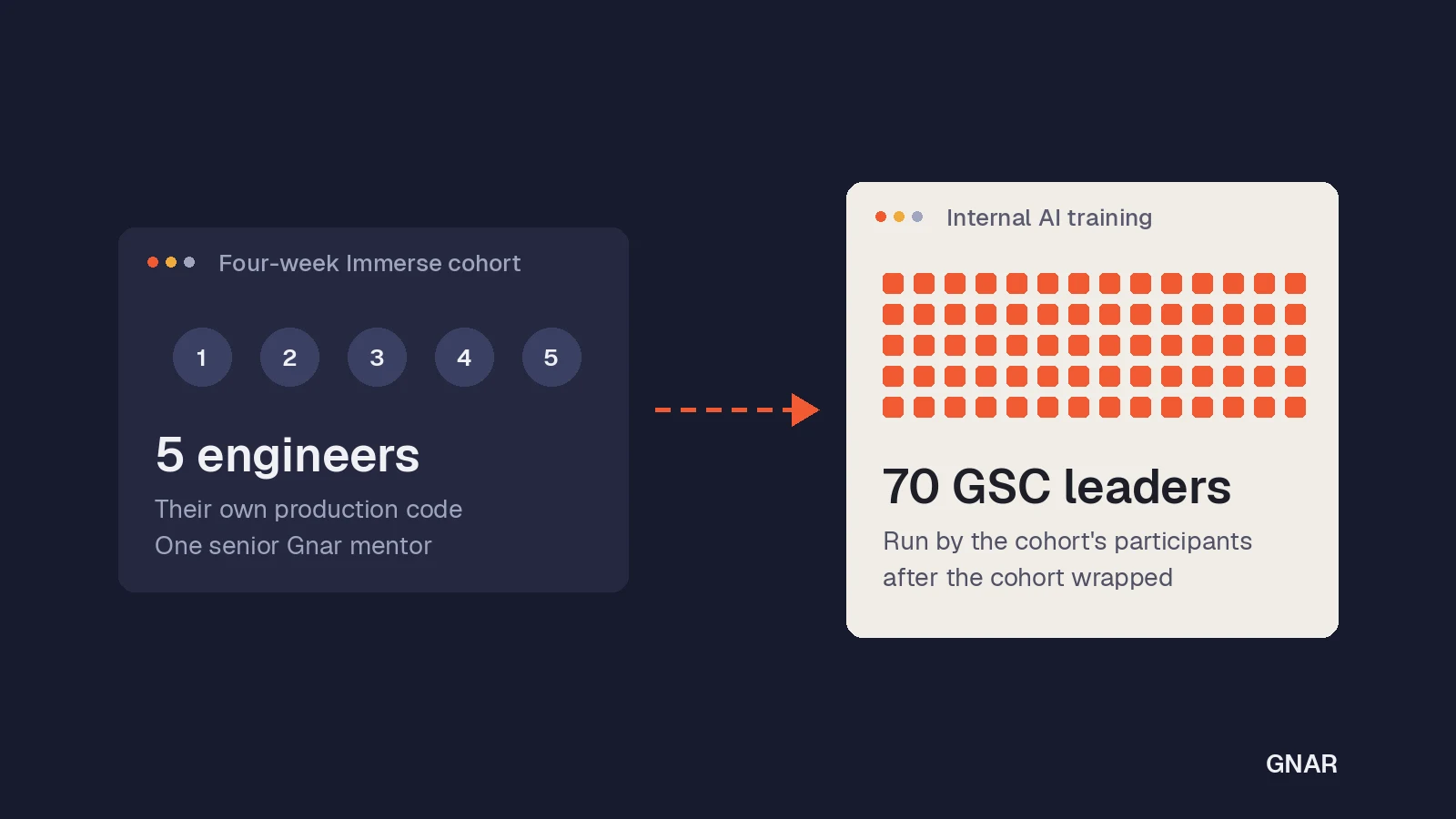
At GSC Enterprises, five engineers went through an Immerse cohort on their own production code. Gnar's case study says that afterwards, "the participants ran an internal AI training for 70 GSC leaders". The case study gives that one sentence about the leaders' training, and this post does not guess at how it ran. The rest of the post draws on Anthropic's public rollout guides and general advice.
What did GSC's five engineers do before they trained 70 leaders?#
GSC's five engineers spent four weeks in a Gnar Immerse cohort, working on their own production code with one senior Gnar mentor. Each one left with a merged change, a context file, a reusable skill and a workflow. After the cohort, the group ran an internal AI training for 70 GSC leaders.
GSC Enterprises is the wholesale distributor behind Grocery Supply Company. The GSC Enterprises case study says the company "had already put Claude Code in the hands of its engineering team". It then names the gap: "What it did not have was a shared way of working with it".
The case study describes Immerse as "a mentor-led program that runs entirely against the client's own codebases". It says "For GSC, a single senior Gnar mentor, Alex, ran the cohort over four weeks," with this schedule:
- "two 45-minute 1:1s per engineer per week, each pairing on that engineer's live project".
- A weekly cohort check-in.
- Live-coding sessions and open office hours.
- A dedicated Slack channel between sessions.
The cohort "fit inside a normal workweek, roughly five to six hours per engineer, so delivery commitments held". At the close, the case study reports: "Every participant left with a merged change in their own codebase, a maintained context file, at least one reusable skill, and a workflow they can describe".
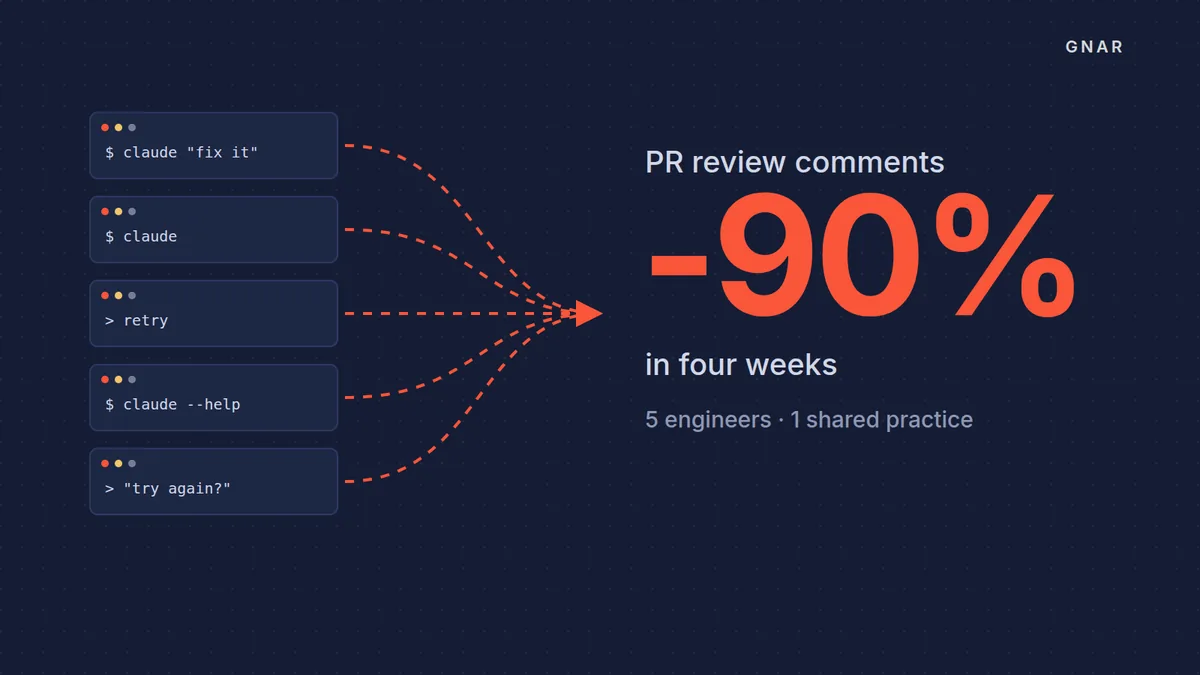
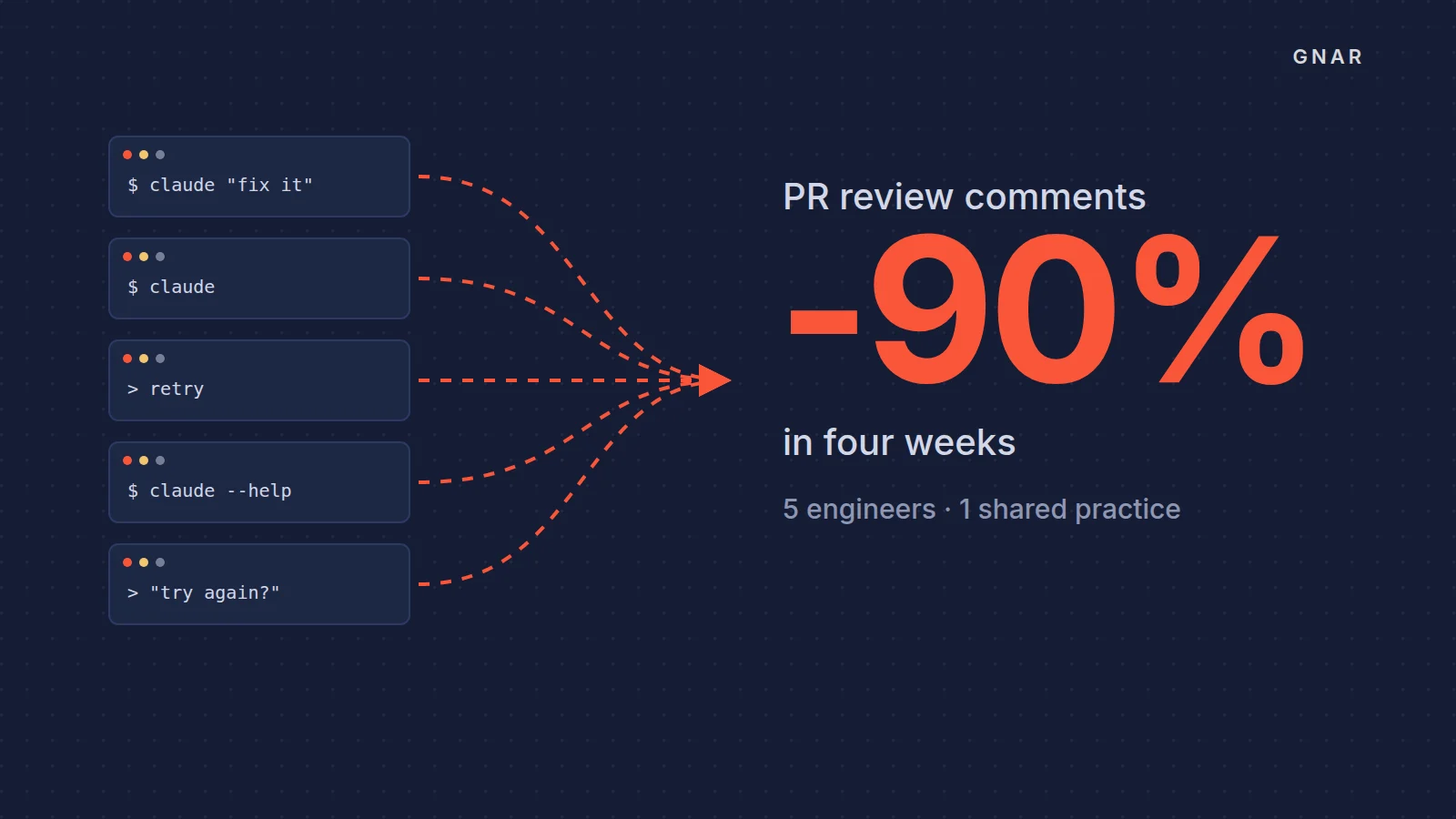
It also reports one signal from outside the team. "The clearest external signal came from a tool nobody touched". GSC runs an independent code review agent on every pull request, and "PRs with review-agent comments went from roughly 100% to less than 10% over the four weeks".
The case study ends its results with this: "After the cohort wrapped, the participants ran an internal AI training for 70 GSC leaders, turning a five-person program into a company-wide conversation".
What does the GSC case show, and where does it stop?#
The GSC case shows that five engineers who had just finished a hands-on cohort went on to train 70 GSC leaders, fourteen times their own number. It stops at that one sentence, because the case study gives the leaders' training no format, length, curriculum or result.
What the case does record is where the trainers started. Before they taught, all five had spent four weeks using Claude Code on the code they ship, with a senior mentor pairing on their live projects. Each had a merged change in their own codebase, a maintained context file and at least one reusable skill.
The case study does not say which of those things mattered for the training that followed. Read it as one company's order of events: a small cohort first, then a much larger internal training.
The case covers one engineering team's cohort and the internal training that came after it. It is no guide to a company-wide rollout.
What is an AI train the trainer program?#
An AI train the trainer program trains a small group to use AI well and to teach it, and then that group trains colleagues. At GSC, a five-person cohort came first and a training for 70 leaders came after it. The case study does not say the cohort covered how to teach. Anthropic has published a course built this way, made with the American Federation of Teachers (AFT) for school educators. A related course prepares academic faculty "to teach and assess AI Fluency in instructor-led settings".
The first course is on Coursera. Its page says "This course is the result of a partnership between Anthropic and the American Federation of Teachers (AFT), built by educators, for educators". The AI Fluency for pK-12 Train the Trainer course prepares educators "to facilitate AI fluency learning for other educators". It hands them "the deck, the facilitator guide, and grade-band exercises" for running their own workshop.
The same page recommends that facilitators first take the learner course, "so you’ve built your own fluency with the 4D Framework before guiding others through it". The page lists the framework's four parts as Delegation, Description, Discernment and Diligence.
The second is Anthropic's Teaching AI Fluency course. Anthropic describes it as a course for academic faculty, instructional designers and others "to teach and assess AI Fluency in instructor-led settings".
Both courses are written for educators. In a company, the people being taught are colleagues. Anthropic's Claude Enterprise administrator guide calls the people who help them champions: "Champions are enthusiastic early adopters who can help drive adoption across their teams".
Who should the first trainers be?#
As general advice, the first trainers should already use AI on their own work and already get questions from colleagues. Their managers should agree to give them hours. Anthropic's guides also start with early adopters, and its administrator guide suggests two or three champions per department or team.
Anthropic's guide to Claude Cowork adoption says: "Find your Claude Cowork power users, the early adopters experimenting with the tool in their day-to-day work". It continues: "They're your first pilot leads". The administrator guide says to "Provide champions with early access and advanced training" and to "Equip champions with talking points and demo guidance". It also says to "Recognize and reward champion contributions to adoption".
At GSC, the people who went on to train the leaders were the five engineers from the cohort. They had used Claude Code on their own production code before they taught anyone.
As general advice, a second trainer in each department keeps its training going when one trainer is out or leaves.
What should the first group finish before it teaches?#
The first group should finish real work with the tool and write down what worked, in a form the next group can reuse. At GSC, each engineer left the cohort with a merged change, a maintained context file, at least one reusable skill and a workflow they can describe. The case study lists these as cohort results and does not tie them to the leaders' training.
Skills are one form that written material can take in Claude. The administrator guide defines them: "Skills are folders of instructions, scripts, and resources that Claude loads dynamically to improve performance on specialized tasks". The Cowork adoption guide says every skill built during the pilot is an asset. It adds: "Tribal knowledge gets encoded and reused rather than walking out the door when someone leaves".
The administrator guide also gives the material an owner. It says to "Designate a program owner and consider forming a lightweight Center of Excellence to curate prompts, Skills, and playbooks".
Check four things before a trainer teaches. The first three cite Anthropic's administrator guide. The fourth is general advice, with Gnar's training page as an example of a cohort that produced a skill:
- Early access and advanced training. The guide says to "Provide champions with early access and advanced training".
- Talking points and a demo. The guide says to "Equip champions with talking points and demo guidance".
- Prompt templates for the department. For department sessions, the guide says to work with team leads and "provide ready-to-use prompt templates".
- At least one skill. As an example, Gnar's training page says each Immerse engineer "leaves with a merged change in your codebase, a maintained context file, at least one reusable skill and a workflow they can describe".
How do you plan the sessions for the next group?#
Plan the next group's training from five parts of Anthropic's administrator guide: all-staff basics, department sessions, office hours, a peer channel and a program owner. As general advice, the trained group leads the department sessions and office hours, and one named owner keeps the material current.
| Format | What Anthropic's guide says | Who leads it (advice) |
|---|---|---|
| All-staff basics | Workshops of 30 to 60 minutes on the basics. Run at launch, then repeat for new hire cohorts. | Two trainers together. |
| Department sessions | Sessions built on each team's own workflows, with an executive sponsor. A follow-up two to four weeks later. | A trainer from that department, with its head as sponsor. |
| Office hours | Weekly or biweekly drop-in sessions with hands-on help from champions. | Trainers on a rotation. |
| Peer channel | A champions Slack channel or Teams group. Monthly user group meetings. | Trainers, then everyone they teach. |
| Program owner | A named owner. Possibly a lightweight Center of Excellence for prompts, Skills and playbooks. | One person with time set aside. |
For department sessions, the guide calls for "Targeted sessions built around each team's actual workflows, with an executive sponsor to signal leadership support". It also says to "Partner with team leads to identify high-value use cases and provide ready-to-use prompt templates".
Office hours, in the guide's words, are "Weekly or biweekly drop-in sessions where users bring real work and get hands-on help from champions". The guide calls them especially valuable in the first 30 to 60 days. Gnar's GSC cohort had open office hours, plus a weekly cohort check-in, live-coding sessions and its own Slack channel between sessions.
Under sustaining momentum, the guide also says to "Refresh training materials quarterly" and to "Incorporate Claude onboarding into your standard new hire orientation".
How do you know the training spread past the first group?#
Measure spread by what the people your trainers taught go on to use and build. Anthropic's administrator guide says to track active users and department penetration in the admin dashboards. Its Cowork adoption guide adds a count for the first group, skills written by champions, counted at the end of the pilot.
The Cowork guide's line is: "Track how many champion-authored skills exist at the end of the pilot; it's the leading indicator for the scale phase". The administrator guide says to "Track adoption (active users, department penetration, feature usage) via the Admin dashboards and API". It also suggests pairing those numbers with short case studies from team leads.
At GSC, the case study measured the cohort. Its external signal was the review agent nobody changed. Gnar's guide to measuring a Claude Code rollout walks through how the case study measured the five engineers. The case study reports no measure for the leaders' training.
Check four things for each department a few weeks after its sessions. Each one ties to a line in Anthropic's guides:
- Active users and department penetration in the admin dashboards, as the administrator guide says to track.
- New skills written by people outside the first group. This carries the Cowork guide's count of champion-authored skills into the second round.
- A short case study from the department's team lead, which the administrator guide suggests pairing with the usage numbers.
- Whether the department takes part in the monthly user group meetings that the guide lists.
If a department's active users stay near zero in the admin dashboards, start with Gnar's post on low Claude adoption after rollout, which starts its checks with whether the group can use Claude at all.
When do you need outside help to start?#
You need outside help when nobody inside has enough practice to teach yet, or when the people who do have no hours to give. That is general advice. If a few people already use AI well on real work and have the time, start the program with them.
The Gnar Company's line on this: "If your own team has the capacity and the direction, you do not need us". Its Immerse cohort is "Built for a small team that already has the tools but not the practice". The training page says where the program came from: "Immerse isn’t a course we wrote for clients. We built it to train our own engineering team into Context-Driven Development".
For non-technical leaders, Gnar runs a separate AI workshop for business leaders. Its page says "The Gnar Company’s AI workshop is a free series of eight live sessions on Google Meet for non-technical business leaders".
If the first trainers will be engineers, Gnar's post on Claude Code training for engineering teams compares self-serve courses, workshops and coaching on your own code.