Gnar Originals

Gridly
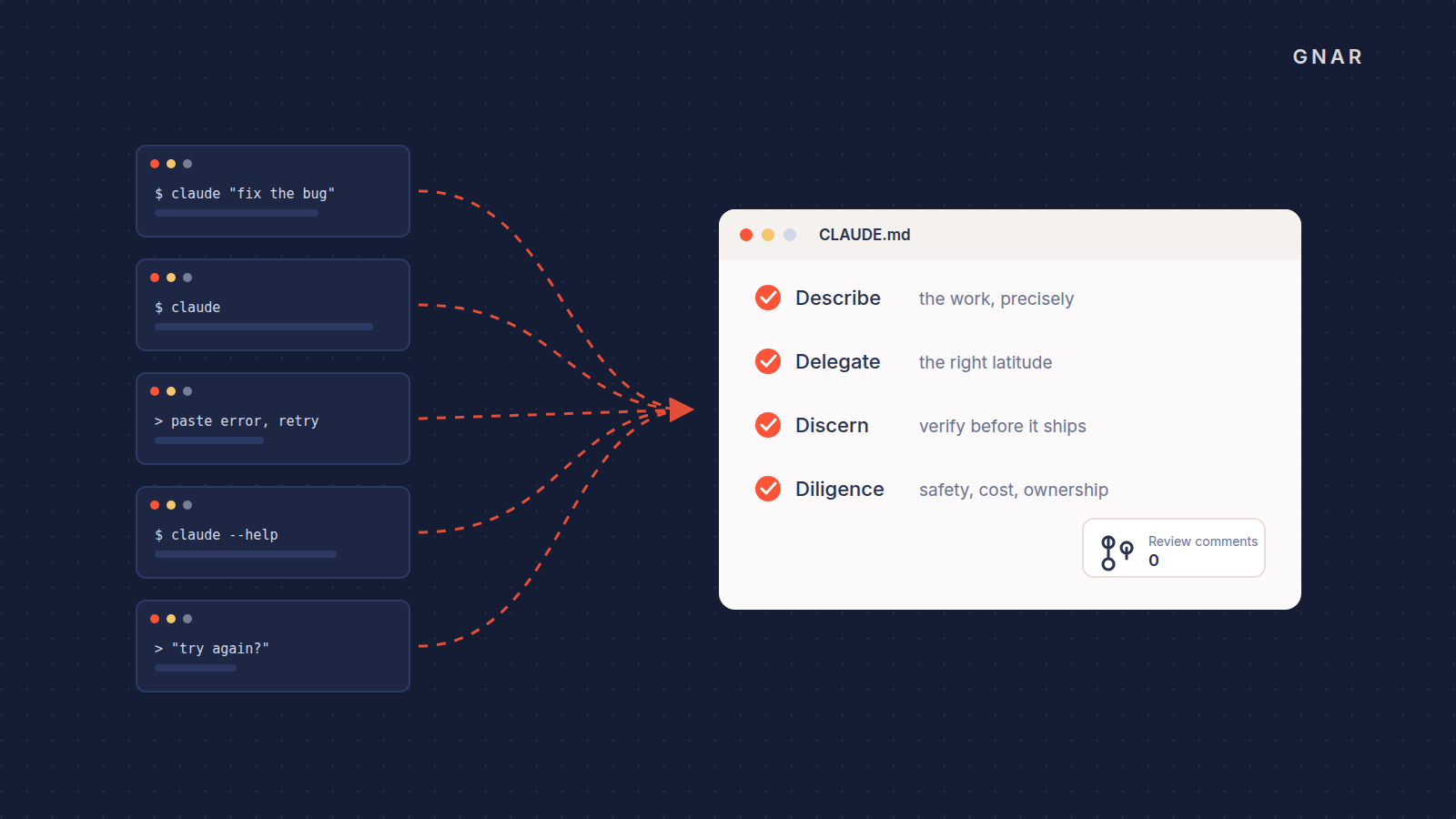
GSC Enterprises, the wholesale distributor behind Grocery Supply Company, had already put Claude Code in the hands of its engineering team. What it did not have was a shared way of working with it. The Gnar ran a four-week Immerse cohort that turned five individual habits into one deliberate practice, on the code the team was already shipping.
GSC's five engineers support the systems that keep a wholesale grocery distributor running: a custom-built ERP on Node.js and AWS, integrations with LANSA on IBM i and DB2, and analytics in Snowflake. Each of them had adopted Claude Code, and each used it differently. Results were inconsistent, and nobody could say which habits produced good output and which produced rework.
Two things made this hard to fix from the inside. The team was under active delivery pressure, with no slack in the schedule to experiment. And their stack is not the one most AI enablement content is written for. A Node engineer working next to an IBM i codebase needs guidance that respects both.
CIO Barrett Williams had seen what a Gnar Immerse cohort did for a peer company's team. He wanted the same for his: not a course, but hands-on mentoring applied to the work already on the board.
Gnar Immerse is a mentor-led program that runs entirely against the client's own codebases. Every technique is proven on work the team is already shipping, which is what makes it stick. For GSC, a single senior Gnar mentor, Alex, ran the cohort over four weeks: two 45-minute 1:1s per engineer per week, each pairing on that engineer's live project; a weekly cohort check-in; live-coding sessions and open office hours; and a dedicated Slack channel between sessions. It fit inside a normal workweek, roughly five to six hours per engineer, so delivery commitments held.
Each engineer was assessed at intake and again at close against the Immerse Four Ds: Description (how precisely work is specified), Delegation (how much latitude is granted), Discernment (how output is verified), and Diligence (safety, cost, and accountability). Each dimension is placed in one of four bands: Craft, Direct, Systematize, or Orchestrate. Intake results set the exercises per engineer; the mentor adjusted at the midpoint.
The cohort worked in Claude Code from the terminal and VS Code, with Claude Desktop alongside, and put the full agentic toolkit to use: plan mode, subagents and agent teams, PreToolUse hooks, skills, workflows, sandbox mode, and git worktrees for agent isolation. MCP connectors for Snowflake, Atlassian, Microsoft 365, and GitHub brought GSC's real systems into the loop.
All five engineers started at Direct or higher across the Four Ds. By the end of the program, all five self-assessed at Systematize or Orchestrate on every dimension. The largest jump came from an engineer who moved from Craft and Direct to Systematize and Orchestrate across the board.
The clearest external signal came from a tool nobody touched. GSC runs an independent code review agent against every pull request. At the start of the program it commented on nearly every PR; by the end it rarely commented at all. PRs with review-agent comments went from roughly 100% to less than 10% over the four weeks. Better up-front specification and tighter context discipline raised the quality of generated code before it reached review. The drop was sharp enough that GSC's Business Application Manager checked whether the reviewer was broken.
Every participant left with a merged change in their own codebase, a maintained context file, at least one reusable skill, and a workflow they can describe. Claude Code is now part of the team's daily production workflow. After the cohort wrapped, the participants ran an internal AI training for 70 GSC leaders, turning a five-person program into a company-wide conversation.
"The one-on-ones with Alex turned general knowledge into progress on our own projects. We came away with working changes, not just notes."
— Blake Macek, Business Application Manager, GSC Enterprises
This is exactly what Gnar Immerse is built for: a small team that already has the tools but not the practice. Four weeks, one mentor, your code. Teams that want to go further pair Immerse with our AI Transformation work, from strategy through live automation, so the fluency the cohort builds turns into systems the company runs on.
Start with a four-week Immerse cohort on your own codebase. Talk to us or learn more about Gnar Immerse.