Good Claude Code training for a team changes what the team does in its own repository. It should end with shared files every engineer works from, plus a way to see how far each engineer moved.
The formats differ in what they can deliver. Anthropic publishes free self-serve courses on Claude Code. A group workshop puts the team in one session to agree how they will work. Coaching over several weeks puts a mentor next to each engineer on the code they already ship. This guide compares the formats and says which gap each one fits.
Our GSC Enterprises case study describes the starting point for five engineers this way: "Each of them had adopted Claude Code, and each used it differently." The Gnar Company runs AI training for engineering teams as a four week cohort called Immerse, and its page says where the program came from: "Immerse isn’t a course we wrote for clients. We built it to train our own engineering team into Context-Driven Development."
Unless a line is credited to Anthropic's pages or to Gnar's own pages and approved answers, what follows is general engineering advice.
What should Claude Code training for a team cover?#
Claude Code training for a team should cover four skills and the tools that carry them, such as plan mode, CLAUDE.md, skills and hooks. Anthropic's AI Fluency course teaches a "4D framework: Delegation, Description, Discernment, and Diligence," and two Claude Code courses teach the tools.
Claude Code 101 covers plan mode, the CLAUDE.md file, subagents, skills, MCP and hooks. Claude Code in Action covers scheduled and headless runs, the GitHub action, and how to "package a setup you trust as a plugin your whole team can install."
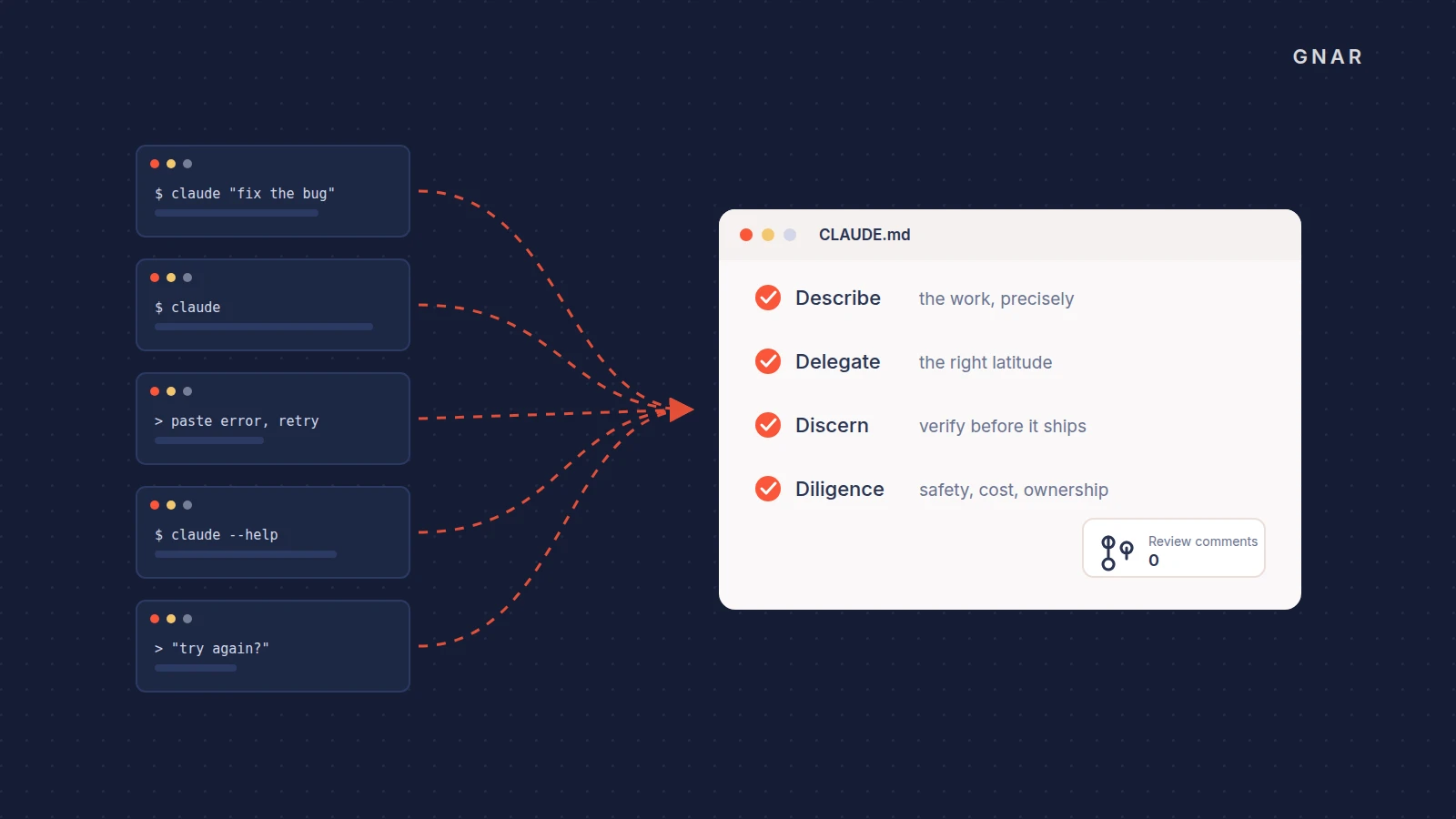
Gnar's training page describes its own starting placement in plain words: "Each engineer is assessed at kickoff on how they specify work, delegate it, check the output and handle safety and cost." The GSC case study names those four lines the Immerse Four Ds: Description, Delegation, Discernment and Diligence. They are the same four words Anthropic's AI Fluency course uses.
The checklist below is general engineering advice, built from those course outlines. A team training plan should cover:
- Specifying work. Writing a task so Claude builds what you meant, and starting larger changes in plan mode.
- Delegating. Deciding what Claude may do without asking, through permission modes, and when to hand a job to a subagent.
- Checking the output. Giving Claude a check to run, and reading the change itself before it merges.
- Safety and cost. Which files and commands are off limits, enforced with hooks or deny rules, and what each session may spend.
- Shared context. One project CLAUDE.md the whole team edits, kept short enough that Claude follows it.
- Repeated work. Saving a procedure the team runs often as a skill.
- Connections. Which outside systems Claude can reach through MCP, and with what access.
Anthropic's Claude Code guidance page explains why the checking line matters. When a session goes wrong, one of the cases it names is that "Claude said it was done and it wasn’t quite, usually because it had no way to check its own work." Its answer is to give Claude a check to run.
A program that covers only the tools can leave out the team's agreement. Five engineers can each know plan mode and still use it five different ways.
The deliverable is shared files in your repository#
The most useful output of team training is a set of files in the repository that every engineer's Claude Code reads. Anthropic's documentation on CLAUDE.md lists the project file as "Team-shared instructions for the project," shared with "Team members via source control."
Skills work the same way. Anthropic's skills page says to "commit it to a repository to share it with everyone who works there, or distribute it through a plugin or managed settings to reach a whole team." The personal file, CLAUDE.local.md, is for "Personal project-specific preferences," and the same docs say to add it to .gitignore.
The docs also say CLAUDE.md files in the folders above the working directory are loaded at launch. So training that ends with these files committed gives every engineer the same shared project instructions to start from.
Anthropic's Claude Code guidance page sorts every instruction into two kinds:
- Claude decides. A prompt, a CLAUDE.md file or a skill is non-deterministic. "Claude (the model) reads it" and then decides what to do.
- Claude Code enforces. A hook, a deny rule or a managed setting is deterministic. "Claude Code applies this every time, no matter what the model decided to do."
A training plan should end with both kinds written down. The guidance goes in CLAUDE.md and skills. The rules that cannot bend go in hooks and settings. For a company, Anthropic's admin guide says managed settings "take precedence over local developer configuration," so the hard rules can be set once for every engineer.
Self-serve courses, workshops and coaching compared#
The outside formats differ in who does the learning and where it happens. A self-serve course teaches each engineer alone. A workshop teaches the group together in a set block of time. Coaching pairs a mentor with each engineer on live work over several weeks.
| Format | What the team gets | What to add |
|---|---|---|
| Anthropic's free courses | Claude Code 101 and Claude Code in Action, each with a course quiz | A team session to agree the shared files and settings |
| Group workshop | Time together to write first drafts of the shared files | Follow up on live work after the session |
| Coaching on your own code | A mentor pairing with each engineer on work already on the board | A named owner for the shared files afterward |
| Training led by your engineers | People who learned first teach the next group | A first group that already has the practice |
Anthropic's free courses. Both Claude Code courses are hosted on Anthropic Academy, and the Academy's host says it uses learning data to "provide you with completion certificates." Claude Code 101 lists a prerequisite of "A Claude account (Pro, Max, or Enterprise) or an API key." A course teaches the tool. Your team still has to decide how each tool applies to your repository.
Group workshop. A workshop is where a team can write its first shared CLAUDE.md together and agree its permission rules in one sitting. The risk can come the week after, when each engineer is back under delivery pressure with the old habits close at hand.
Coaching on your own code. A mentor sees each engineer's real work, so the exercises fit the stack and the backlog. It takes hours from each engineer's week. At GSC, the case study puts it at "roughly five to six hours per engineer."
Training led by your engineers. This works once someone inside has the practice. At GSC, the case study says that after the cohort wrapped, "the participants ran an internal AI training for 70 GSC leaders."
Which format fits which gap?#
Engineers new to coding agents fit the Claude Code 101 course, and engineers who use single prompts fit Claude Code in Action. A team with the tools but no shared practice fits coaching on its own code, and a team at similar levels fits a workshop.
- Engineers who have not used a coding agent. Anthropic says "Claude Code 101 is designed for developers who are either new to software engineering or experienced engineers who haven't yet explored AI coding agents."
- Engineers who use it for single prompts. Claude Code in Action is for "Developers who already use Claude Code for single prompts and want to move to longer, less supervised, team-wide workflows."
- A team with the tools and no shared practice. Gnar's Immerse cohort is "Built for a small team that already has the tools but not the practice."
A workshop fits a fourth case, as general advice: a team whose engineers are at similar levels and mainly need to agree on the shared files and settings once.
With uneven use, your engineers may sit in different lines of that list. Start each engineer where they are.
How do you judge whether the training worked?#
Judge training by what changed in the repository and in a signal nobody tuned. The GSC case study lays out three measures: where each engineer placed at the start and at the end, a review tool nobody changed, and what each engineer left in the codebase.
- Placement at the start and at the end. Each engineer gets a starting placement and is placed again later. Gnar's page says engineers "are retaken at midpoint and wrap-up, so each one sees how far they moved." At GSC, the close measure was a self-assessment, so read it as the engineers' own view.
- A tool reading that stayed the same. Pick one signal nobody changes during the training, such as a review agent, a test suite or a CI check. At GSC, the review agent was that signal.
- Files in the codebase. Count what was merged. A project CLAUDE.md, at least one saved skill and real changes are things you can open and read.
A course certificate shows that an engineer finished a course. Anthropic's course host tracks "course progress, lesson completion status, quiz scores, and time spent on materials." Those numbers describe the course.
Read usage numbers next to work numbers. Our post on how to measure a Claude Code rollout sets out how to take a baseline and pair the two.
What did four weeks of coaching change at GSC Enterprises?#
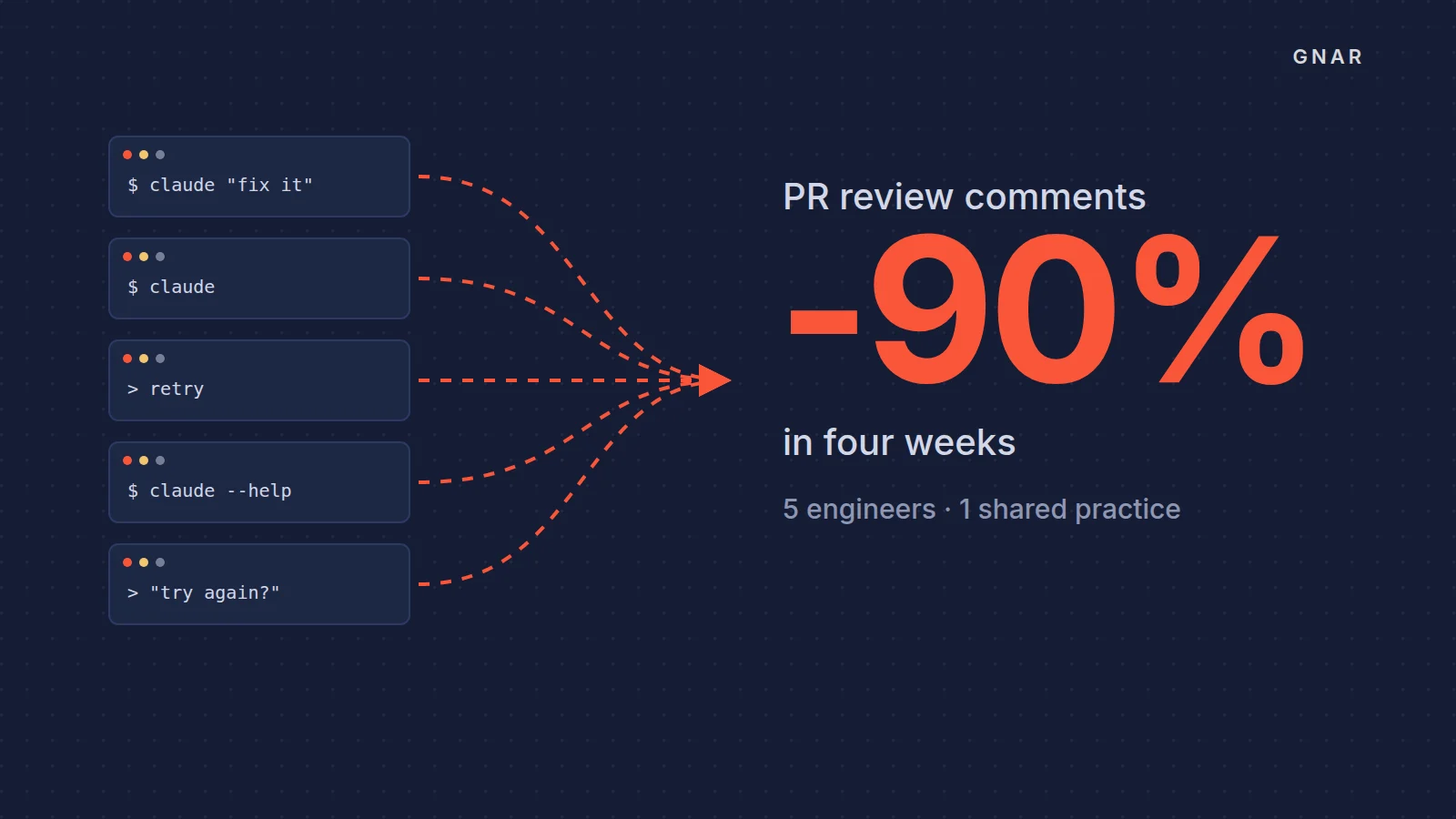
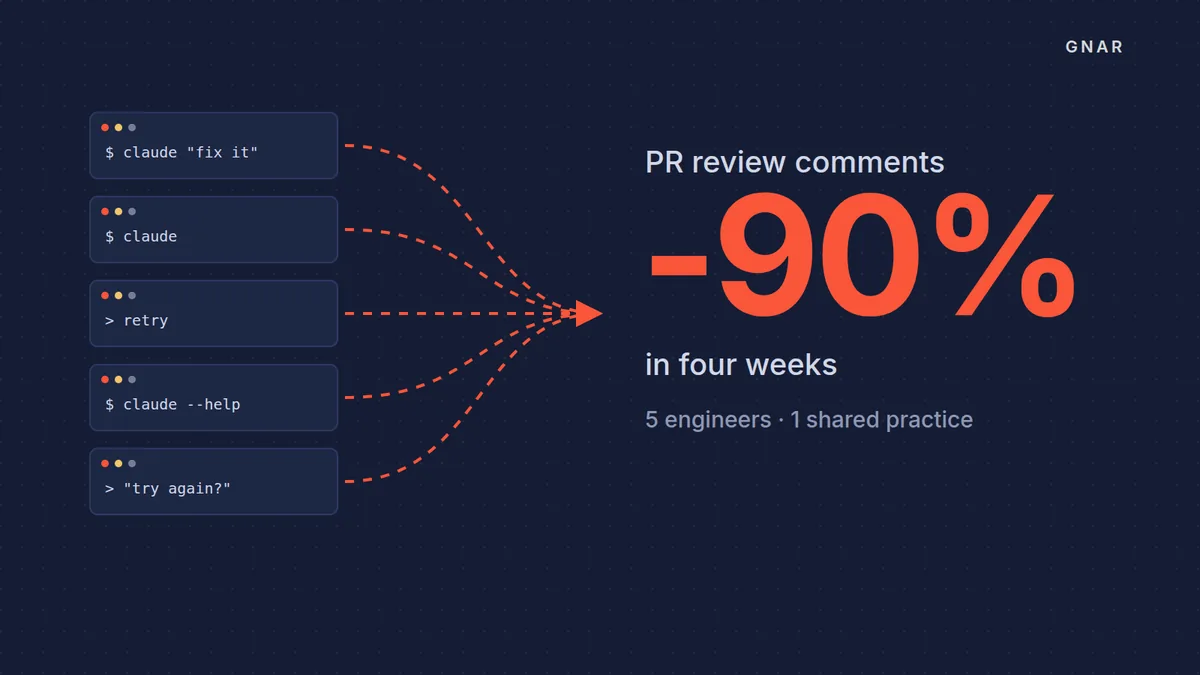
The Gnar Company moved GSC Enterprises' five engineers from individual Claude Code use to one shared practice in a four week Immerse cohort. Over those four weeks, the share of pull requests GSC's automated code reviewer commented on fell from roughly 100% to under 10%.
GSC is the wholesale distributor behind Grocery Supply Company. Its engineers support "a custom-built ERP on Node.js and AWS, integrations with LANSA on IBM i and DB2, and analytics in Snowflake." The case study says "their stack is not the one most AI enablement content is written for." It also says the team "was under active delivery pressure, with no slack in the schedule to experiment."
CIO Barrett Williams wanted "not a course, but hands-on mentoring applied to the work already on the board." The GSC Enterprises case study describes the four weeks this way:
- One mentor. A single senior Gnar mentor, Alex, ran the cohort.
- Pairing. Each engineer had "two 45-minute 1:1s per engineer per week, each pairing on that engineer's live project."
- Group time. A weekly cohort check-in, live coding sessions, open office hours and a Slack channel between sessions.
- The real systems. MCP connectors for Snowflake, Atlassian, Microsoft 365 and GitHub brought GSC's own systems into the work.
The case study reports these results:
- Placement. At close, "all five self-assessed at Systematize or Orchestrate on every dimension" of the Four Ds. Each dimension is placed in "one of four bands: Craft, Direct, Systematize, or Orchestrate."
- The review agent. GSC runs an independent code review agent on every pull request, and the tool stayed the same. The case study credits the drop to "Better up-front specification and tighter context discipline."
- Files in the code. Every participant left with a merged change in their own codebase, a maintained context file, at least one reusable skill and a workflow they can describe.
What the case does not show matters too. It covers one team of five engineers, one mentor and four weeks. Its close placement is a self-assessment. It gives no figure for hours or dollars saved. And it is a single case, so it cannot tell you how a workshop or a course alone would have done for the same team.
What a coaching cohort looks like at Gnar#
Gnar's training page sets Immerse out in three steps: place every engineer, mentor on live work, then retake and keep the practice. Each step below quotes the live page.
- Place every engineer. "Each engineer is assessed at kickoff on how they specify work, delegate it, check the output and handle safety and cost. The results set each engineer’s exercises."
- Mentor on live work. "A senior Gnar mentor pairs with each engineer on their own project, with a weekly cohort check-in and a Slack channel between sessions."
- Retake and keep the practice. "Engineers are retaken at midpoint and wrap-up, so each one sees how far they moved. The practice stays in your codebase when the cohort ends."
The page also says what each engineer keeps: "Each engineer leaves with a merged change in your codebase, a maintained context file, at least one reusable skill and a workflow they can describe."
Immerse has "Two ways in," which the page puts as "On its own, or alongside a build." On the second path, the page says "Cohorts can run alongside the first build, so engineers ship with the skills the roadmap calls for."
Gnar is a Claude Select Services Partner. Its partner page lists two options for a company starting out, and Option A is "We train your existing team."
Questions to ask a Claude Code trainer#
Ask where the exercises run, what gets merged into your repository, how each engineer's progress is measured, and who keeps the shared files current afterward. The full list below is general engineering advice, and each question tests a point from the sections above.
- Do the exercises run on our repositories or on a sample project? If your security team rules out your code, ask how close the sample is to your stack.
- What will be merged into our codebase by the last session? Ask for names: a project CLAUDE.md, at least one skill, and the permission rules.
- Which rules become hooks, deny rules or managed settings? Ask which ones stay as written guidance, and why.
- How do you place each engineer at the start and at the end? Ask whether the end measure is a self-assessment or a test.
- Which outside signal will we watch? A review tool, a test suite or a CI result works, as long as nobody changes it during the training.
- How many hours does each engineer spend each week? Ask how delivery work continues alongside it.
- Who teaches? Ask whether they use Claude Code on their own delivery work.
- Who owns the shared files after you leave? Ask how the CLAUDE.md and skills stay current.
When does your team not need outside training?#
Your team may not need an outside trainer when someone inside has the time and the direction to run the practice. The Gnar Company's own answer to the objection that a company has people for this is "Often you should use them. If your own engineers have the capacity and the direction, do it internally and we will say so on the call."
An in-house plan, as general advice, can look like this:
- Send each engineer to the Anthropic course that matches where they are, using the lines in the section on which format fits which gap.
- Hold one working session to write the project CLAUDE.md, the first skills and the permission rules.
- Name one owner for those files, and review changes to them the way you review code.
- Check the instruction files from time to time. Anthropic's memory docs say that to have Claude check them for outdated or conflicting content, you can "run /doctor prompt-audit in a session," which "requires Claude Code v2.1.283 or later."
Outside help makes more sense when the team has no slack in the schedule, when the stack is far from what most training material covers, or when seats have gone quiet. Our post on why a Claude rollout goes quiet sets out the checks for that last case.
Budget the seats and usage next to the training plan. What Claude Code costs per developer sets out Anthropic's own per developer numbers.