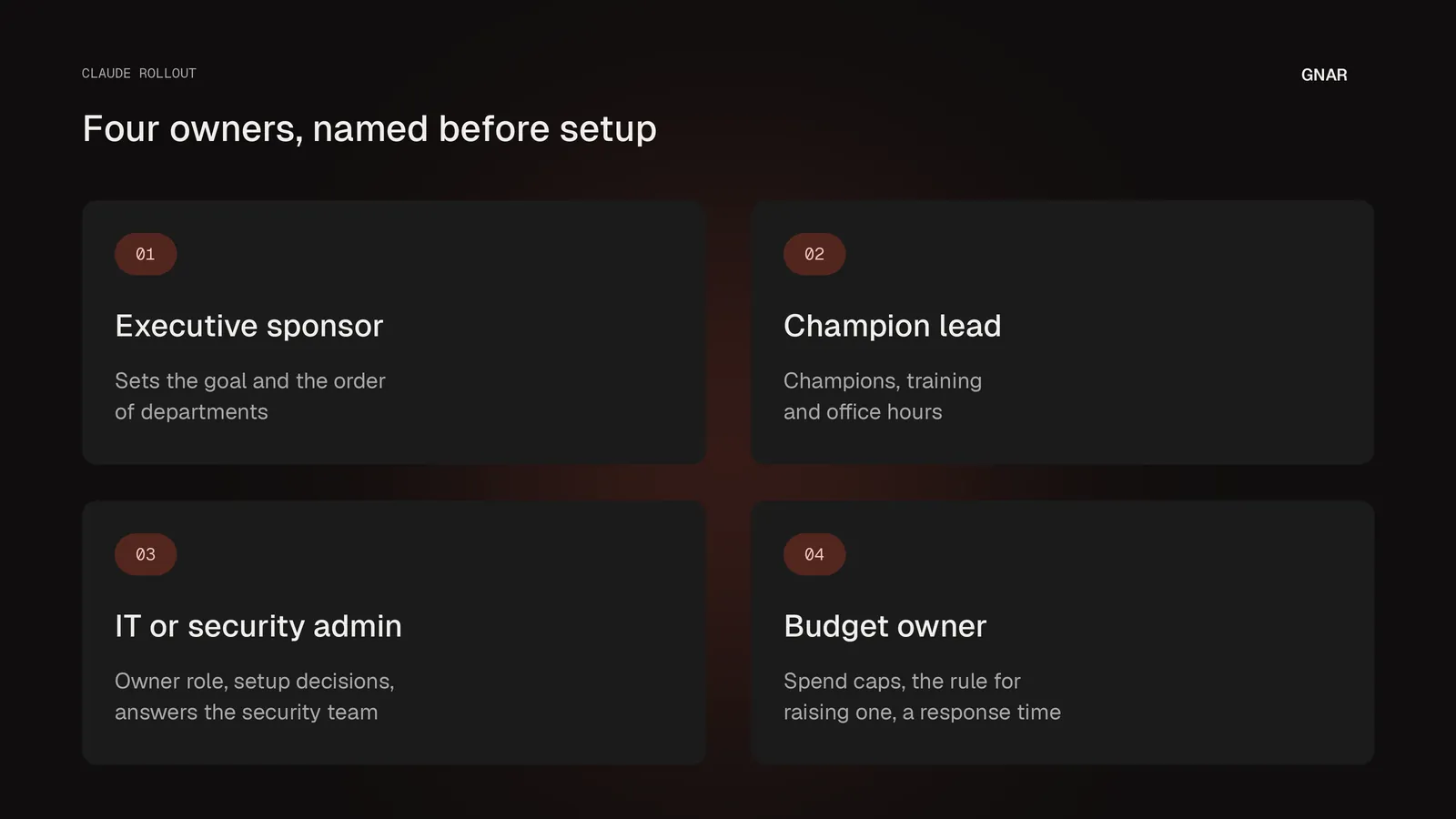
A Claude rollout needs four named owners inside your company before anyone sets it up. They are an executive sponsor, a champion lead, an IT or security admin and a budget owner. The CEO who announced Claude can be the executive sponsor. Each of the four needs hours set aside for the work, and the admin needs them every week.
The Gnar Company is a Claude Select Services Partner in Anthropic's Claude Partner Network. On its enterprise AI integration page, Gnar describes linking Claude to the ERP, CRM and other systems a business runs today. The page says "U.S.-based senior engineers at The Gnar Company build those connections." The owners in this post are the people inside your company who decide what those connections may do.
This post is for a CEO who has announced Claude Enterprise and has not yet named who runs it. The four roles are general engineering advice for a mid-market company. Where a sentence is not credited to Anthropic, NIST or Gnar, it is advice.
Who should own a Claude rollout inside a company?#
Four people should own a Claude rollout, and each one owns a different kind of decision. The executive sponsor owns priority and the champion lead owns adoption. The IT or security admin owns setup, and the budget owner owns the spend number.
- Executive sponsor. Sets the goal, picks which departments go first, announces the launch and settles disputes between departments. For example, the CEO, COO or CIO.
- Champion lead. Recruits champions in each department, runs training and office hours, and gathers the skills champions write.
- IT or security admin. Holds the Owner role in Claude, puts the setup in place and answers the security team. The security team reviews the answers and decides.
- Budget owner. Commits the spend cap for each group, sets the rule for raising one and answers requests on time. For example, the CFO or a finance lead.
At a smaller company one person can hold two of these roles. The test is that each job has a name next to it, with hours, before setup starts.
Which owners does Anthropic's rollout material name?#
Anthropic's administrator guide names an executive sponsor, champions in each department and a program owner. Its rollout course companion asks for an owner for each of the five decisions and says that in many companies a budget owner commits the spend number. Anthropic's consumption guide suggests a group owner in each department. The words differ from page to page, so the table lists each one with the page that uses it.
| Term | Where it appears | What the page says |
|---|---|---|
| Executive sponsor | Admin guide, training phase | Department training sessions include an executive sponsor. |
| Executive announcement | Admin guide, launch plan | Launch day includes an executive announcement. |
| Champions | Admin guide, launch phase | Two or three champions per department or team. |
| Program owner | Admin guide, scaling phase | Name a program owner and consider a Center of Excellence. |
| Owner role | Rollout course page | The five decisions need Owner-level access. |
| Budget owner | Rollout course companion | Commits the spend number in many companies. |
| Decision owners | Companion, Lesson 2 | One named owner for each of the five decisions. |
| Group owner | Help center guide | Consider one per department, reviewing usage and fielding questions. |
Anthropic's administrator guide is a four-phase deployment playbook. The rollout course, Deploying Claude Enterprise with confidence, covers five decisions: Structure & Identity, Access, Governance, Spend and Visibility. Its work-along companion is a document you fill out. Filled out, the companion says, it is "your rollout plan: your objective, an owner for every decision, and your answer to each of the five decisions."
The companion also sends decisions to people outside the admin. One hand-off goes to "counsel, the data-residency owner, or your identity team". Another goes to a "risk owner, for any row with write access". Others go to the budget owner and to "the unit leaders whose groups are on the checkpoints." The governance hand-off adds "your security lead if the posture isn't yours alone to set". So even a skilled admin needs other named people to finish the plan.
What does the executive sponsor own?#
The executive sponsor owns the priority of the rollout: the goal, the order of departments and the call when two departments disagree. Anthropic's administrator guide lists an executive announcement on launch day and names an executive sponsor for each department's training sessions.
The guide's launch plan lists, for launch day, "Executive announcement, getting started guide, training schedule". Its training phase describes department sessions built around each team's own workflows, "with an executive sponsor to signal leadership support."
Outside Claude, the NIST AI Risk Management Framework (AI RMF 1.0, January 2023) puts responsibility for AI risk decisions with executive leadership. NIST says the framework "is intended to be voluntary". Its GOVERN 2.3 reads: "Executive leadership of the organization takes responsibility for decisions about risks associated with AI system development and deployment." That is one reason this post's executive sponsor is an executive, such as the CEO, COO or CIO.
The sponsor's first written job is the goal. Anthropic's course companion asks for "one sentence that names what success looks like", plus the limit that has to hold while you get there. The sponsor signs that sentence, then names the departments that go first.
Gnar's Claude partner page lists a problem it calls a mandate from the top. It reads "Your CEO, CFO or board wants results from AI, with a target to hit by year end." A target like that needs one executive who owns it.
What does the champion lead own?#
The champion lead owns adoption: finding champions in each department, running training and office hours, and gathering the skills champions build. Anthropic's administrator guide asks for two or three champions per department or team, and someone has to recruit, equip and keep them.
The guide's launch phase lists what champions need. That includes "Provide champions with early access and advanced training" and "Equip champions with talking points and demo guidance". It also suggests a champions Slack channel or Teams group for peer support.
Champions also appear in the training phase. The training phase adds office hours every week or two, where people bring their own work to champions for help. Someone has to schedule those sessions and keep champions showing up for them.
Anthropic's guide to Claude Cowork adoption at scale says where to find the first pilot leads for Claude Cowork, which Anthropic's deployment guide groups with "office agents": "the early adopters experimenting with the tool in their day-to-day work." It adds: "They're your first pilot leads, and most are already using AI for chat."
The scaling phase of the administrator guide says to "Designate a program owner and consider forming a lightweight Center of Excellence to curate prompts, Skills, and playbooks". Our advice is to name that person at the start and call them the champion lead. Then the person who recruits the champions also keeps what they build.
What does the IT or security admin own?#
The IT or security admin owns setup: the Owner role in Claude, sign-in, groups and connectors, and putting the course's five decisions in place in the console. This person also answers the security team, which reviews the answers and decides. The course companion asks you to enter "the five decision owners for your company", so the admin configures the five decisions without owning every one. The companion hands Governance to "the governance owner you named in Lesson 2, and your security lead if the posture isn't yours alone to set", and Visibility to "the visibility owner you named in Lesson 2". In this post's split, the IT or security admin owns Structure & Identity and Access and is also the governance owner and the visibility owner. The budget owner owns Spend.
The course page says the five decisions "are organization-wide settings that take Owner-level access". Anthropic's roles article says "Team and Enterprise organizations can only have one Primary Owner." The course companion lists a must-do it calls lockout insurance: "at least two members hold the Owner role directly, not through a group". So the admin needs a second Owner named as backup.
Anthropic's role-based permissions guide adds a warning about one admin permission, Identity & Access set to Manage. It says "Members with this permission can expand their own access, so reserve it for trusted security and IT administrators."
The administrator guide's pre-launch checklist includes "Security review completed with IT and information security teams" and "Admin roles assigned". The admin brings the documents listed in How to Get Claude Enterprise Through a Security Review to that review. The security team reviews the documents and decides.
What does the budget owner own?#
The budget owner owns the spend number: the cap for each group, the rule for raising one and how fast a request gets an answer. Anthropic's course companion says "In many companies the budget owner commits the number; you bring the proposal, and configure the caps once it comes back."
The companion's hand-off to the budget owner is direct. It says "Brief them so the number gets set, not just discussed." It asks for the default settings and the review rule to be agreed before anyone hits a cap. Otherwise, it warns, "the first request lands with no one able to answer it." It also says "Ask them to commit to a response time, not just to the rule."
Anthropic's Enterprise billing article says "Owners, Primary Owners, and custom roles with the Billing permission set to "Can manage" can set spend limits to manage your organization's consumption." The roles article says custom roles exist on Enterprise plans only. On those plans, the role-based permissions guide gives an example that fits a budget owner: "You could create a "Finance" role that grants Billing access but no chat or Claude Code capability".
Two lines from the consumption guide matter for this role. "The Billing permission applies to the whole org, so anyone who can edit one group's pool can edit every group's pool." And when a usage report "shows high-value work, raise the limit, because members at their limit are often your top adopters." Our advice: the budget owner reads that report with the champion lead before saying no.
Who owns each rollout job?#
Each rollout job gets one owner from the four, and Anthropic's material names who else is involved in several of them. The owner column is this post's advice. The third column comes from Anthropic's administrator guide and course companion.
| Job | Owner | What Anthropic's material says |
|---|---|---|
| Launch announcement | Executive sponsor | Launch day lists an executive announcement. |
| Department training | Champion lead, with the sponsor present | Sessions run with an executive sponsor. |
| Champions and office hours | Champion lead | Two or three champions per department or team. |
| Groups and sign-in | IT or security admin | The identity team confirms the groups can be provisioned. |
| Connectors that can change records | IT or security admin, with a named risk owner | A risk owner approves or declines each one. |
| Security review answers | IT or security admin | The review is done with IT and information security teams. |
| Spend caps | Budget owner | In many companies, the budget owner commits the number. |
| Requests for more spend | Budget owner | The budget owner is asked to commit to a response time. |
Read each row for a name. A row with no name is the first thing to fix before setup starts. If a row names someone with no hours for it, that is the second thing to fix.
What should each owner have in writing before setup starts?#
Each owner should have a short written scope before setup starts, with dates and names. This list is general engineering advice, built on the jobs above.
- Executive sponsor: the one-sentence goal, the departments that go first and the date the sponsor reviews results.
- Champion lead: two or three named champions in each first department, an office hours slot and a place to collect the skills they write.
- IT or security admin: the Owner role, a second Owner named as backup and a date for the security team's review.
- Budget owner: a starting cap for each first group, the rule for raising one and a response time for requests.
- All four: hours in their week for the rollout, agreed with their own manager.
Put the five items on one page. The course companion suggests the admin bring its plan to the kickoff and "walk your stakeholders through the decisions you've recorded and the open items still to close." That meeting is where each owner confirms their line.
Should the CEO own the Claude rollout?#
The CEO should own the decision to roll out Claude and can serve as executive sponsor, but should not run the admin console. That job needs someone who works in the settings every week.
Anthropic's course page describes that person. "You're in the admin console every week: opening connectors, reading the analytics dashboard, deciding which team gets access next, revisiting spend caps." If the CEO is the only Owner, every change that needs the Owner role waits on the CEO's calendar.
At a smaller company, our advice is that the CEO can hold two roles: executive sponsor and budget owner. That works when the CEO already signs off on spend at that level. The admin and champion lead jobs should still go to people with the hours.
What happened at GSC Enterprises when the CIO asked for help?#
At GSC Enterprises, the request came from the CIO, and a four-week Claude Code cohort for five engineers followed. In this post's terms, the CIO acted as the executive sponsor for that one team's cohort. Gnar's case study covers that one engineering team and the training its engineers ran afterwards.
The GSC Enterprises case study says "CIO Barrett Williams had seen what a Gnar Immerse cohort did for a peer company's team. He wanted the same for his: not a course, but hands-on mentoring applied to the work already on the board."
The case says one senior Gnar mentor worked with the five engineers for four weeks, on the code the team was already shipping. It says the five engineers went on to train 70 GSC leaders on AI inside the company.
Where does outside help fit, and who keeps ownership?#
Outside help fits under one of the four owners, on work such as a custom connector or a first round of engineering training. The owners stay inside your company, and the help reports to one of them.
Gnar's Claude partner page describes scattered use with no owner. It says "Nobody can see where data is going or who approved it to go there, and the token spend keeps climbing while nobody can point to the business outcome it bought." In this post's split, data approval sits with the IT or security admin and the security team, and spend sits with the budget owner.
On a connector Gnar builds, the enterprise AI integration page says "A log shows what Claude looked up and changed, so your security team can review it." It also says "You own what gets built, and Gnar keeps no ownership of it." In this post's split, that connector belongs to the IT or security admin.
For a build like that, Gnar's integration page says to start with Gnar Discovery and Design. The Discovery page lists Foundation at $15,000 for two weeks. Gnar puts it this way: "Two weeks, $15,000, and you walk out with a build plan that has a fixed price on it."