A CIO who is asked for a date will not find a total in Anthropic's administrator guide. It splits the work into four phases and dates only a few steps.
The rest of the calendar waits on decisions. Someone has to decide how people sign in, which groups get which tools, what Claude may touch, what each group may spend and what gets logged. A rollout moves at the pace of the slowest of those answers.
This post is for a CIO who has bought the seats, or is about to, and has been asked for a date. It takes the four phases in order. For each one it covers what Anthropic dates, who inside your company has to say yes, and which part of the work an outside firm can carry.
The Gnar Company, a Claude Select Services Partner, connects AI models like Claude to your ERP, CRM and databases through its enterprise AI integration work. That work shows up in the first phase and again in the last one.
What does Anthropic put on the calendar?#
Anthropic dates a handful of rollout steps, and none of the guides checked adds them up to a total. The administrator guide's one dated rollout example is the pilot: 50 to 100 users synced from your identity provider through SCIM and monitored for 2 to 4 weeks before more groups are added.
These are the time markers in the administrator guide, the consumption guide and the plan page, all checked on the day this post was published.
| Step | What Anthropic says | Where it says it |
|---|---|---|
| Pilot | 50 to 100 users synced through SCIM, monitored for 2 to 4 weeks, then widened department by department | Administrator guide |
| Launch communications | Start 2 weeks before launch, with tips and pilot stories in the first week after | Administrator guide |
| All staff training | 101 sessions of 30 to 60 minutes, run at launch and repeated for new hires | Administrator guide |
| Department sessions | A follow up 2 to 4 weeks after each department's session | Administrator guide |
| Office hours | Weekly or biweekly, especially valuable in the first 30 to 60 days | Administrator guide |
| Spend review | Weekly during the initial rollout, monthly after that | Consumption guide |
| Training refresh | Every quarter | Administrator guide |
| Contract | Billed annually, annual commitment, 20 seat minimum | Enterprise plan page |
Each marker sizes one step. None of them covers the time a step waits for an approval. Security reviews, identity provider changes and budget sign-offs run on other teams' calendars, so a plan built only from these markers will promise a date that is too early.
The Claude Enterprise plan page adds a contract term. Seats are billed annually with an annual commitment, and usage is billed at API rates on top. The decisions in the next section can be made on paper before the contract is signed.
What sets the length of a rollout?#
Five decisions shape the rollout, and Anthropic's course Deploying Claude Enterprise with confidence takes them in the order they depend on each other: structure and identity, access, governance, spend and visibility. Each one needs an owner and a decide-by date, and the course's plan has groups go live one at a time, and no group goes live until visibility is switched on for the groups that need the record.
The course starts before any setting. Its first exercise is one sentence that names what success looks like and the constraint that must hold on the way there. Every later decision is weighed against that sentence, so a rollout without one has no way to settle an argument about scope.
| Decision | What it settles | Who usually has to say yes |
|---|---|---|
| Structure and identity | How many Claude organizations you run, your groups, and how people arrive | The owner of your identity provider |
| Access | Which groups get chat and Claude Code, and which connectors they see | Department heads and IT |
| Governance | The rules for skills, connectors and other customizations | Security and legal |
| Spend | Caps per group and per person | The budget owner |
| Visibility | Audit logs, the Compliance API, telemetry and data retention | Security and compliance |
The third column is our engineering judgment for a mid-market company, and your org chart may differ. The course's work-along companion PDF says that in many companies the budget owner commits the spend number, and the admin brings the proposal.
Four settings are hard to undo, according to the course's work-along companion. They are domain claiming, how many organizations you run, your group structure and your data retention window. The administrator guide adds that domain claiming cannot be reversed. The companion asks for each of the four to be decided, or to have a named owner and a decide-by date, before go-live.
A practical test before you give leadership a date: count the decisions that still have no owner. Each one is an open item with no end date, and a go-live date set while any of them is open is a guess.
Phase 1: what has to be set up before the wider rollout?#
Before the wider rollout, your domain is verified, single sign-on works for a test group, people arrive through a provisioning method you chose, and the developers who need Claude Code hold a seat that includes it. Anthropic's guide calls this phase technical setup. Most of the work sits with teams outside the rollout, so their queues set its length.
The guide's pre-launch checklist has the full list. The items below are the ones that wait on another team:
- The domain and single sign-on. Single sign-on cannot be set up until the domain is verified. Anthropic says to test it with a small pilot group, then enforce it for everyone. Claude Enterprise supports SAML 2.0 and OIDC, so your identity provider team does this work.
- Provisioning. Anthropic recommends SCIM, which syncs people from your identity provider. SCIM is an open protocol for managing identities across systems. The other choices are creating people on their first sign-in, or manual invitations, which the guide calls best for small, controlled pilots.
- Claiming the domain. Claiming is optional and separate from verifying. It moves personal Claude accounts on your domain into your organization. It needs restricted organization creation, enforced single sign-on and SCIM or first sign-in provisioning, and it cannot be reversed.
- Seats for developers. On usage-based plans, Claude Code needs a Chat + Code or Claude Enterprise seat. On older seat-based plans it needs a Premium seat. On usage-based plans, with no spend limits set, spend is not capped.
- Devices. Anthropic asks the team that manages developer devices to pre-install the Claude desktop app on developer machines, which includes Claude Code in its Code tab.
- Security review. The checklist calls for a review with IT and information security, a written data retention policy, and access to audit logs and the Compliance API.
Connectors are on the same checklist, and they depend on how your business runs. Choosing which systems Claude may reach means deciding what it may read and what it may change in each one. Anthropic offers pre-built connectors for tools such as Microsoft 365, Google Drive and GitHub. A system only your company runs needs a custom connector, which the guide describes as a remote MCP server you build. MCP is an open source standard for connecting AI applications to outside systems.
Gnar's integration work starts with that same question. Its first step reads: "We list each system AI needs to reach, what it may see and change, and who signs off." A connector can be read only, so Claude can find an order or a customer without being able to change either one.
Phase 2: what gets decided before launch day?#
Before launch day you need a number that says whether the pilot worked, and two or three champions in each department. The one-sentence objective comes from the course's first lesson. Anthropic's guide calls this phase change management and launch, and it dates launch communications, from two weeks before launch through the first week after.
The guide gives example targets. Weekly active users at 70% of licensed seats is one. Others are 25 or more messages per user per week, and 3 or more hours saved per user per week, measured by survey. Our arithmetic: on the 20 seat minimum, 70% is 14 people using Claude each week.
Pick one metric that follows from your objective sentence. Then write down, before the pilot ends, the result that widens access and the result that pauses it. Hours saved come from a survey, so pair that number with one you can count, such as weekly active users from the admin dashboard.
Champions come next. Anthropic suggests two or three per department, with early access, more advanced training and a shared channel. Pilot users make good candidates, because by launch they will have used Claude on real work during the pilot.
The objective is the part of this phase that outside help can shape. Gnar's AI strategy work produces "use cases ranked by ROI, an implementation roadmap, and a clear view of what not to build." The Gnar Company found 79 AI and automation opportunities for Counter Culture Coffee, a coffee roaster that runs on NetSuite. A ranked list like that gives the objective sentence something concrete to name.
Some leadership teams want to try Claude themselves before they sign off on an objective. For them, Gnar offers a free AI workshop series for non-technical business leaders: eight live sessions of 45 minutes each, bi-weekly, on Google Meet. The next series is not scheduled yet, and leaders can join the waitlist.
Phase 3: how long does training take?#
Anthropic dates training in short blocks: all staff 101 sessions of 30 to 60 minutes, a department follow up 2 to 4 weeks after each department session, and office hours that are especially valuable in the first 30 to 60 days. Engineers who use Claude Code need a separate track, because the work they hand to Claude ends up in the code they ship.
| Track | Who it is for | Format | Time | From |
|---|---|---|---|---|
| All staff basics | Everyone with a seat | A 101 workshop on the interface, prompts, Projects and Artifacts | 30 to 60 minutes, repeated for new hires | Anthropic's guide |
| Department sessions | One team at a time | Built around that team's workflows, with an executive sponsor | Follow up 2 to 4 weeks later | Anthropic's guide |
| Office hours | Anyone with real work to bring | Drop in help from champions | Weekly or biweekly | Anthropic's guide |
| Engineering cohort | Developers on Claude Code | Gnar Immerse, with one mentor pairing on each engineer's own project | Four weeks | Gnar |
| Leaders' series | Non-technical executives | Gnar's free AI workshop | Eight sessions of 45 minutes, bi-weekly | Gnar |
Anthropic's consumption guide says Claude Code uses more tokens per session than chat, because each session carries system prompts, file context, tool calls, and multi-turn reasoning. The guide also suggests using groups to decide who gets Claude Code at all, and rolling out the heavier tools in waves. Gnar's AI training for engineering teams, called Immerse, is "Four weeks, one mentor, your code." The page describes it as "Built for a small team that already has the tools but not the practice." Each engineer is assessed at kickoff and again at midpoint and wrap-up, so each one can see how far they moved.
What did four weeks look like for one engineering team?#
At GSC Enterprises, five engineers who already had Claude Code spent four weeks in a Gnar Immerse cohort on their own production code. Over those four weeks, the share of pull requests that GSC's code review agent commented on fell from roughly 100% to under 10%.
GSC is the wholesale distributor behind Grocery Supply Company. This example covers its engineering team only. The GSC Enterprises case study lays out how the four weeks were spent:
- One senior Gnar mentor, Alex, ran the cohort.
- Each engineer had one-on-ones every week, each pairing on that engineer's live project.
- The group had a weekly cohort check-in, live coding sessions, open office hours and a Slack channel between sessions.
- The case study says it "fit inside a normal workweek, roughly five to six hours per engineer, so delivery commitments held."
- MCP connectors for Snowflake, Atlassian, Microsoft 365 and GitHub brought GSC's real systems into the work.
The case study reports these results:
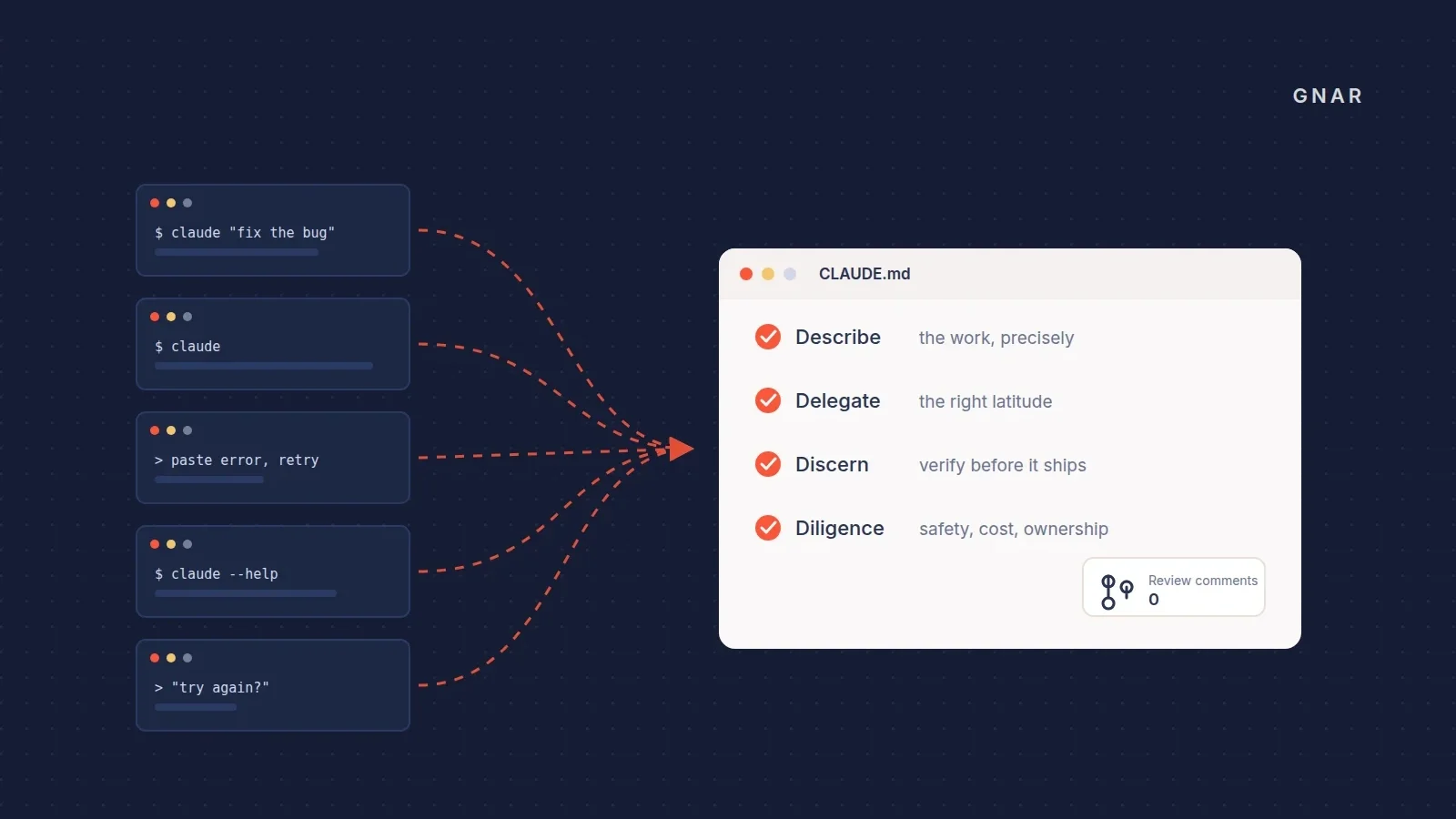
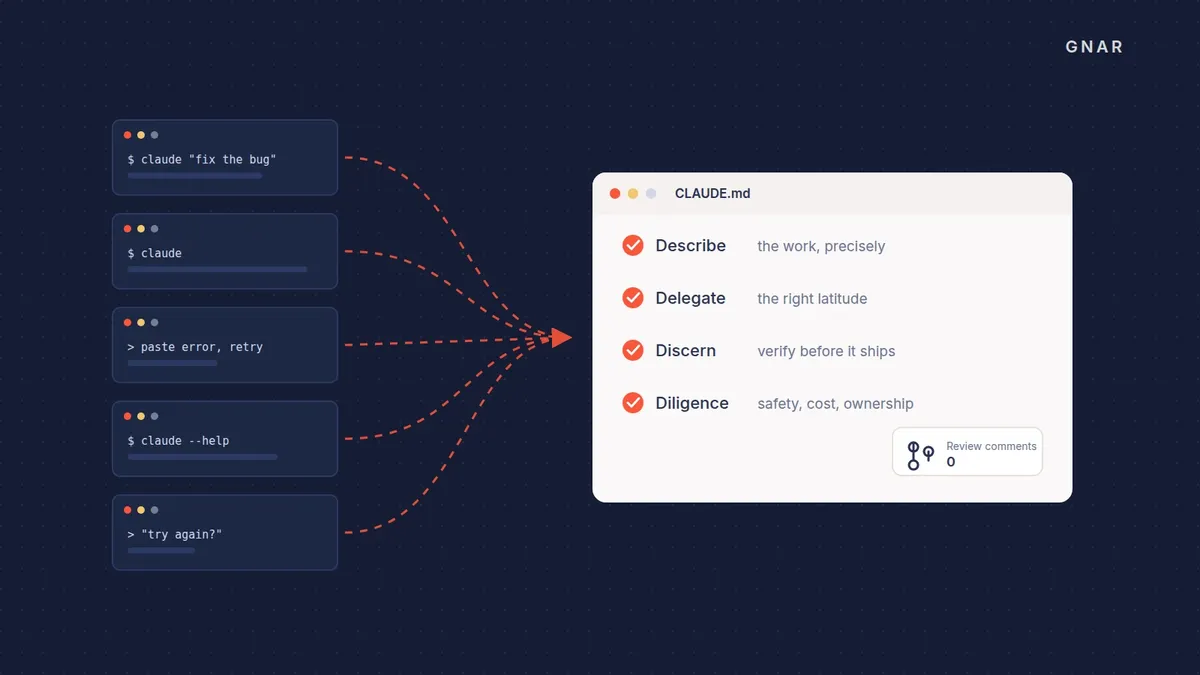
- Fluency. Each engineer was assessed at intake and again at close on the Immerse Four Ds: Description, Delegation, Discernment and Diligence. The case study places each of the Four Ds in one of four bands: Craft, Direct, Systematize or Orchestrate. At close, all five self-assessed at Systematize or Orchestrate on every one of them.
- Review comments. GSC runs an independent code review agent on every pull request, and nobody changed it during the cohort. The drop in its comments was sharp enough that GSC's Business Application Manager checked whether the reviewer was broken.
- Work in the code. Every engineer left with a merged change in their own codebase, a maintained context file, at least one reusable skill and a workflow they can describe.
- What came next. After the cohort wrapped, the participants ran an internal AI training for 70 GSC leaders.
The one-on-ones with Alex turned general knowledge into progress on our own projects. We came away with working changes, not just notes.
Blake Macek, Business Application Manager, GSC Enterprises
The case study covers five engineers and Claude Code. It does not describe a company-wide Claude Enterprise rollout, and it does not report hours or dollars saved. What it does show for a rollout plan is a sequence: the engineers learned on their own code first, and then the same engineers taught their company's leaders.
Phase 4: when does the rollout end?#
The dated part of the rollout ends when access opens to the whole company, which Anthropic's administrator guide ties to "once processes are established." After that the work keeps going on a cadence, with a program owner and a training refresh every quarter. Anthropic's guide calls this phase scaling adoption. It also suggests a short retrospective at each phase.
The guide suggests starting with Projects, Artifacts and connectors, then search and research, then Claude Code and skills, and last, automation such as scheduled tasks and custom connectors. The consumption guide adds a review rhythm: check each group's spend weekly during the initial rollout and monthly after that. It also suggests starting with four to six groups, since more than eight to ten gets hard to manage.
A custom connector to a system only your company runs has to be built, secured, logged and kept working when the system changes. That work needs engineers, and it needs an owner after launch.
The Gnar Company builds MCP servers for ERPs, CRMs and internal databases. When a connector is allowed to make changes, the AI still cannot change a record directly. Every change passes one checkpoint you control, and a person can approve it before it lands. After launch, your team runs it, or Gnar keeps it working on Maintain, its monthly support plan, from $1,000 a month.
The first step is a plan with a price on it. The Gnar Company starts with Gnar Discovery and Design. Two weeks, $15,000, and you walk out with a build plan that has a fixed price on it. If your own engineers have the capacity and the direction, do it internally and we will say so on the call.
Who does what in each phase?#
Your team owns every decision in a Claude Enterprise rollout, Anthropic supplies the guides and the admin console, and an outside firm is useful where the work is building, teaching or planning. Each phase has a different owner inside your company, and Gnar fits in a different place in each one.
| Phase | Your team | Anthropic's material | Where Gnar fits |
|---|---|---|---|
| Technical setup | Identity provider owner, device management, security review | Administrator guide and its pre-launch checklist | Mapping which systems Claude may reach and what it may change |
| Change management and launch | Executive sponsor, budget owner, champions | Example metrics, launch communications, the rollout course | AI strategy that ranks use cases by ROI; the free leaders' workshop |
| Enablement and training | Department leads and champions | 101 sessions, office hours, Claude Academy courses | Immerse cohorts for engineering teams |
| Scaling adoption | Program owner and group owners | The order to turn tools on, the consumption guide, a quarterly refresh | Custom connectors to your own systems, then Maintain |
If the board wants an AI policy before the pilot starts, An AI Governance Framework the Board Can Approve lays out what it should say. If the seats are bought and usage is flat, Everyone Has a License. That's Not AI Adoption. covers where AI rollouts stall.