
To score AI use cases by return, rate every idea on the same five dimensions, count only the money you can actually recover, cap the score of any idea that sits on weak data, and cut the list to three to five projects. This guide is for a COO with a long list of AI ideas and one budget, and it covers the steps, a scoring table you can copy, and a real example that started with 79 ideas.
The list arrives from many directions. A department head wants a chatbot, a vendor shows a demo, a board member read an article. Together they cost more than any budget can carry, and someone has to tell the C-suite which ones are worth the money.
The choice matters because AI spending has often not reached profit. McKinsey's State of AI in 2026, published on 25 August 2026, found that 37% of respondents attribute at least some EBIT impact to AI use, about the same share as last year. About 6% qualify as AI high performers, meaning they attribute at least 5% of EBIT to AI and call the impact significant.
Our AI strategy work runs this method for companies. The rest of this post lets you run it yourself.
How do you score AI use cases by return?#
You score AI use cases by putting every idea in one list, tying each to a number you already track, rating each on the same five dimensions from 1 to 5, counting only recoverable value, and capping any idea with weak data. This structured approach helps leaders weigh business value against technical feasibility, so the scoring stays tied to business objectives and business goals. Then you sort, cut, and sequence what is left.
- Put every idea in one list. Pull them from department heads, vendors, the board and your own team, often from broad ideation sessions before the list is narrowed. Give each a one-line description and a named owner who can answer questions about it.
- Tie each idea to a metric you already track. Gartner's prioritization funnel, written by Nate Suda and published on 20 January 2026, says every AI project must tie to a preexisting business outcome or metric the executive team understands, such as sales conversion rate.
- Check that a baseline exists. If the metric mattered before the idea, you have history to measure against. Gartner advises avoiding initiatives that lack historical data.
- Score the five dimensions. Use the table in the next section, with one written definition per dimension for every idea.
- Count only recoverable value, then apply the data cap. The next two sections cover both rules.
- Sort, cut and sequence. Keep three to five, then order them by what unblocks what.
Some teams first use a 2 x 2 prioritization matrix to sort ideas by value and feasibility before applying the fuller five-dimension score.
The five dimensions to score#
Score each idea from 1 to 5 on return, implementation cost, data readiness, reasoning risk and the cost of changing behavior. A 5 is always the good end: high return, low cost, strong data, low risk, easy change. Add the five for a total out of 25, then apply the data cap before you rank.
The table uses the five dimensions in Gnar's AI strategy engagement, each with a plain question and a plain test.
| Dimension | The question it asks | How to score 1 to 5 |
|---|---|---|
| Return (ROI) | If this works, how much money do we recover, and in which budget line? | 1: no clear number or line. 5: a named saving or revenue gain tied to a metric we track. |
| Implementation cost | What does it cost to build, buy, connect and run? | 1: a large build with many connections. 5: a small build, or a tool we can buy and configure. |
| Data readiness | Is the data complete, in one place and owned by someone? | 1: scattered, missing or kept in spreadsheets. 5: clean, in one system of record, with an owner. |
| Reasoning risk | What happens when the AI is wrong? | 1: a wrong answer does real harm and nobody checks it. 5: a wrong answer is cheap and a person reviews the output. |
| Behavior-change cost | How much must people change how they work? | 1: whole teams change roles or habits. 5: the work flows in without a change of routine. |
Counter Culture Coffee's roadmap, described below, used a close cousin: financial ROI, operational efficiency gains, implementation complexity, data readiness, and cultural readiness. Pick five and use them on every idea.
Reasoning risk catches the idea that cannot run unattended. An AI that drafts a reply for a person to check carries low risk. An AI that approves a refund or answers a regulator carries high risk and needs review steps that add cost.
An illustration with made-up scores#
The scores below are invented to show the arithmetic. They are not from any client, and the cap rule is explained two sections down.
| Idea | Scores: return, cost, data, risk, change | Result |
|---|---|---|
| Draft replies to routine customer emails | 4, 4, 4, 4, 3 | 19, rank 1 |
| Auto-fill supplier forms from PDFs | 3, 4, 4, 4, 4 | 19, rank 1 (tie) |
| Summarize weekly call notes | 2, 5, 4, 5, 4 | 20, but lowest return |
| Forecast demand from order history | 5, 2, 2, 3, 3 | 15, capped to 12 |
The forecasting idea has the highest return score, but its data score is a 2, so the cap applies. The call-notes idea has the best total and the weakest return, so a team that cares about money ranks it below the two 19s. Decide that tie-break before scoring.
Count only the value you can recover#
Count only the value you can recover, which means business value that will show up in a budget line because a cost goes away, a sale closes or a contract is cancelled. Time saved on a task counts only when you can say what happens to that time. If no budget line changes, the saving is real for the person and zero for the company.
A team estimates that a tool saves each analyst five hours a week, multiplies by an hourly rate, and reports a large number. The arithmetic is fine. The forecast is not, because nobody said what the five hours become.
Gartner's step 7 makes the same point. It says to detail the organizational change needed to turn productivity gains into financial value, such as reducing headcount, redeploying people to higher-value tasks or cutting third-party contracts.
Gnar's Counter Culture engagement used the same discipline: scoring counted only recoverable value. That rule changes the ranking. An idea that frees many hours with no plan for them falls. An idea that cancels a contract, or lets a team take on more volume without hiring, rises.
Ask three questions of every return estimate. Which budget line moves, and by roughly how much? Who owns that line, and have they agreed it will move? What has to happen, in order, for the money to show up? A 5 means a named line, a named owner, measurable outcomes and a short path. A 3 means the saving is real and the path is unclear. A 1 means the benefit is a feeling.
Why weak data caps the score#
Weak data caps the score because an AI system is only as reliable as the data it reads, so a large projected return means little until the data can support it. Set a hard ceiling on any idea with low data readiness and apply it before ranking. Otherwise a big upside pulls a shaky idea to the top. Technical feasibility depends on data quality too.
The Counter Culture case study states the rule this way: weak data readiness capped an opportunity's score regardless of its upside. It also explains why this matters for AI. The company's NetSuite setup is deeply customized, so pulling a reliable number often depended on the few people who knew which fields to use. An assistant reading that data has no way to know which of two similar fields is right.
How you set the cap is a judgment call. This version is a suggestion and no published Gnar rule. On the 1 to 5 scale above, if data readiness scores 1 or 2, cap the idea's total at 12 out of 25, whatever the other four scores add up to. The idea stays on the list, but it cannot outrank an idea with good data. It also tells you something: the capped idea is waiting on a data project.
Three questions settle the data score. Is the data in one system of record, or copied across tools and spreadsheets? Does someone own it, with an agreed definition of each field? Can a person outside that system pull the same number the system shows? If the answer is "only Dana knows which export to use," the data is not ready, and weak data can block AI implementation even when the potential impact looks high.
A capped idea is not a dead idea. It has a prerequisite. In the Counter Culture roadmap, governing a trusted set of NetSuite data, with agreed definitions and clear ownership, opens up three complex builds at once: a plain-language query assistant, an executive scorecard, and automated board reporting. A data fix like that can rank first even when it scores modestly alone, because it lifts the caps behind it.
Cut the list to three to five#
Cut the scored list to three to five projects, because one budget and one leadership team cannot carry more and still finish. Keep ideas that tie to a tracked metric, have a baseline, can run on data you have, and recover money through a short, clear path. Those are the strong candidates for a pilot.
Scores alone do not cut a list. You also need rules about which ideas leave the room. Gartner's funnel pares 150 or more ideas to three to five, and offers a useful set.
Sort by intent. Gartner has you categorize every initiative as defend, extend or upend. Defend ideas boost individual productivity and rarely yield positive financial ROI. Upend ideas disrupt markets, but the odds of success are low and the timelines are long. Extend ideas change existing divisions and teams for competitive differentiation, and Gartner says to keep only those.
Match each idea to one financial goal. Gartner notes that most AI projects that deliver value do so in one area: cost reduction or revenue growth. Pick this year's goal, start small, prove success, then scale.
Then sequence. Put ideas that remove barriers first, such as a shared data fix. Then quick wins that build confidence with the people who will use the tools. Then the larger builds. Counter Culture's sequence removed barriers first, then quick wins for internal champions, while Gnar built the larger automations, covered next.
As general advice, pilot each high-priority AI initiative first to test your assumptions and adoption, and measure the result before a wider rollout.
A sponsor whose idea missed the cut will ask why. "It scored a 2 on data readiness, and here is the project that fixes that" is an answer a sponsor can accept, especially when you can show which potential initiatives made the shortlist and which wait behind a prerequisite.
A scored list at Counter Culture Coffee#
Counter Culture Coffee, a specialty coffee roaster, worked with The Gnar Company to find 79 AI and automation opportunities and score every one on the same five dimensions. The result was a prioritized roadmap instead of a wish list. This section sticks to what the published case study says.
Leadership wanted AI to support growth without adding back-office overhead, and the open question was where to start. Gnar mapped how the business runs, found where AI could remove waste from sales, operations and finance work, checked whether the data was ready, and laid out the order to pursue the work. The findings were presented to the board.
The steps match the method above:
- Interview. 15+ interviews with leadership, department heads, and the operators who run the day-to-day.
- Map. Every system and data flow, end to end.
- Identify. 79 opportunities across seven capability areas. Workflow and task automation led with 17, followed by insight generation and analytics with 14 and generative content and marketing with 13.
- Rank. Every opportunity scored on the same five dimensions. Scoring counted only recoverable value, and weak data readiness capped an opportunity's score regardless of its upside.
- Sequence. Remove barriers first, then quick wins for internal champions, while Gnar builds the larger automations.
The process also tested its own assumptions. Coffee procurement first looked like a market-timing opportunity. A full year of contract data showed the team was already managing that well, so the recommendation moved to what would help most: a single, real-time view of the coffee position across contracts, importers and warehouses.
The case study reports $1.5M in potential savings identified across the top 10 initiatives, each with a score, an owner and a place in the sequence. It also lists 34 projects ready to start and 8 already underway, led by five internal champions from IT, finance and operations using Claude.
Joe Prewett, CEO of Counter Culture Coffee, said of the work: "The Gnar team did an outstanding job mapping our tech stack, evaluating the strength of all the connections, and looking for opportunities for strengthened data integrity and, of course, productivity (from big to small). The engagement gave us a roadmap that we're using to flow into our 3-year plan."
The full account is in the Counter Culture Coffee case study.
Common mistakes when ranking AI ideas#
The most common mistake is chasing too many ideas without a clear, defensible link to financial value. Gartner names it as the biggest one, along with lacking a plan for value harvesting. The mistakes below share a root: scoring the idea and forgetting the company around it.
- Using a different yardstick for each idea. If each sponsor writes their own return estimate, the list ranks salesmanship.
- Counting hours saved as money saved. Count the budget line that moves. Hours alone are no saving.
- Letting upside outrank data. A large return on weak data is only a forecast.
- Funding too many projects at once. Gartner recommends three to five. A team that funds twelve will finish few. Many organizations mistake a long list for progress.
- Ignoring the people who must change. Strong data and high return still fail when nobody wants to change how they work.
- Bolting AI onto the old process. McKinsey reports that high performers redesign workflows rather than insert AI into existing ones. Artificial intelligence should support a redesigned workflow where the technology fits the process. Score the redesigned process.
- Hiding the cut ideas. Keep the full list with each score and the reason for each cut. Next year's budget starts from it.
If the ranking surprises the team, find out why before you accept it. A surprise usually points to a definition nobody agreed on or data nobody checked.
Score it yourself or hire a firm?#
Score it yourself when your leadership team agrees on the metrics, your data owners can answer readiness questions, and someone outside the sponsoring departments can break ties. Connect AI selection to clear business goals and keep isolated experiments off the list. Hire a firm when the list is long, sponsors disagree, or nobody on staff can judge how hard each idea is to build.
A spreadsheet is enough. Bring finance and the data owners, write the definitions first, and score every idea together, so key stakeholders from finance, operations and technology evaluate the list as a group.
Three conditions favor an outside firm:
- Sponsors disagree and no one owns the tie-break. An outside group can rank ideas with no stake in the result.
- Nobody can judge feasibility. Scoring implementation cost and reasoning risk takes someone who has built these systems and is capable of judging implementation complexity and fit with your existing technology.
- The data picture is unclear. Mapping systems and data flows is slow work, and it decides the cap.
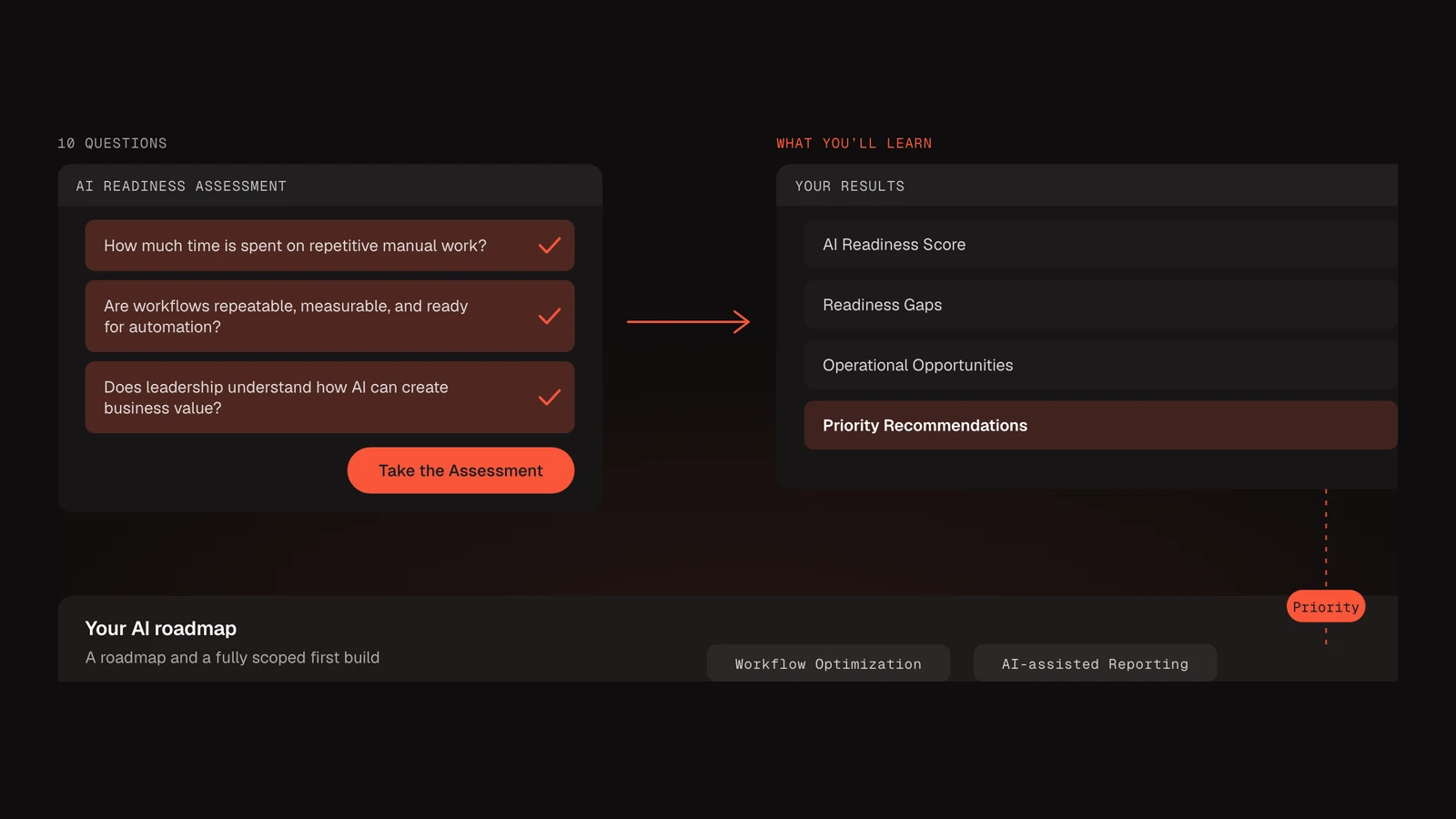
The Gnar Company's AI strategy and fluency page describes its strategy work as stakeholder interviews, process mapping, and five-dimension opportunity scoring across ROI, implementation cost, data readiness, reasoning risk, and behavior-change cost. The engagement produces a strategy, a roadmap, and a fully scoped first build.
If your list is still forming, read how to find AI opportunities in your business processes. To check readiness for the top ideas, read what an AI readiness assessment should cover. To fund the result, read how to build an AI roadmap the board will fund.
Generative AI can help generate and sort early AI ideas, but people still need to review the output and the data privacy risks.
Either way, finish with a short ranked list: each idea tied to a metric, an owner, a baseline, a data check and a place in the sequence. That is what a COO can carry into a budget meeting.