The best first use case for Claude Enterprise is one workflow that runs often, uses material Claude can reach, and is already measured. A wrong answer in it should be cheap and caught by a person before it goes anywhere. To find it, answer four questions in order. Which outcome do you want? Which workflow is broken? Does it sit on a system you plan to replace? Which numbers does the CFO already trust?
This guide is for a COO who has bought Claude seats. That COO now owes the company a first result. It gives you the four questions and a pass or fail checklist for candidate workflows. It also covers one client case where every AI idea was scored the same way.
The Gnar Company is a Claude Select Services Partner. Its enterprise AI integration work connects an AI model, such as Claude, to the systems a company already runs. An ERP and a CRM are examples. The first workflow you pick decides whether that kind of connection is needed at all.
What makes a workflow a good first use case for Claude?#
A good first workflow for Claude passes four tests: it runs often, Claude can reach the material, a wrong answer is cheap and caught, and the result is already counted. These four tests are general engineering advice. A workflow that fails one of them is a weak first pick, however large its upside.
- It runs often. A daily or weekly task gives you many outputs to judge during the pilot. A monthly or quarterly task gives you few.
- Claude can reach the material. The work depends on documents, records or exports. They sit in files or systems Claude can be connected to.
- A wrong answer is cheap and caught. A named person reviews each output before it leaves the team.
- The result is already counted. Someone measures the work today. That gives you a before number to compare against.
Anthropic's guide to deploying Claude Cowork, Anthropic's office agent, says "Good pilot candidates fall into one or a few of these categories." It names four: "High volume, high repetition," "Information-dense synthesis," "Bottleneck-creating work" and "Expertise-dependent but process-driven." The guide describes the last one as "the work only your best people do well today, because they've internalized a process nobody wrote down." It says "This category pays back the most: encode that process in a skill and everyone on the team inherits it."
Anthropic's enterprise AI transformation guide adds a limit on risk. It says to "avoid selecting customer-facing applications or mission-critical processes for initial pilots regardless of their potential value." The same guide suggests starting with "one or two initial projects."
The Anthropic Economic Index report from September 2025 studied Anthropic's first-party API customers. It found that "API customers that use Claude for complex tasks tend to provide Claude with lengthy inputs." The report says "This could represent a barrier to broader enterprise deployment for some important tasks that rely on dispersed context that is not already centralized or digitized."
What should a COO decide before picking a workflow?#
Decide four things in this order: the outcome you want, the workflow and what is wrong with it, whether it sits on a system being replaced, and which numbers the CFO already trusts. Each answer shortens the list of candidates before the next decision. This order is general engineering advice for a first pick.
1. The outcome you want#
Two outcomes fit a first workflow: people doing their own work better, or a process done faster. Each one needs a different first workflow and a different setup. Pick one outcome for the first workflow. Mixing two makes the result hard to read.
2. The workflow and what is wrong with it#
Name the workflow the way a front line employee would, such as "we copy supplier quotes from email into a spreadsheet." Then name what is wrong with it. It may be slow or produce errors. It may wait on one person or cost overtime at month end.
3. Whether it sits on a system being replaced#
Some workflows run on a system the company plans to retire. Claude work built there may be thrown away with that system. Ask this before picking.
4. The numbers the CFO already trusts#
Prefer a workflow whose result already shows up in a report the finance team uses. Invoices processed per week is one example. A number the CFO already trusts needs no debate about how it was measured. A new metric made up for the pilot invites one.
How does each outcome change the first workflow?#
People doing their own work better starts with one team's recurring report or review. A process done faster starts with a step that moves records between systems. The table below lists what each one needs first.
| Outcome | A first workflow that fits | What it needs first |
|---|---|---|
| People doing their own work better | One team's recurring report or review, done with Claude seats | The team's files in reach, and a named reviewer |
| A process done faster | A step that moves records between systems, such as supplier quote intake | A connection to each system, or manual handoffs at first |
For the first outcome, Anthropic's Claude Cowork guide lists starting points by function. It calls each one "a single, real deliverable Claude produces against your actual files and systems." For legal it lists "NDA review and redline against your playbook," measured by "Review turnaround time; queue depth." For sales it lists "Pre-call research and brief generation," measured by "Prep time per call; rep-reported confidence." For marketing it lists "Campaign brief to asset draft against brand guidelines," measured by "Concept-to-review time; rounds of revision."
For the second outcome, Claude has to reach the system where the records live. That can be a connection, or manual handoffs at first. Gnar's integration page gives an example of that reach: "Ask which orders ship this week. AI looks it up in your order system itself."
How do you check candidate workflows?#
Check each candidate workflow against the five tests in the table below. Treat a candidate that fails one of them as a weak first pick. The five are the four tests from the first section plus the old-system question.
| Test | Fails | Passes |
|---|---|---|
| How often it runs | Monthly or less often | Daily or weekly |
| Whether Claude can reach the material | Claude cannot reach it, even through exports or manual handoffs | In files or systems Claude can reach |
| Cost of a wrong answer | A customer or regulator sees it first | Cheap to fix, and a named person reviews it before it leaves the team |
| How the result is measured | No number today | A number someone reports today |
| Tie to a system being replaced | Built on the system being retired | Reads from a system you are keeping |
Counter Culture Coffee's scoring applied a similar idea to data readiness. The Gnar case study says "weak data readiness capped an opportunity's score regardless of its upside."
No candidate list yet? Gnar's guide to finding AI opportunities in your business processes covers the interviews and system maps. They produce one.
How did Gnar rank AI opportunities at Counter Culture Coffee?#
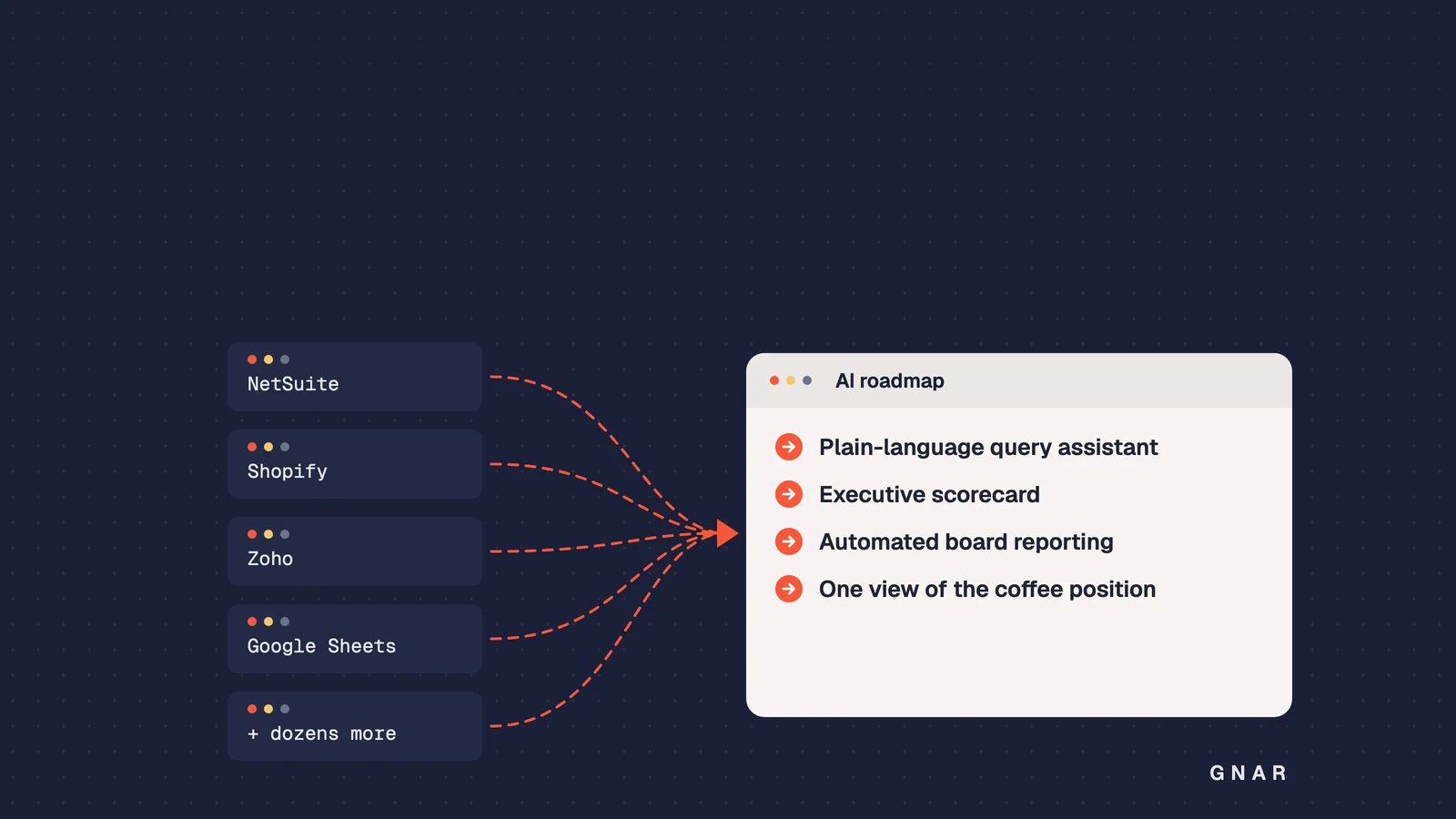
Gnar scored every opportunity at Counter Culture Coffee on the same five dimensions. Then it set the order of the work. The case study describes a specialty coffee roaster that runs NetSuite as "the ERP and system of record."
The work started with people. Gnar ran "15+ interviews with leadership, department heads, and the operators who run the day-to-day." It mapped every system and data flow, with NetSuite at the center. It then catalogued "79 AI and automation opportunities" across seven capability areas. The case study says "Workflow and task automation led with 17, followed by insight generation and analytics (14) and generative content and marketing (13)."
Each opportunity was scored on "financial ROI, operational efficiency gains, implementation complexity, data readiness, and cultural readiness." The case study adds that "Scoring counted only recoverable value." The order of the work came next: "Remove barriers first, then quick wins for internal champions, while The Gnar builds the larger automations."
The process also tested its own assumptions. The case study says "Coffee procurement initially looked like a market-timing opportunity. A full year of contract data showed the team was already managing that well." The recommendation moved to a single view of the coffee position across contracts, importers and warehouses.
The case study puts $1.5M in potential savings across the top 10 initiatives. It also lists "34 projects ready to start and 8 already underway, led by five internal champions from IT, finance, and operations team members using Claude."
For a COO picking one first workflow, the case shows two habits worth copying. Score every candidate on the same tests. Then check the data behind the favorite before you commit to it.
Should the first workflow be part of replacing an old system?#
Pick a first workflow that reads from a system you are keeping. Avoid one built on a system you plan to retire. Claude work built there may be thrown away with that system.
Anthropic's transformation guide warns that "Integration complexity with legacy systems frequently exceeds initial estimates." It suggests "starting with manual handoffs between AI and existing systems if necessary, then automating connections as you prove value."
A connection that only reads is the smaller first step. Gnar's integration page describes this option: "We give the AI a connector that only allows lookups, called a read-only MCP server." MCP stands for Model Context Protocol. The page calls it "an open standard for connecting AI to software." When changes are needed, the page says "Every change passes one checkpoint you control, which checks permission first."
The Counter Culture case states a related rule for data that several systems share: "master data is edited only in its system of record, and every other system reads from there." A first Claude workflow that only reads from the system of record fits that rule.
Which numbers should judge the first workflow?#
Judge the first workflow on numbers that existed before the pilot and stay measured the same way during it. Record the before number before the pilot starts. Anthropic's Claude Cowork guide says to "Define success before you start among relevant stakeholders."
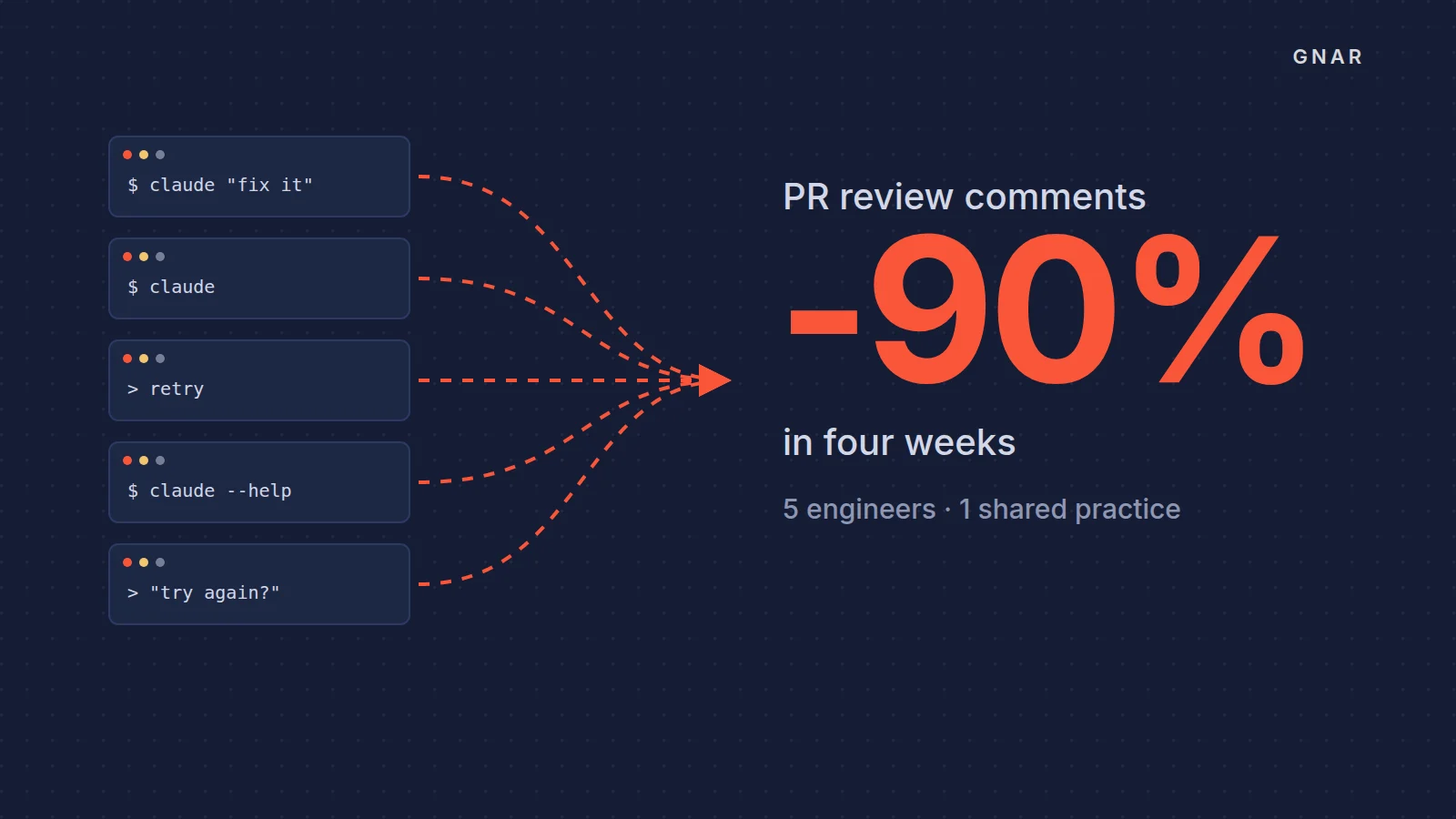
A measure nobody changed is the hardest to argue with. The GSC Enterprises case study used one. GSC is the wholesale distributor behind Grocery Supply Company. Gnar ran a four-week Gnar Immerse cohort for GSC's five engineers, using Claude Code on their own production code.
GSC already ran "an independent code review agent against every pull request." Over the four weeks, pull requests with review-agent comments "went from roughly 100% to less than 10%." The case study notes the tool itself did not change. After the cohort, the participants ran an internal AI training for 70 GSC leaders.
That case covers one engineering team's four-week cohort. The lesson for a first workflow is narrower: the measure was already running before the cohort started.
Where does outside help fit in picking the first workflow?#
Outside help fits when the candidate list is long or nobody can say whether the data is ready. It also fits when nobody inside can build the ERP or CRM connection. Otherwise, your own team may be the right one to do it. Gnar's integration page says so directly: "If your own engineers have the capacity and the direction, do it internally."
Some companies want a score of where they stand first. Gnar's free AI Readiness Assessment asks 10 questions about operations, workflows, technology and team readiness.
When outside help is the answer, the first paid step is Gnar Discovery and Design. Gnar's AI consulting page describes that step this way: "We rank where AI pays off and design the first build. You keep the fixed-price plan either way." Gnar's enterprise AI integration page says: "Start with Gnar Discovery and Design, from two weeks and $15,000. You leave with a build plan that has a fixed price on it."