Does AI reduce software development costs? Yes for the part where code gets typed, and far less for the whole project, because typing code was never most of the bill. This post is for a CEO or COO holding a custom software quote who has read that AI now writes most of the code and wonders whether the number should be lower.
The Gnar Company, a custom software firm, publishes its prices: Discovery at $20,000 for four weeks or $30,000 for six, and builds that typically cost $150K to $300K+. If you are comparing that kind of quote, our custom software builds run on a fixed milestone price agreed before the work starts.
The question matters because it sets how you negotiate. Push for a flat discount and you may get a thinner team. Ask where AI sits in the price and you learn what you are buying.
Below, we look at what the research measured, where the money in a custom build goes, why faster code does not always shrink the bill, and what to ask a vendor.
Does AI cut the cost of software development?#
AI lowers the cost of writing code and leaves most other costs alone. A custom build also pays for learning your operation, making decisions, connecting to systems you keep, testing against real data and supporting the result. Expect the quote to change by less than the code-writing speedup suggests, and ask the vendor to show where it changed.
Two studies mark the two ends of the range. In a 2023 controlled experiment, developers asked to implement an HTTP server in JavaScript finished 55.8% faster with GitHub Copilot than the control group. The 95% confidence interval ran from 21 to 89%, so even that study shows a wide spread.
A different design gave a different answer. METR ran a randomized trial with 16 experienced open-source developers working on 246 real issues in their own repositories. With AI tools allowed, they took 19% longer. METR itself says those results are out of date.
The gap between the two is the point. A scoped task with a clear target is where AI helps most. Real work in a large, old codebase, with unwritten rules, is where it helps least. Most custom builds sit closer to the second case than the first.
So the decision rule is simple. If a vendor says AI cuts your price in half, ask which tasks, measured how, on whose code. If a vendor says AI changes nothing, ask the same questions. Both claims need evidence.
Real numbers from the research#
Six sources speak to this question, and they measure different things. One times a single task, one times real repositories, one surveys developers about trust, one studies organizations, and one asks whether the gains reach the budget. Read them together and the pattern is consistent: speed on code is real, savings on the project are not automatic.
| Source | What it measured | Result | What it means for a buyer |
|---|---|---|---|
| Copilot experiment, 2023 | One scoped task, an HTTP server in JavaScript | 55.8% faster with Copilot (95% CI 21 to 89%) | Clear, bounded tasks speed up. Your system is probably not that. |
| METR, July 2025 | 16 experienced developers, 246 real issues | 19% longer with AI tools allowed | In real repositories the result can reverse. METR calls it out of date. |
| METR update, Feb 2026 | Follow-up study | Estimated speedup of negative 18% for returning developers and negative 4% for new ones | METR says selection effects make the data unreliable. Treat it as unsettled. |
| Stack Overflow survey, 2025 | Developer attitudes | 84% use or plan to use AI. 66% cite answers that are almost right, but not quite. | Review time is a real cost. |
| DORA, 2025 | Organizations using AI | AI acts as an amplifier of existing strengths and weaknesses | The team and process decide the result. |
| Gartner, April 2026 | Software engineering leaders | They improve delivery performance but struggle to convert gains into cost savings | Speed does not reach the invoice on its own. |
Where the money in a custom build goes#
A custom build spends money on eight things: understanding your operation, decisions, building, integration with systems you keep, data, testing, review and deployment, and support after launch. AI speeds the building step the most. It helps less on the others, because they depend on people knowing your business.
This list is general engineering judgment and is no Gnar cost split. No percentages are given because none are published. Here is how AI touches each line.
- Understanding the operation. Someone has to learn how your orders, claims or shipments really move, including the workarounds. AI can summarize documents. It cannot sit with your dispatcher.
- Decisions. Which cases the software handles, which it hands to a person, and who approves exceptions. These are your calls, and they take meetings.
- Building. This is where AI helps most, on routine tasks and repetitive tasks such as boilerplate. Code that used to take a day to type takes less, and AI coding tools can offer code suggestions and draft documentation updates while the work is being built.
- Integration. Your software has to talk to the ERP, the carrier portal or the accounting system you are keeping. Each has its own quirks, and failures show up at the seams.
- Data. Real data has gaps, duplicates and old formats. Testing with clean sample data hides all of that.
- Testing. A test is only as good as the cases someone thought of, and those come from knowing the operation. Automated testing helps catch bugs earlier, when they are cheaper to fix than after launch.
- Review. Every line of generated code still needs code review and human judgment, especially on security-sensitive changes, before a person can say it is right.
- Deployment and support. Hosting, monitoring, fixes and the person who answers when something breaks. Maintenance costs continue after launch and are a real part of the software lifecycle.
Gnar's approved line on this is plain: "Producing code is close to free now. Understanding your operation is not." That is why a cheaper way to type code does not give you a proportionally cheaper system.
Offshore quotes follow the same logic. The reason to go offshore was cheap code production, and code production is nearly free now. What you are paying the premium for is the communication, and that is the part that decides whether the thing you get is the thing you asked for.
The hidden costs behind faster code#
Faster code can leave the bill the same for three reasons: someone has to verify what the AI wrote, teams tend to fill the time they save with more work, and savings in one step do not automatically become savings on an invoice. Gartner describes the third problem directly.
Start with verification. In the Stack Overflow 2025 Developer Survey, 66% of respondents cited "AI solutions that are almost right, but not quite" as a frustration, and 45% said debugging AI-generated code is more time-consuming. Code that is almost right costs more to review than code that is plainly wrong, because the mistake hides.
The same survey shows how much trust the tools have earned: 46% of developers distrust AI accuracy and 33% trust it. It also found that 69% do not plan to use AI for project planning. Developers use AI for typing and keep the planning for people, which matches the cost list above.
Next, volume. When a team can write code faster, the backlog grows to fit. A vendor who saves two days on a module may spend them on the next module you asked for. That is good for your product. It is not a lower invoice.
Then the conversion problem. Gartner reported in April 2026 that software engineering leaders are using AI to improve operational performance in the delivery life cycle, but struggle to convert those gains into cost savings. Its abstract offers three cost levers to turn AI efficiency gains into demonstrable financial impact, which tells you the savings take deliberate work. If the leaders running these teams cannot turn the speedup into a smaller budget, a buyer should not assume a vendor can do it by default.
As general advice, also count the AI costs themselves, such as tool subscriptions and licensing fees, and track those line items in the budget before deciding the savings are real.
A worked example makes this concrete. Say a quote is $200,000. Suppose a vendor tells you AI made the code-writing portion much cheaper. You still owe the learning, the decisions, the integration, the testing, the review and the support. If the vendor charges time and materials, the saved hours may be spent on extra scope. If the vendor charges a fixed price, the savings stay with the vendor unless you ask for them in the terms. That leads to the next question.
Common pitfalls with AI coding tools#
The common pitfalls with AI coding tools are code nobody reviewed, security gaps, and quality that differs from what the team would have written by hand. Each one turns a saving on day one into a cost later. A buyer can ask about all three before the project starts.
George Manuelian, chief strategist at software security vendor RapidFort, described the first two to CIO.com: "We're seeing teams ship AI-generated code that pulls in outdated or vulnerable open-source libraries, and code that works functionally, but wouldn't pass a proper security review." He added that "the volume of unverified code entering production is also rising." His advice to customers was to expect better software, which he spelled out as fewer defects, faster turnaround on requests, and stronger security built into the product.
Developers share the worry. In the Stack Overflow 2025 survey, 87% of all respondents said they are concerned about the accuracy of AI agents, and 81% said they have concerns about the security and privacy of data. If your system holds customer records, pricing or claims, data privacy belongs on the vendor checklist.
Quality can shift too. In METR's February 2026 update, some developers said the quality of the final work for a given task was different between the AI-allowed and AI-disallowed conditions. Speed numbers alone do not show that.
As general engineering judgment, code that works today but that nobody on the team understands becomes technical debt. It costs little to write and a lot to change in year two. Ask who will own each part of the code after launch, and whether they read it before it shipped.
Should my build quote be lower because of AI?#
Probably not by a fixed percentage, and a flat discount request often goes nowhere. A better request is for terms that show the value: a fixed price, outcome commitments, flexible scope or a warranty. Those are things a vendor can offer when AI makes its own delivery more predictable.
The CIO.com reporting backs this up. Enterprises contracting software firms have started to ask what is in it for them. According to some studies, developers increased output by up to 40% with AI coding assistants. Even so, the article says CIOs should not hold their breath waiting for price drops from outside software engineering firms. Yoni Michael, quoted there, expects the value to show up first in commercial flexibility, bundling, faster services delivery and outcome-based commitments.
Read that as a buyer. The vendor's savings, if there are any, are more likely to appear as a better contract than a lower number. A flat discount is easy to give and easy to take back through a thinner team, fewer tests or a longer schedule.
Before you push on price, sort out which problem you have. Gnar's approved answer to "it costs too much" is this: "Then say which one you mean. A cheaper bid is a different problem from no budget, and only one of them is about our price."
If you have no budget, ask the vendor to scope a smaller first step. If you have a cheaper bid in hand, compare what each bid includes. Ask the cheaper vendor who reviews the code, what happens when the work runs over, and what the warranty covers. A lower number with none of those answers buys a different product.
Questions to ask a vendor about AI and price#
Ask six questions: where AI is used, who reviews its output, what price is fixed, who pays for overruns, what the warranty covers, and who owns the code. A vendor who answers all six in writing has told you how the quote is built. A vendor who avoids them has told you something too.
This is a general buyer's checklist. It does not describe any one firm's process.
- Where is AI used in this project? Ask for the steps by name: planning, coding, tests, documentation, testing and deployment. "Everywhere" is no answer.
- Who handles code review of AI-generated code before it ships? Ask for a named engineer.
- What in this quote is a fixed price? Ask which milestones are fixed and which are estimates.
- Who pays when the work runs over? If the answer is "we will discuss it," the risk is yours.
- What does the warranty cover, and for how long? Ask for the written text.
- Who owns the code, and can we get repository access during the project? You should be able to read what you are paying for.
Also ask which parts of the development process use automation and which still rely on a senior engineer's review.
How Gnar uses AI in a fixed-price build#
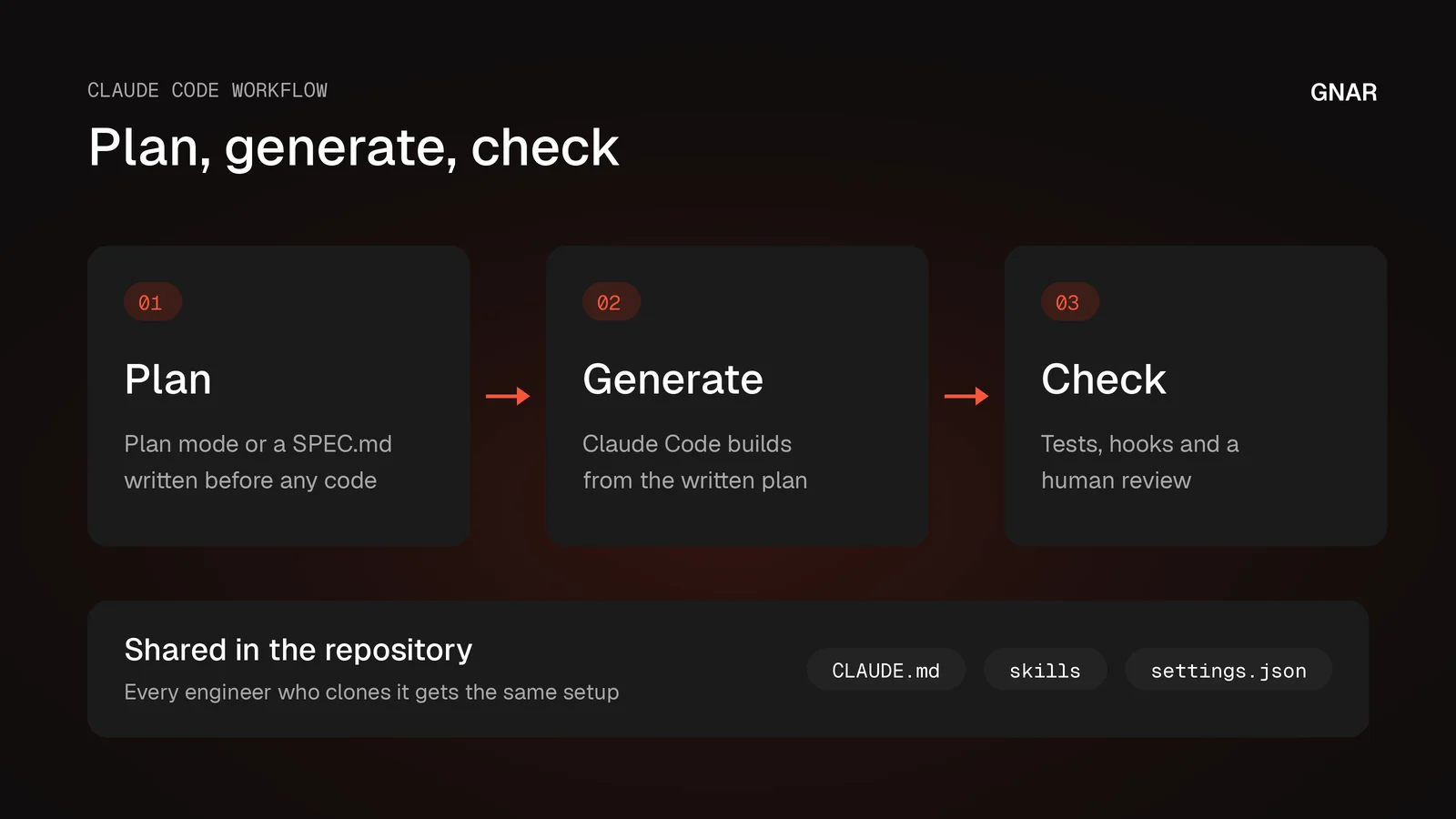
Gnar uses AI to write code and keeps people responsible for the plan and the checks. Its careers page describes the method: "First the engineers write down the context: a clear plan for the software. Then AI agents write code from that plan. Then the engineers check every result before it ships." The team calls it Context-Driven Development.
Notice where the human work sits. The plan comes first and a person checks every result at the end. AI sits in the middle. That order matches the cost list above: understanding the operation and review stay with people, while code production, the cheap part, goes to the agents. For a closer look at the method, read our post on Context-Driven Development. For the day-to-day tooling, see how Gnar engineers use Claude Code.
The price terms are published. Discovery and Design is an upfront investment of $20,000 for four weeks or $30,000 for six weeks, and it ends in a costed build plan. Builds typically cost $150K to $300K+. You can read both numbers on the Discovery page. Gnar's approved guarantee wording reads: "Three commitments on every build engagement: a fixed milestone price with any overage on us, a guaranteed outcome meaning the software works as specified or we fix it, and a twelve-month bug-free warranty. It covers Discovery, Build, Forge and Maintain. It does not cover Embed. On Compass, Immerse and Integrate, ask us."
Read that against the checklist. A fixed milestone price answers question three. Any overage on us answers question four. The twelve-month warranty answers question five. You can ask any vendor for the same three things, and you should.
Discovery also protects you from the discount trap. Gnar's answer to whether you have to build with it is no: start with a discovery sprint that ends in a guaranteed price, whether or not you build with Gnar. You take the plan and the price to any other vendor and compare. If another firm gives a lower fixed price for the same plan, you have a real data point. The published work is on the case studies page, where each project carries the client's name.
Can we just build it ourselves with AI tools?#
Yes, when your engineers have the capacity and a clear written plan, building in house with AI tools is a sound choice. If your team is already full, AI tools will not create capacity. They will make the same overloaded team produce more code that still needs review. Low-code and no-code tools can help in some cases, but they do not remove the need for capacity and review either.
Gnar's approved answer to "we have people for this" is direct: "Often you should use them. If your own engineers have the capacity and the direction, do it internally and we will say so on the call."
The DORA 2025 report explains why the answer depends on your team. It describes AI's primary role as an amplifier that magnifies an organization's existing strengths and weaknesses, and it finds the greatest returns come from a focus on the underlying organizational system. A team with clear plans, good tests and fast review gets more from AI. A team with unclear requirements and slow review gets more confusion, faster.
Use four checks before you decide.
- Capacity. Do the engineers have open time, or would this pull them off work that already matters?
- Direction. Is there a written plan someone can hand to an engineer, or only a goal?
- Review. Who reads the AI-written code, and do they have time to do it well?
- Support. Who gets the call when the system breaks at 6 a.m. in month eight?
If you can answer all four with names, build in house. If two or more come back blank, the gap is a plan and a team, and that is what a Discovery engagement produces.