Yes, your own team can run a Claude rollout for its pilot teams without a partner, if the right people inside have the time. Claude Enterprise has the admin controls, and Anthropic publishes the guides a first rollout needs. The harder test is the teams that come after the pilot. Three jobs decide whether it works: the security review, spend controls and getting people to use Claude.
The Gnar Company is a Claude Select Services Partner in Anthropic's Claude Partner Network. Gnar's enterprise AI integration page describes its Claude integration work in one line: "Enterprise AI integration connects an AI model, such as Claude, to the systems your company already runs." When a buyer tells Gnar they have people for the work, the answer is: "Often you should use them. If your own engineers have the capacity and the direction, do it internally and we will say so on the call."
This post is for a CIO deciding whether internal staff can run a Claude Enterprise rollout. It names each job, who inside the company can own it, and what a partner should leave behind if you hire one. Where a sentence is not credited to a source, it is general engineering advice.
Can your own team roll out Claude without a partner?#
Yes, for the pilot teams, when three people exist inside your company. You need an owner with hours set aside, an admin who can set roles and spend limits, and someone who can answer your security reviewer. If one of the three is missing, scope outside help to that one gap.
Pilot teams are groups you choose. Anthropic's Cowork guide suggests picking "teams with a motivated lead who's already experimenting with AI." It says "They'll surface the real use cases faster than a top-down mandate will." Later teams may not share that interest, and that is where an in-house rollout gets tested.
So the question to settle first is about people. Does your company have the three roles, with time, through the pilot and the first wave after it? If yes, start in house. If the answer is no for one role, hire for that role's work and keep the rest.
What does Anthropic give an internal team to work from?#
Anthropic gives an internal team five public resources to work from. They are an administrator guide, a consumption guide for spend, a deployment guide, self-paced courses and developer docs for custom connectors. All five are public pages that anyone on your team can read today.
| Resource | What it covers | Who uses it |
|---|---|---|
| Claude Enterprise administrator guide | Four deployment phases, from technical setup to scaling adoption, plus a resource directory | Your Claude admin |
| Claude Enterprise consumption guide | The levers to control and optimize token consumption | Your admin, with finance |
| Deploying Claude across your organization | First use cases, the security review, champion pilots and adoption phases | The rollout owner |
| Claude Academy | Self-paced courses on prompt engineering and other Claude topics | Everyone with a seat |
| Building connectors | How developers build a remote MCP server for Claude | Your engineers |
Anthropic's administrator guide says it "walks you through the four phases of a successful Claude Enterprise deployment: Technical Setup, Change Management & Launch, Enablement & Training, and Scaling Adoption." It also holds a directory of "support, training, and enablement resources for Claude Enterprise administrators and end users." It links help articles on identity, roles, usage analytics, audit logs, data retention and connectors. It lists Claude Academy for "Self-paced courses on prompt engineering" and other Claude topics.
The consumption guide says it "walks Enterprise admins through the key levers available to control and optimize token consumption." The deployment guide is written around Claude Cowork, which Anthropic groups with "office agents", and has chapters on getting started and on adoption at scale.
These pages cover the settings and the steps. They do not decide who owns each job inside your company. That is the part an internal team has to settle for itself.
Which three jobs decide whether an in-house rollout works?#
Three jobs decide whether an in-house rollout works, from the pilot onward: the security review, spend controls and getting people to use Claude. Each one needs a decision from someone with their own authority: the security team, finance or a department head.
- The security review belongs to your security team. They decide whether Claude may touch company data, and on what terms.
- Spend controls belong to your Claude admin and finance. The admin sets the limits, and finance sets the budget behind them.
- Getting people to use Claude belongs to team leads and department heads. They decide whether Claude becomes part of the work or stays an extra tab.
A partner can help with each one. None of the three can be handed to a partner for good, because each needs someone with authority inside your company. The next three sections take them in turn.
Who answers the security reviewer?#
As general advice, someone in IT who knows your plan and your connectors answers the security reviewer, working with the Claude admin. Anthropic puts that review before the pilot. Its guide to getting started with Claude Cowork says: "Before you pilot, run the security review."
The same guide names what the reviewer will want. It says your security team will want to understand "the data boundaries, the connector permission model, and the auditability options." It adds: "Get this done before users are waiting on it."
The administrator guide points to the Anthropic Trust Center for "Certifications (SOC 2 Type II, CSA STAR), pen test reports, and compliance documentation". That person can collect that material for the reviewer before the first meeting.
What an in-house team needs is a person who can answer those three questions for your plan and your connectors. That person also needs the authority to change a setting when the reviewer says no. Gnar's guide to getting Claude Enterprise through a security review lists the documents to send the security reviewer before the first meeting and who answers each question.
Who sets spend limits, and at what level?#
Your Claude admin sets spend limits, and Anthropic's consumption guide calls them "your primary tool for controlling consumption." It lists the levels in one sentence: "Claude Enterprise lets admins set limits at three levels: the organization level, the group level (with RBAC), and the individual user level, plus optional pooled budgets that give a group one shared monthly amount."
The consumption guide says "Claude Enterprise is priced on a per-seat, usage-based model," while the administrator guide also lists legacy seat-based plans. The consumption guide adds that "Your org's consumption pool is shared across all users." RBAC is role-based access control. The guide says it lets you "group users and manage their access to Claude surfaces and consumption budgets as a unit rather than individual by individual."
Three lines from the guide tell an admin what to do:
- Start below the organization level. "Our recommended approach is to start with RBAC group-level limits and per-user limits". The guide warns that hitting the organization limit "affects everyone simultaneously, which can be disruptive."
- Add the heavier products in waves. "Giving everyone Claude Code and Cowork access on day one is the fastest way to generate unexpected consumption."
- Review on a schedule. "Review group consumption weekly during initial rollout, monthly thereafter."
An admin who has read the guide can do all three. The number for each group is a different job. It is a budget decision for finance and the department head, so get it in writing before launch.
Who gets people to use Claude after launch?#
People inside your company get others to use Claude: champion teams first, then a named person in each department. Anthropic's chapter on driving adoption at scale opens with this line: "Deploying the technology is the easy part; getting an organization to actually use it is much harder."
The Cowork guide says to "Pilot with two or three champion teams rather than one." It gives the reason: "A single team gives you one data point, but a handful gives you enough to separate the pattern from the team."
The adoption chapter gives a measure for the pilot. It says: "Track how many champion-authored skills exist at the end of the pilot; it's the leading indicator for the scale phase." A skill, in Anthropic's terms, is a reusable set of instructions that teaches Claude a workflow. The chapter sums up its approach as "bottom-up discovery, top-down scale."
The consumption guide adds a role for each department. It suggests a "group owner" in each department, "responsible for reviewing usage and fielding questions from their team." It notes that this person does not need to be an Owner or Admin.
This is the job most worth keeping inside. A partner can run the first sessions. The people who answer questions in month four should work for you.
Checklist: can you run the rollout in house?#
You can run the rollout in house when the people-and-hours questions below come back yes. Answer them in order, since most questions answered no mark one job to staff or to hire for.
- Is one named owner given hours for the rollout, written into their goals?
- Can your Claude admin create groups, assign roles and set group and per-user spend limits?
- Has finance set a monthly budget for each group?
- Can someone inside answer your security team on data boundaries, connector permissions and audit options?
- Does each pilot team have a lead who already uses AI and will run sessions for the team?
- Is there a person in each department who reviews usage and answers questions?
- Is there a written measure for the pilot, agreed before it starts? The Cowork guide says to "Define success before you start among relevant stakeholders."
- Do the first use cases run only on pre-built connectors?
- If they need a custom connector, do your engineers have the hours to build it, host it and support it?
A no on questions 1 to 7 is a people gap. Outside help can cover it for a while, but someone inside has to own it afterwards. A no on question 8 sends you to question 9, and a yes on question 8 means question 9 does not apply. A no on question 9 is an engineering gap, and that work can be built by a partner and handed back.
Which parts need engineering your team may not have?#
Custom connectors are the part of a Claude rollout most likely to need engineers, because each one is software that someone has to host and support. Anthropic's connector docs say "An MCP server gives Claude access to your product or data, and people who use Claude see it as a connector."
MCP is the Model Context Protocol. Its own docs define it as "an open-source standard for connecting AI applications to external systems." Anthropic's connector page says "This page is for developers building a remote MCP server for other people to use in Claude." It also says "A remote server runs on infrastructure you host and is reachable over the internet," and tells developers to "Decide on authentication before you write tool code."
Not every rollout needs one. The administrator guide lists pre-built connectors for Google Drive, GitHub and Microsoft 365, and links a full list of pre-built web connectors. A first rollout that stays on connectors from that list does not need custom code. An order system, a CRM with its own permissions or a homegrown database needs a custom connector when no pre-built one exists.
Anthropic has its own view on partners, and it runs the partner program. Its June 3, 2026 announcement of the Services Track and Partner Hub says "a successful pilot is not the same as a system a business can run on." It goes on: "That's why the companies getting AI integration right are doing it with partners who have done it before."
That build is what Gnar's enterprise AI integration work covers. The page says "Most connections are small programs called MCP servers. Each lets AI use one system, only in the ways you allow." It describes the last step this way: "Before launch, your security team gets the access rules and the request log to review. Then your team runs it, or we keep it working on Maintain, our monthly support plan."
For a connector you cannot staff, the first step is a plan with a price on it. The page puts it this way: "Start with Gnar Discovery and Design, from two weeks and $15,000. You leave with a build plan that has a fixed price on it." The Discovery page lists the three tiers and their prices.
What should a partner hand back?#
A partner should hand back the setup it built and people inside who can run it. Your own champions run training and answer questions, and the partner steps back to backup. Write that end state into the contract before the work starts.
Gnar's Claude partner page states its own version of the handover: "Your team runs it after we leave. Configurations, evals and runbooks are handed over. If your engineers can't operate it without us, we haven't finished." The page offers two ways in. Option A is "We train your existing team." Option B is "We do all the heavy lifting for you."
Ask for these at the end of any partner engagement:
- The admin settings written down: groups, roles, spend limits and who approves increases.
- The answers your security team accepted, with the date and the plan they apply to.
- For each custom connector, the code in your own repository, what it can read and change, and who supports it.
- A training plan your champions run without the partner in the room.
- A named person in each department who answers questions.
The consumption guide adds one item for the approver list. When a member hits a limit, they can send a "Request more usage" request to admins. The guide says to "Tell users who their approver is and your expected turnaround."
Then test the handover before the engagement ends. Ask the partner to sit out one training session and one week of questions. If your people run both without calling the partner, the handover is done.
What did GSC Enterprises' engineers do after the cohort?#
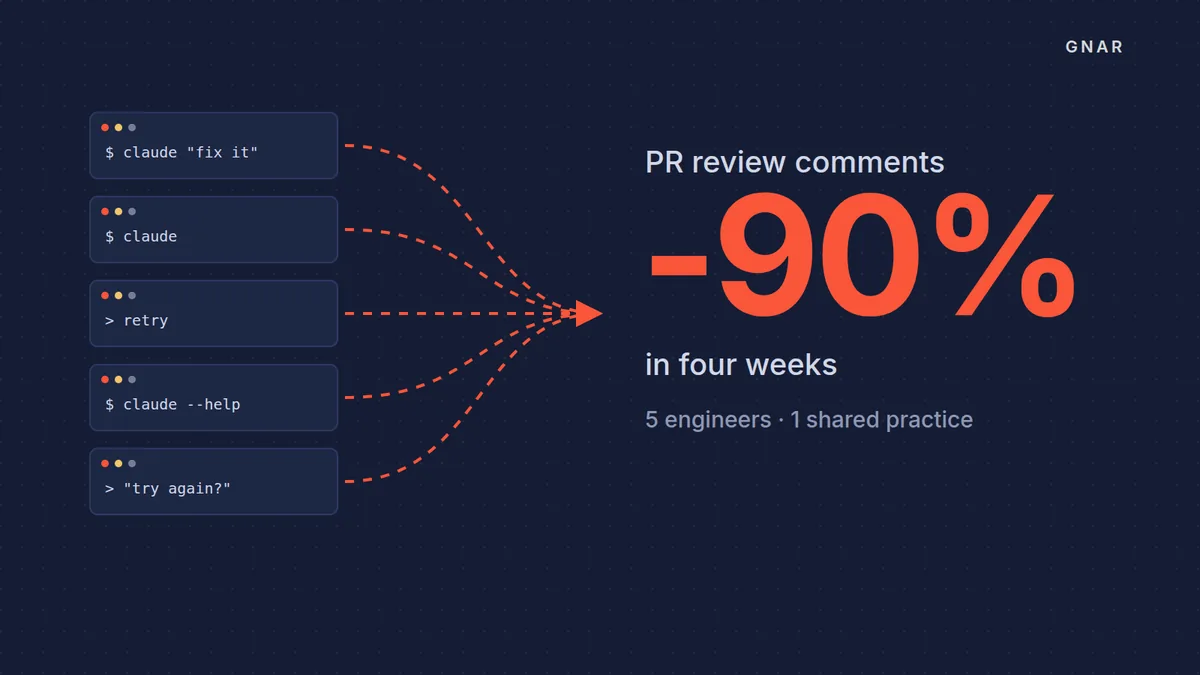
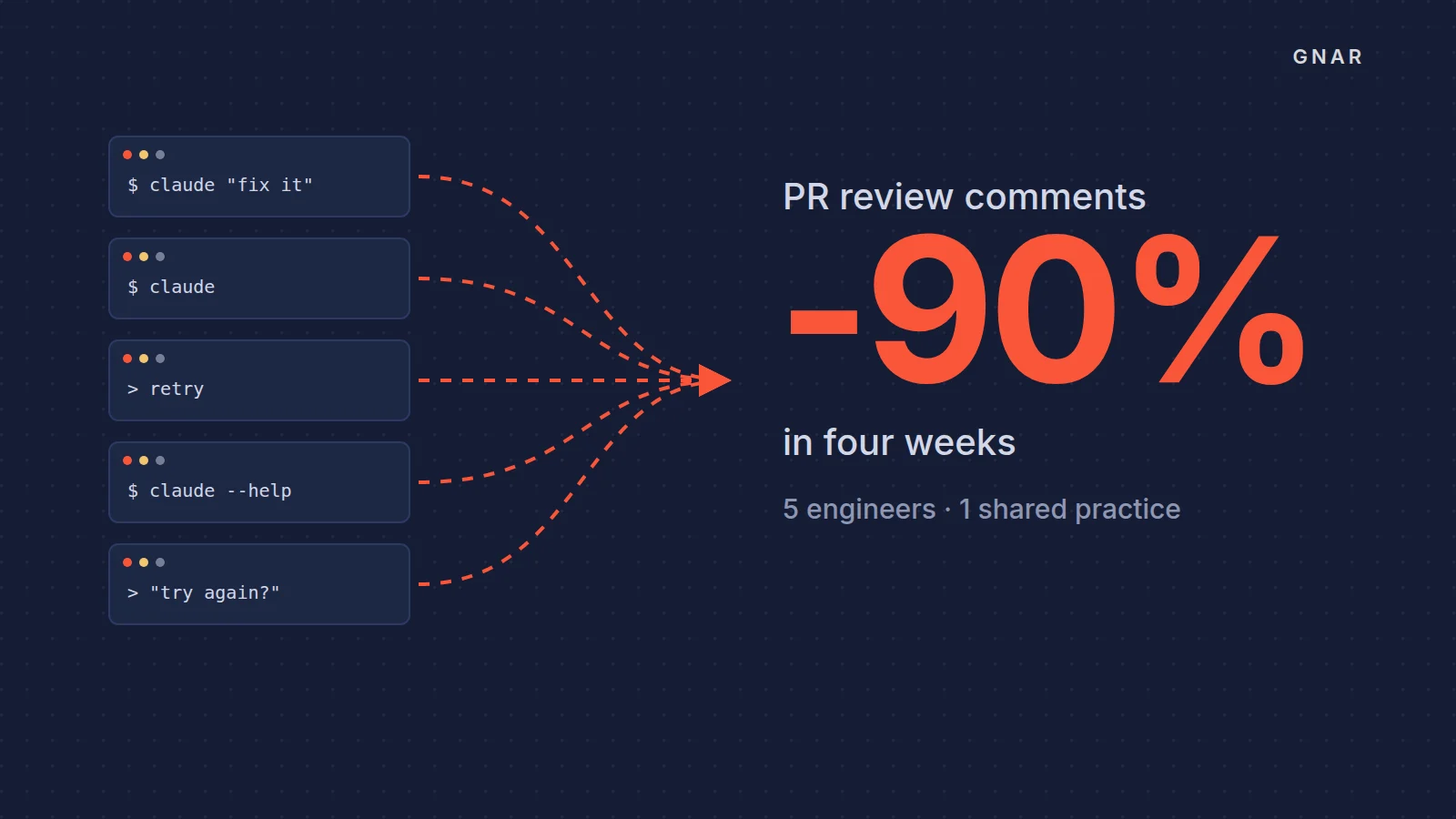
After a four-week Claude Code cohort, GSC Enterprises' five engineers ran an internal AI training for 70 GSC leaders. It is one example of people inside a company running AI training themselves after an outside program ended.
The GSC Enterprises case study says GSC, "the wholesale distributor behind Grocery Supply Company, had already put Claude Code in the hands of its engineering team." What it lacked, the case says, was "a shared way of working with it."
The case gives two reasons it was hard for the team to fix from the inside. "Two things made this hard to fix from the inside. The team was under active delivery pressure, with no slack in the schedule to experiment. And their stack is not the one most AI enablement content is written for." That stack included "a custom-built ERP on Node.js and AWS, integrations with LANSA on IBM i and DB2, and analytics in Snowflake."
A single senior Gnar mentor ran the cohort over four weeks, on GSC's own production code. The case says it fit inside a normal workweek, "roughly five to six hours per engineer". It says "Every participant left with a merged change in their own codebase, a maintained context file, at least one reusable skill, and a workflow they can describe." Then: "After the cohort wrapped, the participants ran an internal AI training for 70 GSC leaders."
The case covers one engineering team of five and the training they ran afterwards. It is proof for a Claude Code cohort. It does not describe a Claude Enterprise rollout, a security review or spend limits. Its two reasons, delivery pressure and an unusual stack, are worth checking against your own team before you decide.
How do you split the work if you hire help for part of it?#
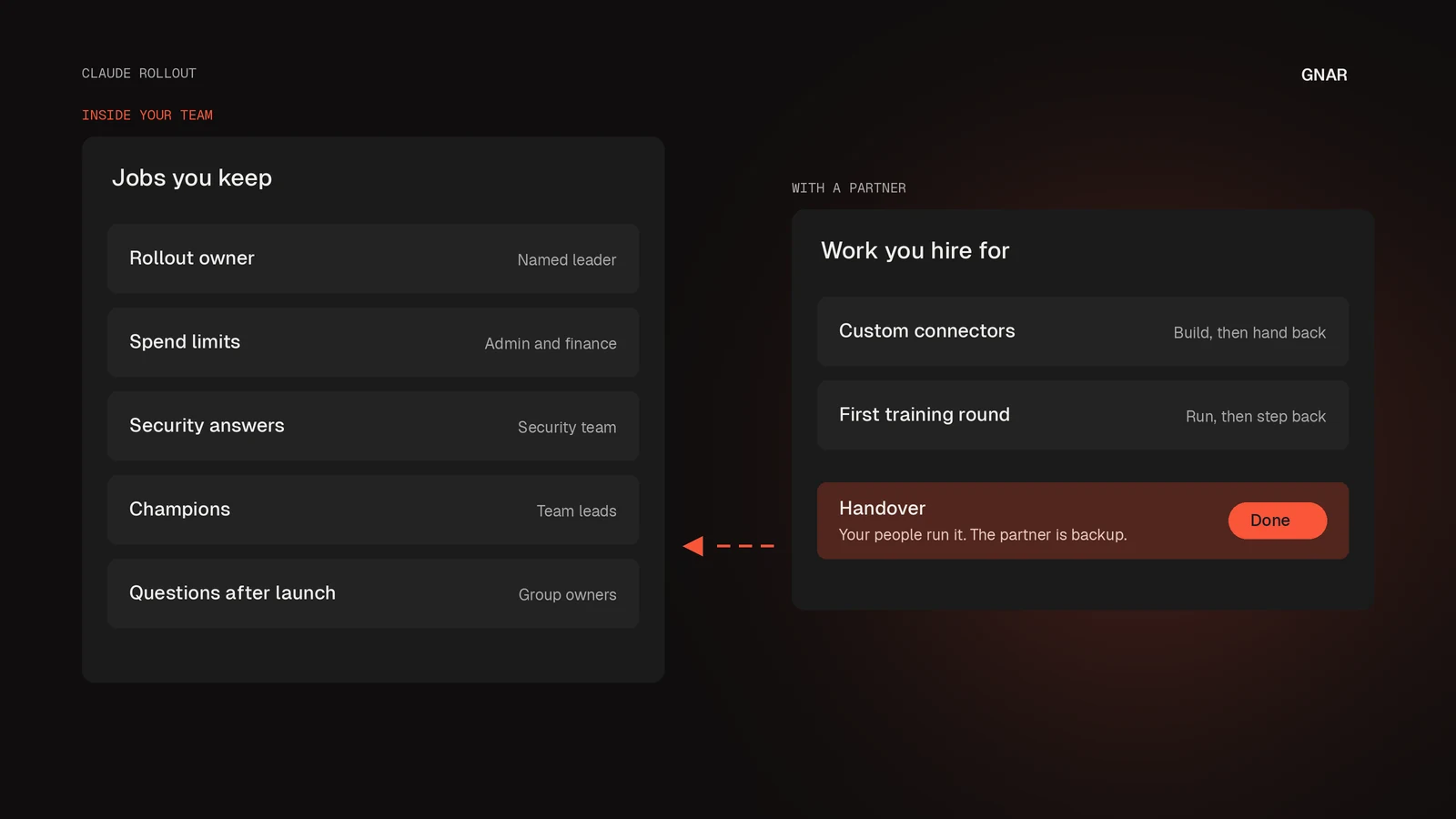
Keep the jobs that must last inside your company, and hire help for skills you will not need again soon. Your people should own the rollout, the budget, the security answers and the champions. Outside help fits best on custom connectors and on the first round of training.
| Job | Who should own it | Where outside help fits |
|---|---|---|
| Running the rollout | A named leader inside | Planning support, if asked |
| Admin settings and spend limits | Your Claude admin, with finance | A review of groups and limits before launch |
| Security review answers | The person named to answer the reviewer, with the Claude admin and the security team deciding | Preparing the documents for the first meeting |
| Champions and training | Team leads in each pilot team | Running the first sessions, then stepping back |
| Custom connectors | Your engineers, if they have hours | Building one and handing it back |
| Questions after launch | A group owner in each department | Backup only |
Read the table row by row against the checklist above. In the GSC case above, the engineers "ran an internal AI training for 70 GSC leaders" after the cohort. A row where your people have the hours stays inside. A row where they do not becomes the scope you put in front of a partner, with the handover written in.