The best Anthropic consulting firm for a mid-market Claude rollout is one that Anthropic lists in its own service partner directory, at a tier you understand, with people on your project who hold a current Claude certification. As of November 14, 2026, that directory lists 354 partners: 17 Global Premier, 42 Preferred and 295 Select.
This post explains what each tier requires and profiles nine firms from the directory, three from each tier. It ends with the questions to send before you sign. It is written for a CIO whose company already bought Claude seats and now wants them used on real work.
The Gnar Company is a Claude Select Services Partner, listed at the Select tier in that same directory. Its enterprise AI integration work connects AI models such as Claude to the ERP, CRM and databases a company already runs.
Gnar is one of the nine firms below. Every other entry quotes Anthropic's directory or Anthropic's own announcements as they read on November 14, 2026. Nobody on the list is ranked.
Where is Anthropic's own list of Claude consulting firms?#
Anthropic publishes the list on claude.com, as the service partners page of the Claude Marketplace. Its headline reads, "Bring in certified experts to roll Claude out across your entire organization." As of November 14, 2026, the page shows 17 Global Premier partners, 42 Preferred partners and 295 Select partners, 354 in all.
Each entry carries a tier and a short description, and nearly every one links to a profile page on partnerhub.claude.com. The directory filters by partner tier, customer size served, services offered, Anthropic products, deployment surface, engagement type, industry, office locations and budget.
The directory grew out of the Claude Partner Network. Anthropic launched the network on March 12, 2026 with an initial $100 million commitment for training courses, dedicated technical support and joint market development. That post said, "Qualified partners will also be added to our Services Partner Directory, where enterprise buyers can find firms with Claude implementation experience."
The same post said any organization bringing Claude to market is eligible to join, and that membership is free of charge. Anthropic's June 3, 2026 post says new applicants start at Registered, the program's entry level, and that partnership begins at Select.
What does each Claude partner tier require?#
Anthropic's June 3, 2026 Services Track announcement sets three tiers. Each is measured on three counts: certified people, customers running Claude in production and public customer stories. Select needs at least 10, 2 and 1. Preferred needs at least 100, 15 and 3. Global Premier needs at least 1,000, 100 and 15, plus a joint business plan with named executive sponsors.
| Tier | What Anthropic requires | What it tells a buyer |
|---|---|---|
| Select | At least 10 active certified individuals, at least 2 joint customers deployed in production in the trailing 12 months, and at least 1 public customer story | The firm took at least two customers live on Claude in the past 12 months, and at least one customer went on record |
| Preferred | At least 100 active certified individuals, at least 15 deployed joint customers, and at least 3 public stories | A bigger certified bench and more customers in production |
| Global Premier | At least 1,000 active certified individuals, at least 100 deployed joint customers across three or more regions, at least 15 public customer stories, and a joint business plan with named executive sponsors | Customers in production across three or more regions, and a business plan agreed jointly, with named executive sponsors |
Anthropic defines the people count as "How many of the firm's people hold a current Anthropic certification and have used Claude in the past 90 days." The first certification, Claude Certified Architect, Foundations, is described in the March post as "a technical exam for solution architects building production applications with Claude."
Standing is checked on a schedule. The June post says, "we verify standing every quarter," and that each firm's dashboard shows the same numbers Anthropic sees. Promotions are processed twice a year, on January 1 and July 1, with an additional review on October 1, 2026, in this first year.
The same post says a firm moves down only at the annual review on December 31, only if it no longer meets its tier's published requirements, and only after 90 days' notice and a chance to close the gap. The narrow exceptions are spelled out in the Program Guide. A listed tier may not match today's numbers. Note the tier you saw and the day you saw it, and ask the firm to confirm it in writing.
What does a partner tier not tell you?#
A tier does not tell you whether a firm has worked at a company like yours, or who will work on your project. The tier requirements in Anthropic's June 3 post name no industry and no customer size. A tier counts the firm's whole Claude practice.
Anthropic's post is plain about size: "Size doesn't lower the bar or raise the tier." A ten-person shop and a global consultancy are measured against the same requirements. So a higher tier does not mean a better fit for a company of 800 people. A Select tier does not mean a small firm.
Certifications belong to people. The post says, "Certifications belong to individual people, not firms, and are earned through Anthropic Partner Academy exams." A firm with 1,000 certified people can still staff your project with people who are not among them. Ask for the names, and put them in the statement of work.
A tier also says nothing about what a firm earns from sending business to Anthropic. The post says, "Building a practice and bringing us business are two different things, and we credit them separately." Referral credit and deal protection sit on their own track. The tier measures the practice.
Last, a tier says nothing about the calendar. Our post on how long a Claude Enterprise rollout takes walks through the four phases in Anthropic's administrator guide and the decisions each one waits on.
Which Global Premier firms are on Anthropic's list?#
Anthropic's directory shows 17 Global Premier firms, including Accenture, Deloitte, PwC, KPMG, Cognizant, Infosys and Tata Consultancy Services. Each firm below has a number you can check. The second column below says whether each number comes from the directory listing or from an Anthropic post.
| Firm | What Anthropic's directory and posts say | A question to ask |
|---|---|---|
| Accenture | The directory says Accenture has "779,000 talented people." In Anthropic's March 12 post, Accenture's Alex Holt said, "We're training 30,000 Accenture professionals on Claude." | Which of the people trained on Claude would work on an account our size? |
| Deloitte | The directory says Deloitte serves nearly 90% of the Fortune 500 and more than 8,500 U.S.-based private companies. Anthropic's June post says Deloitte is making Claude available to 470,000 people across its global network. | Which private company rollouts in our industry can you show us? |
| PwC | The directory says PwC and Anthropic have a joint Center of Excellence and "a program to train and certify 30,000 professionals on Claude." It says PwC "helps clients deploy Claude where the compliance bar is highest." | Which compliance reviews has your Claude work passed for a client like us? |
Anthropic's June post adds two more numbers for this tier. Cognizant has rolled Claude out to roughly 350,000 associates. KPMG is integrating Claude across a workforce of more than 276,000. These figures describe each firm's own use of Claude, as Anthropic reported them in June 2026.
Which Preferred firms list mid-market customers?#
Of the 42 Preferred firms in the directory, Caylent, Loka and Tenex are three examples that each list "Mid-Market" under Customer Size Served on their directory profiles. The directory defines that band as 500 to 2,500 employees.
| Firm | What Anthropic's directory says | A question to ask |
|---|---|---|
| Caylent | Its listing calls Caylent an "AWS Premier Tier Services Partner, Anthropic Preferred Services Partner, and AWS Managed Services Provider." Its profile lists Amazon Bedrock and the Claude API (direct) as deployment surfaces. | How does your work change if we buy Claude through a different cloud? |
| Loka | Its profile headline reads "Dedicated Anthropic Practice for Mid-Market, Enterprise & Regulated Organizations." Its listing says Loka has walked the path from choosing Claude to running on it "500+ times since 2023, mostly inside regulated spaces." | Which of those projects are in production at a company our size? |
| Tenex | Its listing says Tenex "acts as an embedded Chief AI Officer / FDE team." FDE is short for forward deployed engineer. Its profile lists hybrid delivery, on site plus remote. | Which engineers would sit with our team, and for how many weeks? |
Each profile also shows a "Profile updated" date. Caylent's and Tenex's read October 20, 2026, and Loka's read October 27, 2026. Check the date before you rely on a profile's lists.
Which Select firms build custom software?#
The directory shows 295 Select firms, the largest of the three groups. 28Stone Consulting describes custom software work in its listing, and 3Pillar Global describes full-lifecycle software development in its listing. The Gnar Company describes custom software work on its own site. Anthropic's June post says Select requires the counts in the table above, and that Anthropic verifies standing every quarter.
| Firm | What the directory or the firm's site says | A question to ask |
|---|---|---|
| 28Stone Consulting | The directory says 28Stone, founded in 2011, "builds custom software for capital markets and financial services." Its listing includes legacy system modernization and migration. | Which of your Claude projects match our industry? |
| 3Pillar Global | The directory says 3Pillar Global "provides technology consulting and full-lifecycle software development for high-growth companies." | What does your Claude work hand over when it ends? |
| The Gnar Company | The directory lists Gnar at Select. Gnar connects AI models such as Claude to the ERP, CRM and databases a company already runs. | What runs in our own account when you leave? |
Gnar sums up its own work in one line: custom software built around how your operation actually works, from a firm that will tell you when not to build it. On integration work, U.S.-based senior engineers at The Gnar Company build the connections. You choose what the AI can see and change, and every lookup and change is recorded. Where your system allows it, the AI only sees what the person asking can see.
For engineering teams that already have Claude Code, Gnar runs Immerse cohorts, mentor-led training on the team's own codebase. The training page names its audience, including teams stuck between "we have Claude licenses" and "we ship faster with them."
How do you narrow the directory to your rollout?#
Use the directory's own filters, in this order: customer size, location, the Anthropic product you bought, the services you need, the way you buy Claude, then budget. Then open each profile, note its tier and its update date, and email the firms that are left. The filter names below are the directory's own.
- Customer Size Served. Pick Mid-Market, which the directory defines as 500 to 2,500 employees. If you are larger, add Enterprise (2,500 to 10,000 employees) or Large Enterprise (10,000+ employees).
- Office Locations and Service Delivery Location. Pick United States under Office Locations if you want people on site. Pick the same time zone remote option if you do not.
- Anthropic Products. Pick what you already bought, such as Claude for Teams / Enterprise, Claude Code or Claude Cowork.
- Services Offered. For seats already bought, the directory offers Rollout & Activation, Claude Training Sessions, Sustained Adoption / CoE Program and Ongoing Cowork / Claude Code Scaled User Support. CoE is short for center of excellence.
- Deployment Surface. If you run Claude through a cloud or the API, pick it. The filter lists Amazon Bedrock, Claude API (direct), Google Vertex and Microsoft Foundry.
- Budget. Pick your range. The filter offers under $25K, $25K to $100K, $100K to $500K, $500K to $2M and $2M+.
- Each profile. Note the tier, the "Profile updated" date and the industries listed. Keep three to five firms.
Write the filters you used into your notes. When a firm says it fits, you can check its profile against the same list.
What should a partner do with Claude seats you already bought?#
A partner should get named people using Claude on named workflows, on your own work, and leave your team able to run it. Ask each firm the same questions before you sign. This is general engineering advice, written for a company that already owns seats:
- Who is certified. Which named people on our project hold a current Anthropic certification? Anthropic's count covers people who hold a current certification and have used Claude in the past 90 days.
- Which customer story. Which of your public customer stories looks most like us, and can we speak to that customer?
- Which workflows. Which three workflows will our people run in Claude when the first phase ends? Name the team and the task for each one.
- Whose work. Does the training run on our own documents and code, or on sample material?
- Which numbers. What usage numbers will you report, from which screen, and how often?
- Who we need. Which of our people do you need, and for how many hours a week?
- What we keep. What do we keep when you leave: settings, prompts, skills, runbooks and the code for any connector you build?
On that last point, Gnar's Claude partner page puts it this way: "Your team runs it after we leave. Configurations, evals and runbooks are handed over."
If your seats are already bought and already quiet, our guide to low Claude adoption after a rollout checks four causes in order: configuration, champion coverage, content and use-case fit.
What did turning seats into a practice look like at GSC Enterprises?#
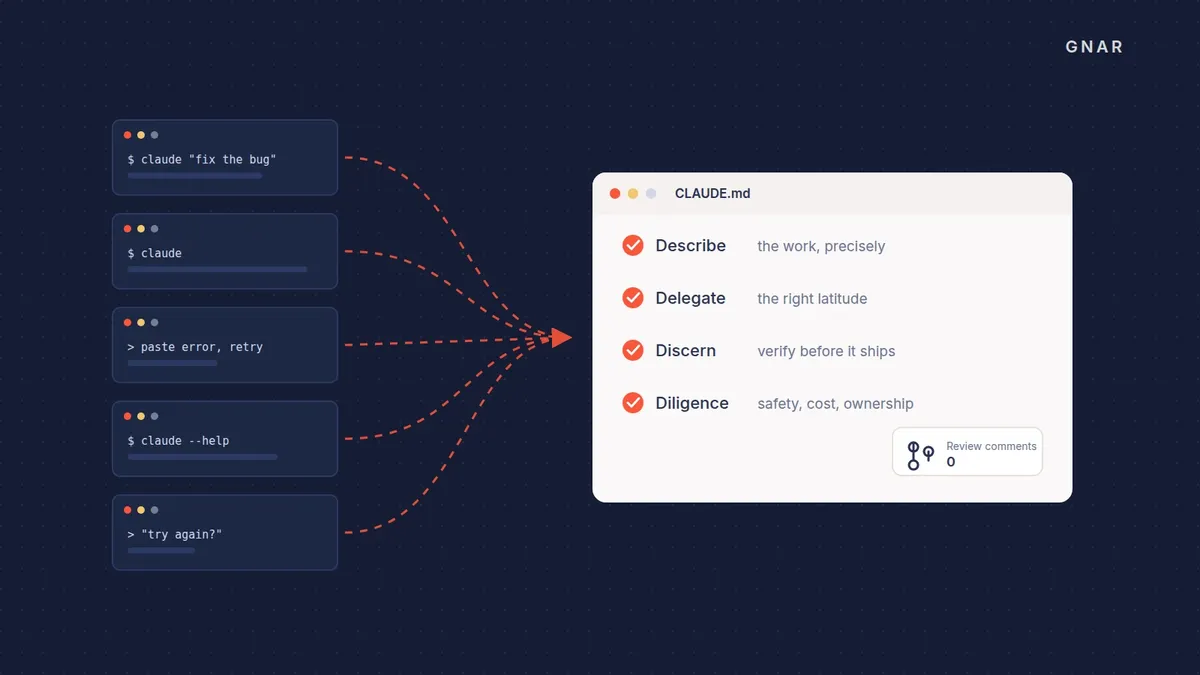
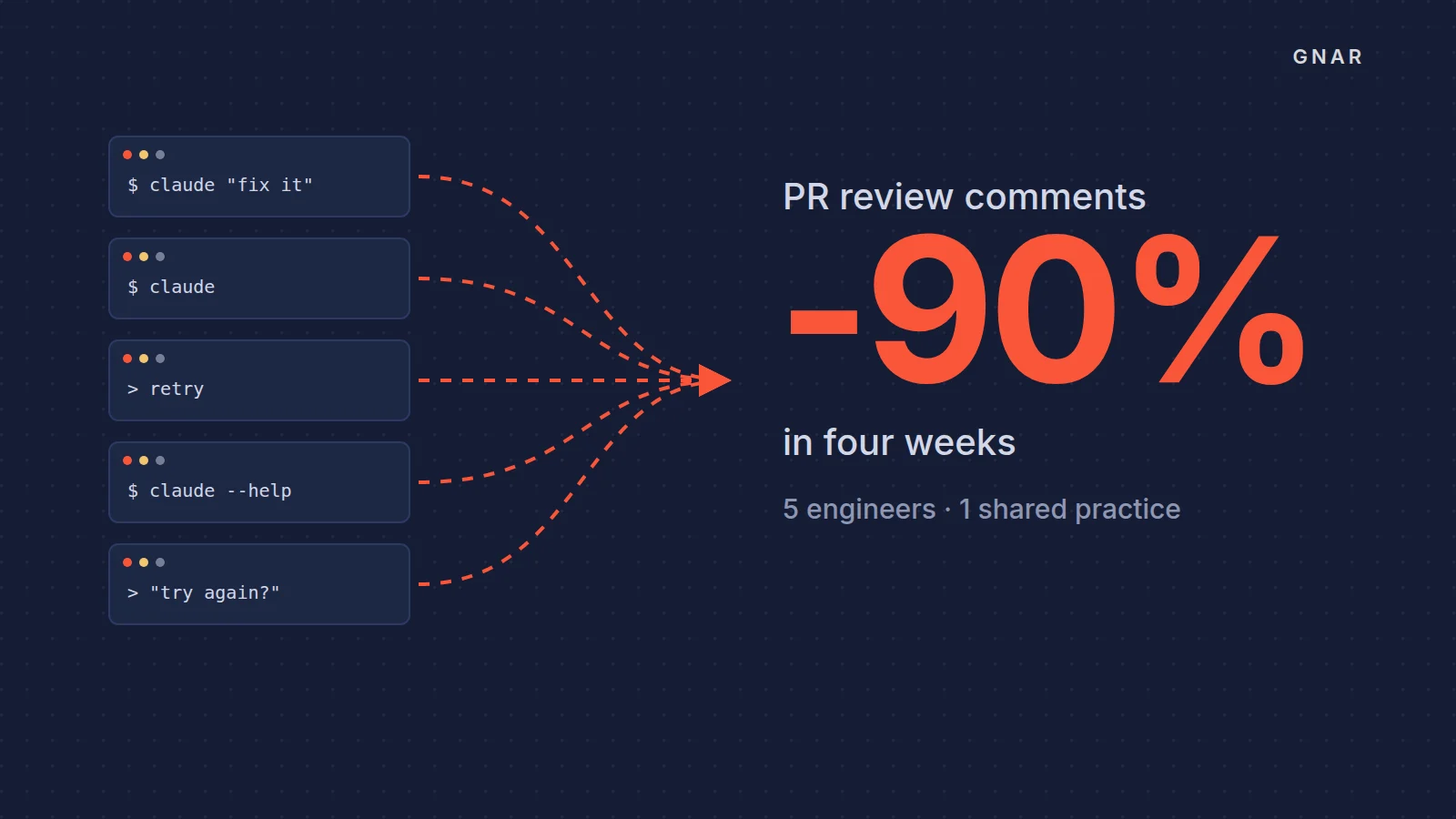
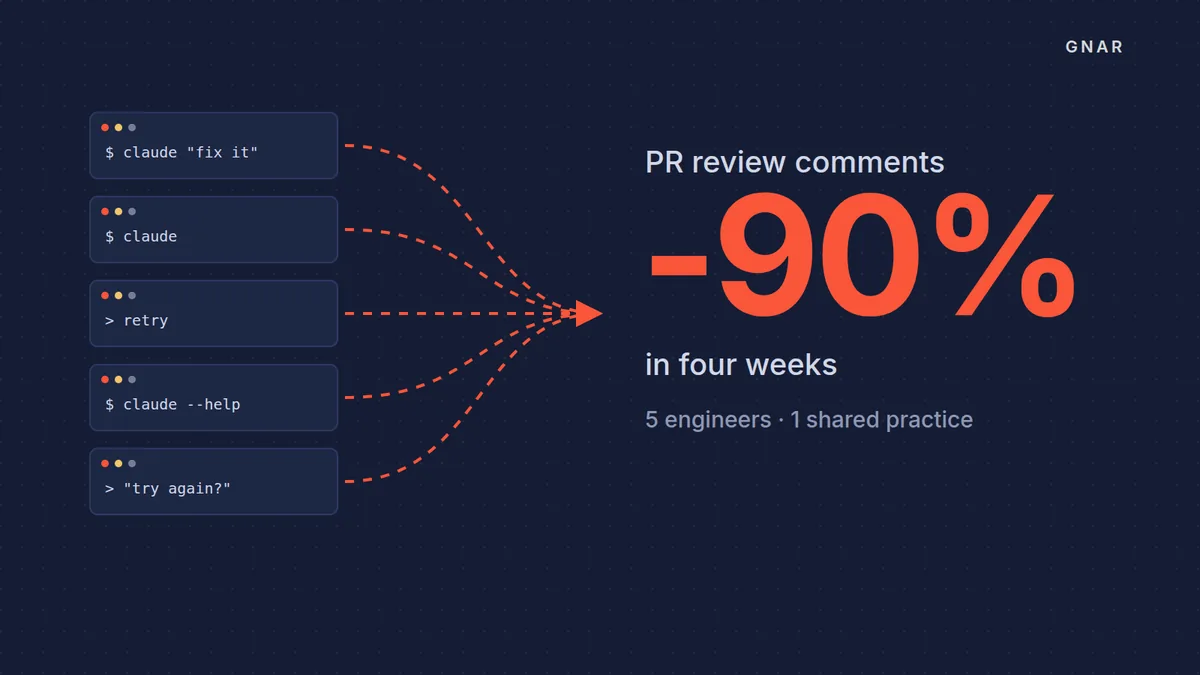
GSC Enterprises turned five engineers' separate Claude Code habits into one shared practice through a four-week Immerse cohort on their own code. GSC, the wholesale distributor behind Grocery Supply Company, already had Claude Code in the hands of its five engineers. The case study says what GSC lacked was "a shared way of working with it." Each engineer used it differently, results were inconsistent, and nobody could say which habits produced good output and which produced rework.
The team supports a custom-built ERP on Node.js and AWS, integrations with LANSA on IBM i and DB2, and analytics in Snowflake. Gnar ran a mentor-led Immerse cohort on GSC's production codebases. One senior Gnar mentor gave each engineer two 45-minute one-on-ones a week, pairing on that engineer's live project. The cohort also had a weekly check-in, live-coding sessions, office hours and a Slack channel.
Each engineer was assessed at intake and again at close on four dimensions Gnar calls the Four Ds: Description, Delegation, Discernment and Diligence. The case study reports three results:
- At close, all five engineers self-assessed at Systematize or Orchestrate on every dimension. Gnar places each dimension in one of four bands: Craft, Direct, Systematize or Orchestrate.
- GSC's own review agent, which nobody changed, commented on roughly 100% of pull requests at the start and less than 10% at the end.
- After the cohort, the participants ran an internal AI training for 70 GSC leaders.
The case shows five engineers who already had Claude Code moving to one shared practice, trained on their own production code. It does not show a company-wide Claude Enterprise rollout, and it does not show a build. GSC hired Gnar for a training cohort. The GSC Enterprises case study has the full account.
What do Claude consulting firms charge?#
Each firm sets its own price, and the directory shows only the budget bands each firm selects. The Budget filter offers five ranges: under $25K, $25K to $100K, $100K to $500K, $500K to $2M and $2M+. Use that filter, then ask each firm for its price.
Gnar publishes its Gnar Discovery and Design prices and a typical build range on its own site. Gnar Discovery and Design costs $15,000, $20,000 or $30,000 for two, four or six weeks. Builds typically run $150K to $300K+.
Treat a budget range as a filter, then ask every firm for its first phase as a fixed price in writing, with a list of what it leaves out.
For integration work, Gnar's page says, "The Gnar Company quotes each project." It names the first step: "Start with Gnar Discovery and Design, from two weeks and $15,000. You leave with a build plan that has a fixed price on it." The Discovery page says each tier ends with a Milestone Project Plan and a fixed price for your build, and that the plan is yours whether or not you build with Gnar.
When do you not need a Claude partner?#
You do not need one when your own people have the hours and the direction to run the rollout. Gnar's answer to its own buyers reads, "If your own engineers have the capacity and the direction, do it internally and we will say so on the call."
A partner is worth its fee in a narrower case. The seats are bought, the work is real, and nobody inside has the hours to lead it. If that is you, filter the directory, send the seven questions to three to five firms, and compare the answers side by side.
Our guide to hiring an AI implementation consultant covers the next step. It shows how to tell a strategy firm from one that builds, and what you should own when the work is finished.