Claude Code consulting cost is the fee a partner charges to set up Claude Code, train your engineers and support the rollout, and it sits on a separate line from what you pay Anthropic. Seven pages from six companies loaded in November 2026 publish prices for Claude work, five of them for Claude Code work, including a $5,000 to $12,000 Claude Code assessment, a team rollout at $15K to $35K, and a deployment at $35,000 to $90,000 over four to eight weeks. This guide is for a CTO comparing quotes from companies that sell Claude Code consulting. It covers what the fee buys, how partners price it, what drives the number, and how to compare quotes line by line. It matters because the same label covers a 90 minute session and a multi-week deployment, so two quotes can buy very different work. Two quotes can differ by tens of thousands of dollars for different scopes.
Read every quote as two bills. The vendor's fee pays for people's time and the files they leave in your repository. Anthropic's bill pays for Claude Code itself, through a paid plan, an Enterprise seat with usage at API rates, or tokens on the API.
The Gnar Company is a Claude Select Services Partner in Anthropic's Claude Partner Network. Its enterprise AI integration page says how Gnar prices AI integration work: "The price depends on how many systems the AI reaches and what it may change in each."
What does a Claude Code consultant do?#
A Claude Code consultant is an outside company or person hired to set up Claude Code for a team, teach the team to use it, and keep the setup current. Anthropic's overview page says "Claude Code is an agentic coding tool that reads your codebase, edits files, runs commands, and integrates with your development tools." Most of what gets set up is documented in Anthropic's Claude Code docs.
Here are six of those parts, each in the words of Anthropic's docs:
- Settings. Anthropic's settings page says settings control "which model it starts with, what it can run without asking, which files it can’t read, how it looks in your terminal, and what your organization enforces."
- CLAUDE.md files. A project CLAUDE.md holds "build and test commands, coding standards, architectural decisions, naming conventions, and common workflows." The memory page adds, "These instructions are shared with your team through version control."
- Skills. The skills page says to "Create a skill when you keep pasting the same instructions, checklist, or multi-step procedure into chat."
- Hooks. The hooks page calls hooks "user-defined shell commands, HTTP endpoints, MCP tool calls, LLM prompts, or subagents that execute automatically at specific points in Claude Code’s lifecycle." The costs page adds that "Custom hooks can preprocess data before Claude sees it."
- MCP servers. "MCP servers give Claude Code access to your tools, databases, and APIs." MCP stands for Model Context Protocol, which Anthropic's MCP page calls "an open source standard for AI-tool integrations."
- Monitoring. The monitoring page says teams can "Track Claude Code usage, costs, and tool activity across your organization by exporting telemetry data through OpenTelemetry (OTel)."
Anthropic's security page also lists five practices under the heading Team security. Four of them read "Use managed settings to enforce organizational standards", "Share approved permission configurations through version control", "Monitor Claude Code usage through OpenTelemetry metrics", and "Audit or block settings changes during sessions with ConfigChange hooks". The remaining one tells teams to train their members on security. Those five practices make a fair test of any quote. Each one is work that someone, on your side or the vendor's, has to do. Gnar's GSC Enterprises case study lists what each engineer left with after a four-week cohort: "a maintained context file, at least one reusable skill."
Is the consulting fee separate from Anthropic's Claude Code price?#
Yes, plan on two bills, one to the partner and one to Anthropic or your cloud provider. On Amazon Bedrock, Google Cloud’s Agent Platform and Microsoft Foundry, the Claude Code costs page says Claude Code "is billed per token to your cloud account."
Anthropic's side of the bill depends on how your developers get Claude Code. Anthropic's pricing page answers in its FAQ: "Claude Code is included in all paid plans." The same page marks Claude Code as not included on the Free plan.
For individual developers, the pricing page lists Pro at $17 per month with the annual discount, or $20 billed monthly. It lists Max at $100 per month and Ultra at $200 per month. For companies, the pricing page lists the Team Standard seat at $20 per seat per month billed annually, or $25 billed monthly. Enterprise is listed at "US$20/seat/month, billed annually, 20 seat minimum," with usage at API rates. Anthropic's support article on Team and Enterprise plans says "Claude Code is included with every Team plan seat." It also says usage-based Enterprise plans, including self-serve Enterprise, have no per seat usage limits, and usage is billed at API rates.
On the API, Anthropic's Claude Code costs page says "Claude Code charges by API token consumption." The same page says "Per-developer costs vary widely based on model selection, codebase size, and usage patterns such as running multiple instances or automation." It gives a figure for business use: "Across enterprise deployments, the average cost is around $13 per developer per active day and $150-250 per developer per month, with costs remaining below $30 per active day for 90% of users." It adds, "To estimate spend for your own team, start with a small pilot group and use the tracking tools below to establish a baseline before wider rollout." Gnar's post on what Claude Code costs per developer covers those same figures.
The same page names the habits that move that bill. "Token costs scale with context size: the more context Claude processes, the more tokens you use." It says "The highest-impact habits to share are clearing between unrelated tasks and matching the model to the job". It adds, "Sonnet handles most coding tasks well and costs less than Opus." Ask whether a quote writes those habits into the team's settings and CLAUDE.md files.
Does Claude Code use API credits on top of a plan?#
Not for the plan's included usage on Pro, Max, Ultra or Team seats. Three common cases add API rate charges there. One is an API key set on a developer's machine. Another is usage credits turned on after a limit is reached. The third is API credits chosen through a Claude Console account. For that case, the Pro, Max and Ultra article says "Usage will be billed at standard API rates (distinct from Pro/Max/Ultra plan pricing)." Anthropic's support article for Pro, Max and Ultra plans covers the key. With an ANTHROPIC_API_KEY environment variable set, Claude Code uses that key, "resulting in API usage charges rather than using your subscription's included usage." The Team article says "Monthly API credits included with Team plans can’t be used in Claude Code or the Claude apps, including for extra usage." Anthropic's pricing page says that when you reach a limit, you can, "on paid plans, turn on usage credits to keep working at standard API rates." On usage-based Enterprise plans, the Team and Enterprise support article says usage is "billed at API rates."
Anthropic also bills the API apart from its plans. Its billing article says "A paid Claude subscription enhances your chat experience, and the Claude API is billed separately." Ask every vendor which sign in method its setup uses. An API key moves spend onto a separate bill that a seat budget does not show.
Does Anthropic sell consulting with Claude Code?#
Anthropic's pricing page lists Consultation on one plan. Its Partnership table marks "Consultation" as Yes for Enterprise (sales-assisted) and No for Team and for Enterprise (self-serve). The same table lists "Customer success support at certain spend thresholds" for Enterprise (sales-assisted) only. The table does not say what the consultation covers. Anthropic's partner directory describes itself as a place to "Find a Claude certified consulting partner or system integrator to help you build your AI strategy and successfully implement Claude."
What do companies that sell Claude Code consulting charge?#
In the table below, the one-time fees run from a $2,500 audit to a $35,000 to $90,000 deployment. ClaudeReadiness's pricing page also lists two larger packages. They are a Core Engagement at $85K to $175K and an Enterprise Transformation at $175K to $400K+. Seven pages from six companies loaded in November 2026 publish prices for Claude work, five of them for Claude Code work, and the fees are hard to compare because each one buys a different scope. The two Vantage Point rows are for general Claude work, not Claude Code. Its rollout page does not mention Claude Code. The table copies each fee and its scope as the page states it.
| Company and page | What the fee buys, per the page | Fee as published |
|---|---|---|
| Vantage Point, Claude consulting page | AI Readiness Assessment, 2 weeks | $7,500 fixed |
| Vantage Point, rollout page | Claude or ChatGPT Team Rollout, up to 25 users, 2 to 3 weeks | From $12,500 plus $2,500 for each further 25 users |
| OperatorZero, Claude Code page | AI Workflow Audit | $2,500 |
| OperatorZero, same page | Claude Code or Claude Team build | From $6,000 |
| Opsio, Claude Code page | Claude Code Assessment, one time, 1 to 2 weeks | $5,000 to $12,000 |
| Opsio, same page | Consulting Engagement, by team size and scope | $5,000 to $30,000 a month |
| WorkWise Academy, Claude Code page | Team rollout, five to twenty five people, 2 to 4 weeks | $15K to $35K |
| PromptMetrics, Claude Code page | Claude Code Sprint, fixed scope, one to two weeks | Starts at €4,500 |
| ClaudeReadiness, pricing page | Claude Code Deployment, 4 to 8 weeks | $35,000 to $90,000 |
Opsio's page states three figures for its assessment. Its call to action says "Get Your Free Claude Code Assessment." Its pricing table lists the Claude Code Assessment at $5,000 to $12,000 for one to two weeks. Its overview says "a focused assessment available at $8,000 one-time." If you get an Opsio quote, ask which figure applies.
The pages also describe the companies in different words. Vantage Point's page calls it an "Official Claude Partner Network member". OperatorZero's page says "OperatorZero is a member of the Claude Partner Network." Opsio's page calls the firm "an Anthropic-aligned implementation partner." The ClaudeReadiness footer says "Not affiliated with Anthropic." Confirm a company's tier in Anthropic's own directory, then read its scope.
How do these companies price Claude Code consulting?#
Four pricing shapes appear on these pages: a paid assessment, a fixed package, a monthly engagement and a per session rate. Each shape answers a different question for the buyer, so the right comparison is shape against shape.
| Pricing shape | Example, as the page states it | Question to ask (general advice) |
|---|---|---|
| Paid assessment | Opsio, Claude Code Assessment at $5,000 to $12,000, one time, 1 to 2 weeks | Does the fee carry into the next step, and for how long? |
| Fixed package | WorkWise Academy team rollout, five to twenty five people, $15K to $35K | What is the price at your head count? |
| Monthly engagement | Opsio, $5,000 to $30,000 a month, depending on team size | What do you get each month, and how do you stop? |
| Per session | WorkWise Academy, $249 for a 90 minute 1:1 session | What is set up by the end of the session? |
Vantage Point, OperatorZero and Opsio each say the first fee carries forward. Vantage Point's assessment is "credited in full against a Jumpstart or Agent Build signed within 60 days." OperatorZero says its audit "fee is credited toward a build or your first month of advisory." Opsio says of its pilot, "If you proceed, the pilot cost is credited toward your project."
The fixed packages state their limits in writing. Vantage Point's rollout page lists "Up to 25 users; each further 25 users $2,500" as a limit of the package. PromptMetrics says "Larger Agent Teams or multi-skill architectures are priced on scope after discovery." The limits tell you more about value than the headline fee. A low starting fee with a tight user cap can cost more than a higher one at your head count.
What drives the price of a Claude Code engagement?#
Six drivers move the published fees: the number of users, the systems Claude connects to, governance and compliance work, prompt libraries and skills, the training format, and how long support runs. Each one below is tied to a line on a consulting page or a Gnar page.
The number of users#
Head count is written into several fees. WorkWise Academy's team rollout covers "Five to twenty-five people on Claude Code with shared conventions." Opsio says its engagements run "depending on team size."
The systems Claude connects to#
Every connected system adds work. ClaudeReadiness prices an MCP Integration Package, "Custom MCP connectors to your enterprise tools," at $15,000 to $45,000 for three to six weeks. Gnar's integration page ties its own price to the same driver, quoted at the top of this post. Its first step lists each system and adds, "We also flag messy data or access settings that would block it."
Governance, security and compliance#
Governance work is often priced as its own line. ClaudeReadiness lists a Governance Framework covering "Usage policies, PII handling, audit trail setup, compliance documentation" at $22,000 to $55,000 for three to five weeks. Vantage Point lists compliance and supervision controls as "Quoted per engagement." Anthropic's security page adds a fact a buyer should know before signing. Anthropic "reviews connectors against its listing criteria before adding them to the Anthropic Directory, but does not security-audit or manage any MCP server." Someone has to review each server you connect, and the quote should say who.
Prompt libraries and skills#
Shared prompts and skills are a deliverable on several pages. Opsio lists an "Internal prompt library and agentic workflow playbooks for your codebase." WorkWise Academy's team rollout includes "A team CLAUDE.md, a shared skills library, three live sessions, adoption checks, and a month of async support." Ask where the library will live. Anthropic's memory page says project instructions "are shared with your team through version control," so a library in your repository stays with you.
The training format#
Training is priced by format and head count. OperatorZero lists its team workshop "From $950" and says it "Gets up to 15 people using what we set up." It adds "$1,500 for a virtual half day, $2,750 for a full day, $100 per extra person." Gnar's AI training for engineering teams runs as a cohort: "Four weeks, one mentor, your code." The page calls it "A cohort program that takes your team from ad-hoc AI use to production-grade agentic development." A workshop and a mentored cohort are different purchases, so compare hours per engineer and what each engineer leaves with.
How long support runs#
Support length changes the total. WorkWise Academy's team rollout includes a month of async support. OperatorZero's monthly advisory is "Ongoing help after launch so the rollout keeps paying off." The section on ongoing support below covers what it costs on its own.
How do you compare Claude Code consulting quotes line by line?#
Put every quote into the same eight rows, then compare row by row: assessment, settings and permissions, CLAUDE.md files and skills, MCP connections, monitoring, training, support after setup, and Anthropic's bill. Ask every company to fill all eight. A blank row is either work you will do yourself or work nobody has priced.
Rows two to six cite an Anthropic Claude Code docs page. Rows one and seven come from the consulting pages above. Row eight cites Anthropic's pricing and support pages.
| Row in the quote | What the row should name | Where the row comes from |
|---|---|---|
| 1. Assessment | Price, length, and whether the fee is credited forward | Consulting pages above |
| 2. Settings and permissions | Who writes the managed settings | Server-managed settings are "available for Claude for Teams and Claude for Enterprise customers" |
| 3. CLAUDE.md and skills | Which files land in your repository | Project instructions "are shared with your team through version control" |
| 4. MCP connections | Which systems, and who reviews each server | Anthropic "reviews connectors against its listing criteria before adding them to the Anthropic Directory, but does not security-audit or manage any MCP server" |
| 5. Monitoring | Whether usage export is set up | Claude Code exports usage "through OpenTelemetry (OTel)" |
| 6. Training | Format, people, hours per engineer | Anthropic's security page lists training team members on security |
| 7. Support after setup | Length, scope and monthly price | Consulting pages above |
| 8. Anthropic's bill | Plan, seats, sign in method, whose account | Anthropic's pricing and support pages |
The source for row two is Anthropic's server-managed settings page. It says these settings let "organization Owners centrally configure Claude Code" from the claude.ai console.
Two more checks help when the rows are filled. First, compare quotes that cover the same head count, because the user cap moves the fee. Second, ask what you own at the end. Every row from two to five should leave a file or a setting in your own accounts.
What does ongoing support cost after setup?#
On the three consulting pages that publish a monthly price, ongoing work starts at $2,500 a month. OperatorZero lists monthly AI advisory "From $2,500/mo". ClaudeReadiness lists an Advisory Retainer at $4,500 to $12,000 a month, for Claude work in general. Opsio's main offer, its consulting engagement, runs $5,000 to $30,000 a month.
The pages describe the month's work in their own words. ClaudeReadiness says its retainer covers "Ongoing Claude strategy, model updates, quarterly optimization, prompt maintenance." Vantage Point's Claude page lists ongoing support "with prompt tuning, new use cases and admin support." It names three ways to buy that help: "a block of hours, a retainer or managed services."
Ask what triggers support work. ClaudeReadiness's retainer lists "model updates" among its work, and Anthropic's pricing page says "Price and plans are subject to change at Anthropic's discretion." A support quote should name who watches for those changes.
For the AI integrations Gnar builds, the integration page names two paths after launch. "Your engineers can run it. Or Gnar keeps it running on Maintain, its monthly support plan, from $1,000 a month."
What did a four-week Claude Code cohort include at GSC Enterprises?#
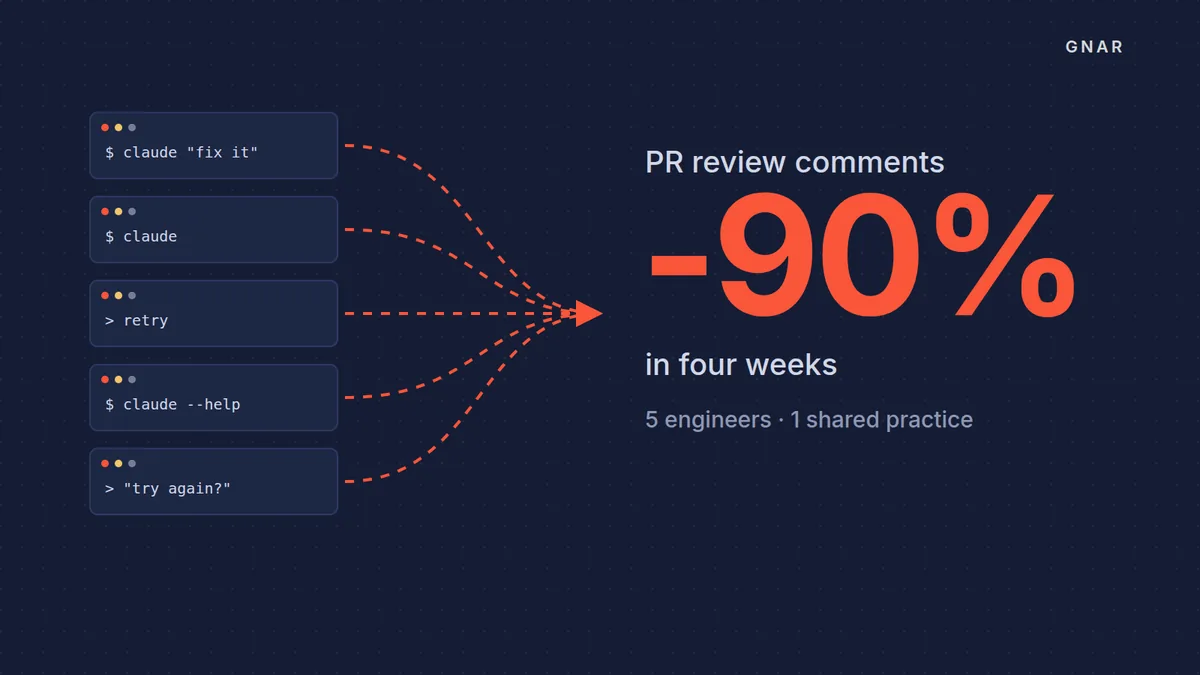
The four-week Immerse cohort at GSC Enterprises gave five engineers one senior Gnar mentor. Each engineer had two 45-minute 1:1s a week on their own production code, plus a weekly check-in and a Slack channel. GSC Enterprises, the wholesale distributor behind Grocery Supply Company, "had already put Claude Code in the hands of its engineering team," the case study says. What it lacked was a shared way of working with it.
The case study lists the scope in detail. A single senior Gnar mentor ran the cohort over four weeks, with:
- two 45-minute 1:1s per engineer per week, each pairing on that engineer's live project.
- a weekly cohort check-in.
- live-coding sessions and open office hours.
- a dedicated Slack channel between sessions.
It fit inside a normal workweek, roughly five to six hours per engineer. Each participant left with a merged change in their own codebase, a maintained context file, at least one reusable skill, and a workflow they can describe. The case study adds that "Better up-front specification and tighter context discipline raised the quality of generated code before it reached review." After the cohort wrapped, the participants ran an internal AI training for 70 GSC leaders.
The case study also reports a signal from a tool the cohort did not change. "The clearest external signal came from a tool nobody touched." Pull requests with comments from GSC's automated code review agent went from roughly 100% to less than 10% over the four weeks.
A training quote should reach this level of detail. It should name who mentors, how many hours each engineer gives, and what each engineer leaves with in the code.
Can you hire someone to build software with Claude?#
Yes, and a build is a different purchase from Claude Code setup. A setup engagement leaves your own engineers working in Claude Code. A build engagement leaves you with software that the company wrote and handed over.
Gnar's integration page describes the company this way: "It is a custom software firm with U.S.-based senior engineers, who use Claude in their own work." Gnar's builds start from a plan with a price on it. On the Gnar Discovery and Design page, the price of that plan's build is described in one line. "This becomes the basis for your Build phase, typically $150K to $300K+."
Ask two questions of any build quote. Whose Claude account does the work run on during the build? Who owns the code when it ends? Gnar's integration page answers the second for its own work: "You own what gets built, and Gnar keeps no ownership of it."
When do you not need a Claude Code consultant?#
You do not need one when your own engineers have the hours and the direction to do the setup. Gnar's own answer to a buyer who says the company has people for this is the same. "Often you should use them. If your own engineers have the capacity and the direction, do it internally and we will say so on the call."
Anthropic's docs give a team a place to start alone. The memory page says, "Run /init to generate a starting CLAUDE.md automatically." It adds that Claude "analyzes your codebase and creates a file with build commands, test instructions, and project conventions it discovers." The settings, skills, hooks and monitoring pages linked above are public too.
Gnar's integration page says who its integration work is for. "This work is for companies with no engineering capacity of their own to point at this. It also fits teams whose engineers are busy with other work."
Where does The Gnar Company fit in a Claude Code budget?#
Gnar sells two kinds of work that sit next to a Claude Code budget: training an engineering team that already has the tools but not the practice, and connecting AI to the systems a company runs. Each has its own page and its own first step.
For training, Gnar's AI training page says "Start with a four-week Immerse cohort on your own codebase." It is "Built for a small team that already has the tools but not the practice."
For integration, the page says "The Gnar Company quotes each project." The first step is Gnar Discovery and Design. The Discovery page lists the tiers: "Foundation costs $15,000 for two weeks, Core $20,000 for four and Accelerator $30,000 for six." It adds, "You get that plan whether or not you build with The Gnar Company."
The AI provider's charge stays on its own line in either case. Gnar's integration page says "Claude is The Gnar Company’s default," and that Gnar also builds with Google's Gemini API and on Amazon's AWS Bedrock. The page adds, "The build plan from Discovery says which AI fits your systems."