A good place to start AI for finance teams is work a reviewer can check against a source. As general advice, start with account reconciliations, the first draft of the forecast and its variance notes, and the evidence for controls the team already tests. A person still signs off on each one. Each one can be measured in numbers finance teams already track, such as hours per reconciliation, open exceptions and days to close.
This guide is for a CFO or finance director at a mid market company whose close drags. Much of that close still runs through spreadsheets outside the ERP. It covers which finance work to start with, what the data has to look like, how the control rules apply, how to measure a pilot, and whether to buy a tool or build on your own systems. Where a sentence is general advice rather than a source's finding, it says so.
The examples come from published sources and from one real roadmap. The Gnar Company built a prioritized AI roadmap for Counter Culture Coffee, a coffee roaster. It found 79 AI and automation opportunities. Then it scored and ranked each one. Several of those findings sit in finance work, and they appear below. The roadmap came from Gnar's AI Strategy & Roadmap engagement. The AI strategy page describes that work in one line: "We map your processes, score each AI idea on return and cost, and plan the first build".
AI for finance teams: where should you start?#
Start with work that has a source of truth, a named reviewer and enough volume to count. As general advice, that points to three jobs: account reconciliations, the first draft of the forecast and its variance notes, and evidence for the controls you already test. Each one keeps a person signing off. Each one can be measured in numbers finance teams already track.
These three tests are general advice. A source of truth means a bank statement, a subledger or a contract that the output can be checked against. A named reviewer means one person approves the result before it is used. Enough volume means the work happens often enough that hours saved add up.
| Starting point | What AI prepares | What a person keeps |
|---|---|---|
| Account reconciliations | Matches lines and lists the exceptions | Approving entries and judging odd items |
| Forecast and variance notes | Updates the model and drafts first notes | The assumptions and the final number |
| Control evidence | Gathers and checks support for a control | The conclusion that the control worked |
The table is general advice. The sources for each row are in the section that covers it below.
Which finance process should you automate first?#
As general advice, account reconciliations are the safest first pick of the three. A reconciliation can be checked against the bank statement or the subledger. A wrong match shows up when a reviewer compares the two. Forecasting is harder to check, because the right answer is not known until the period closes. Control testing needs the controller and often the auditors in the room before anything changes.
How are finance teams using AI today?#
Finance teams use AI most for knowledge management, accounts payable process automation, and error and anomaly detection, according to Gartner's 2025 survey, and few report large results. Gartner's 2025 AI in Finance Survey of 183 CFOs and senior finance leaders, taken May through June 2025, found 59% of finance leaders using AI in their finance function. The Gartner release says the 2024 survey found 58%, after 37% in 2023.
The same Gartner release lists the uses that more than a third of adopters had in place. Knowledge management came first at 49%. Accounts payable process automation followed at 37%, then error and anomaly detection at 34%. Gartner says data quality and availability, plus skills, "remain the largest obstacles to AI adoption across all organizations".
Results lag adoption. In a June 2026 release, Gartner shared data from a June 2025 survey of 183 CFOs: "84% of finance organizations have implemented or are planning to implement AI, yet only 7% report a high or very high impact".
McKinsey's survey of 102 CFOs shows use spreading across more tasks. McKinsey's article on how finance teams use AI says "44 percent of respondents said they used gen AI for over five use cases in 2025, up from 7 percent in the previous year's survey".
McKinsey also reports what changed where the tools took hold. "Across a handful of finance functions where it has been adopted robustly, we have observed that finance professionals spend 20 to 30 percent less time crunching data". McKinsey says they "devote the saved time to their role as business partners who support strategy execution".
Will AI replace finance jobs?#
Employers surveyed by the World Economic Forum expect fewer clerical finance roles by 2030. The World Economic Forum's Future of Jobs Report 2025 is based on a survey of more than 1,000 global employers, conducted in late 2024. Its Figure 2.2 lists "Accounting, Bookkeeping and Payroll Clerks" among the top fastest declining jobs for 2025 to 2030. The report also says respondents expect "Accountants and Auditors" among the fastest declining roles.
The report names the causes in its own words: "Broadening digital access, AI and information processing technologies, and robots and autonomous systems are the primary drivers for this decline". That is a forecast from employers. It does not count jobs already lost. As general advice, design each pilot so finance professionals keep the approval and the judgment on odd items, as each starting point in this post does.
Why are reconciliations a good first job for accounting teams?#
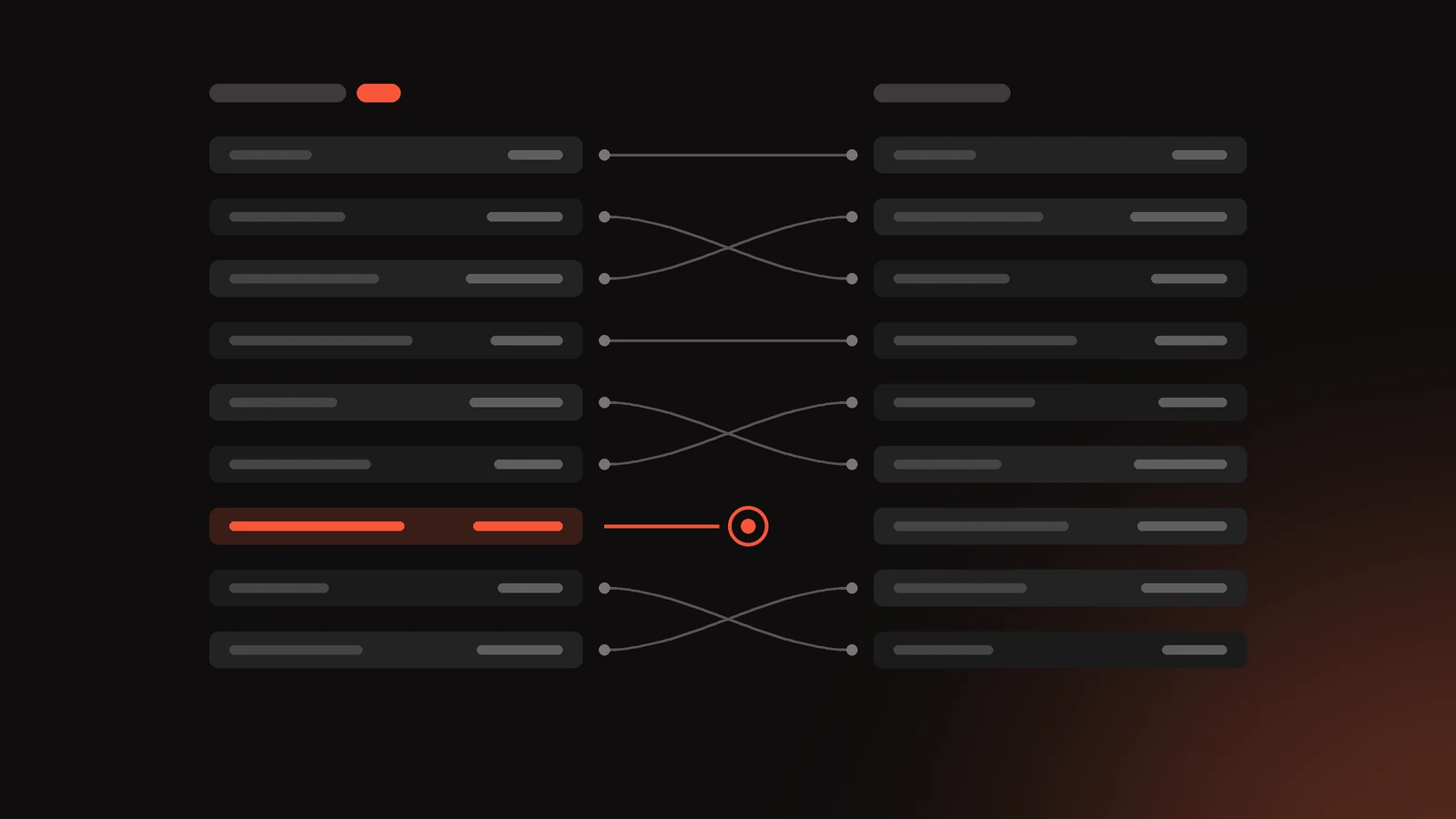
Reconciliations are a good first job for accounting teams because many finance functions already automate the matching rules. McKinsey defines automation as "Rule-based technology that follows predefined instructions to complete repetitive tasks". It says finance functions commonly use it for "checking and paying invoices, performing accounting reconciliations, and generating basic reports". As general advice, AI adds a step on top: reading the exceptions that the rules leave behind.
Anthropic published ten agent templates for financial services firms in May 2026. One of them is a "General ledger reconciler". In Anthropic's words, it "reconciles general ledger accounts and runs net asset value calculations against the books of record". Anthropic says firms "can adapt any of them to their own modeling conventions, risk policies, and approval flows".
As general advice, a reconciliation pilot works in four steps:
- Pick one account with high transaction volume and a clean source, such as an operating bank account.
- Write down the matching rules your team uses today, including the tolerance for small differences.
- Let the AI propose matches and list every item it could not match, with the reason.
- Have the preparer work the exceptions, and have the reviewer tie the proposed matches to the statement and approve the result, the same two people as today.
In this setup the reviewer checks the proposed matches against the statement as well as the exceptions. As general advice, a long exception list points to a data problem, and the pilot has found it early.
How do you automate the month-end close with AI?#
Automate the close one step at a time, starting with the steps a reviewer can check. Anthropic's template list includes a "Month-end closer". Anthropic says it "runs the close checklist, prepares journal entries, and produces close reports". Anthropic also says users review and approve Claude's work "before it goes to a client, gets filed, or is acted on".
As general advice, look at what your ERP can already do before you add AI to the close. Many close steps are configuration: recurring journal entries, allocation rules and approval workflows. AI fits the steps that need reading and judgment, such as accrual support and reconciling items. Judgment calls, such as revenue recognition on an unusual contract, stay with the controller.
Can AI review AP invoices and expense reports?#
Yes, accounts payable is one of the most common places finance teams use AI automation. In Gartner's 2025 survey, accounts payable process automation was the second most common finance AI use, at 37% of adopters. As general advice, point the AI at the invoices that your existing finance automation rules cannot match.
McKinsey gives one example from a global biotech company. It "introduced invoice-to-contract compliance using an agentic AI system that ingests contracts and invoices throughout the year and checks that all contract terms are correctly applied". McKinsey says the approach "helps prevent value leakage when vendors miss or misapply terms such as early payment discounts, tiered pricing, and volume rebates".
In the US, the IRS says in Publication 463 that, for reimbursements under an accountable plan, an employee adequately accounts "by giving your employer a statement of expense, an account book, a diary, or a similar record in which you entered each expense at or near the time you had it, along with documentary evidence (such as receipts)".
As general advice, an AI step in expense management checks each expense report line before a person approves it:
- The line has a receipt, a date and a business purpose.
- The amount on the line matches the receipt.
- The category fits the company's expense policy.
- Lines that fail go to a named approver with the reason, and the AI never pays them.
Can AI help with forecasting and variance analysis?#
Yes, AI can draft forecast updates and variance notes while the forecast owner keeps the assumptions. McKinsey says gen AI in the finance function "can handle tasks including drafting commentary, summarizing performance, and supporting scenario modeling". As general advice, variance commentary is a good fit because the numbers already exist and a person must explain them.
McKinsey also describes "Decision support tools, powered by a combination of predictive analytics and gen AI". In its words, some finance teams "now generate complex scenarios using natural language during planning sessions".
For teams that forecast in Excel, Anthropic's Claude for Microsoft 365 page describes Claude for Excel this way: "Ask about any cell, update assumptions without breaking formulas, and build models from scratch". The same page says "Nothing goes out or gets saved until you say so". It also says the Excel, PowerPoint, Word and Outlook add-ins "are generally available on all paid Claude plans".
Anthropic's May 2026 announcement says that in Excel, Claude "builds financial models from filings and data feeds, audits formulas across linked workbooks, and runs sensitivity analyses". Anthropic's finance webinar demonstrates Claude Cowork on "rolling forecast updates, variance commentary, flux analysis, and board-packet assembly".
As general advice, three rules keep a forecast pilot honest:
- Keep the forecast and the actual data in the same workbook the AI reads, so every variance note points at a real number.
- Let the AI draft the note, and let the person who owns the line sign it.
- Never let the AI change a driver assumption without the owner seeing the change.
Can AI help test controls and keep an audit trail?#
As general advice, yes: AI can gather the evidence for a control test, while a person still signs the conclusion. For public companies, the SEC's Rule 13a-15 sets the frame. It defines internal control over financial reporting as "a process designed by, or under the supervision of, the issuer's principal executive and principal financial officers" meant "to provide reasonable assurance regarding the reliability of financial reporting".
The rule is written for issuers, meaning companies with a class of securities registered under section 12 of the Exchange Act. As general advice, an AI step placed inside a key control is a change to raise with your controller and your auditors before it goes live.
A related template on Anthropic's list is a "Statement auditor", which Anthropic says "reviews financial statements for consistency, completeness, and audit-readiness". As general advice, a control test pilot works this way: the AI pulls the support for each sample, checks it against the control's description, and flags gaps. The control owner reviews the flags and signs the conclusion.
What compliance documentation should an AI step leave behind?#
Each AI step inside a finance control should leave a record an auditor can follow. For teams that run agents on the Claude Platform, Anthropic says its Managed Agents cookbooks include "per-tool permissions, managed credential vaults, and a full audit log in the Claude Console". As general advice, the compliance documentation for each run should show four things:
- The financial data the AI read, and from which of your financial systems.
- What the AI proposed, including the items it could not resolve.
- Who reviewed the output, and what they changed.
- The version of the instructions the AI followed that month.
Does AI need human review in finance?#
Yes, and NIST's guide to generative AI risk says its use may warrant more human review. The National Institute of Standards and Technology (NIST) puts it this way in its Generative AI Profile, NIST AI 600-1: "Organizations' use of GAI systems may also warrant additional human review, tracking and documentation, and greater management oversight". NIST also names a risk that matters for financial numbers. It calls it confabulation: "The production of confidently stated but erroneous or false content".
As general advice, that risk is why each starting point in this post keeps a named reviewer. A reviewer who ties each match to the statement can catch an invented entry.
Is it safe to give financial data to an AI tool?#
As general advice, it can be, when the plan does not train on your data and the tool reaches only the data you allow. Anthropic's financial services page says: "On Team and Enterprise plans, we don't train our models on your data by default". That page is written for "banks, insurers, asset and wealth managers, and fintech firms".
As general advice, set these five things before a pilot:
- Role based access controls, so only the finance team reaches finance data.
- Read access first, and write access only after the pilot proves out.
- An audit trail that shows who prepared, who reviewed and what the AI changed.
- No payment execution by the AI, ever.
- A written list of which data the tool may read.
Does AI bring bias or data privacy risk to finance work?#
Yes, and NIST lists both among the risks of generative AI. NIST AI 600-1 is "a cross-sectoral profile of and companion resource for the AI Risk Management Framework (AI RMF 1.0) for Generative AI". NIST says the AI RMF is "intended for voluntary use". It defines data privacy risk as "Impacts due to leakage and unauthorized use, disclosure, or de-anonymization of biometric, health, location, or other personally identifiable information or sensitive data".
NIST also names "Harmful Bias or Homogenization", which starts with the "Amplification and exacerbation of historical, societal, and systemic biases". As general advice, the risk management step for finance teams is to keep personal data out of a pilot unless the task needs it. Expense reports and payroll files carry names and addresses. A forecast usually does not need them.
Is your finance data ready for AI?#
As general advice, you can start before the financial data is perfect, as long as the pilot uses data that every system agrees on. McKinsey lists "Waiting for perfect data" as a pitfall. It says "finance teams can create value by delivering use cases that work with today's data while also strengthening data foundations".
The risk is data that two systems disagree on. Gnar's Counter Culture case study put it plainly: "An assistant is only as reliable as the data it reads, and it has no way to know which of two similar fields is the right one". At Counter Culture, "pulling a reliable number often depended on the few people who knew exactly which fields to use".
As general advice, check these before a pilot. The first item quotes the Counter Culture case, and the last quotes McKinsey:
- Each master data set has one home. The rule of thumb behind the Counter Culture recommendation: "master data is edited only in its system of record, and every other system reads from there".
- The team can name the right field for each number the pilot uses, so data accuracy can be checked.
- The pilot's account or report has at least a year of structured data, such as ledger lines, in one place.
- Someone owns each data set and can fix it when the pilot finds an error.
- The process is the same across entities. McKinsey warns that "Without simplifying and standardizing core workflows first, AI only adds to the complexity".
Gnar's free AI Readiness Assessment can come before any of this. It is a short check: "Our 10-question assessment helps identify where AI can create measurable operational value across your business".
How do finance teams add AI tools to existing systems?#
As general advice, put AI inside the finance tools, approval steps and finance workflows the team already uses. For Claude, Anthropic said in May 2026 that its agent templates "can be used as plugins in Claude Cowork or Claude Code on all paid plans, or as Managed Agents in the Claude Platform (in public beta)".
The harder part is people. McKinsey lists "Neglecting change management" as a pitfall and says "The biggest barrier is often adoption, not technology".
As general advice, give finance professionals a named use case in their own job, such as the AP clerk's vendor reconciliation or the analyst's variance notes. Then give them a copy of last month's data to practice on before the live close.
Can AI flag fraud and anomalies in financial data?#
Yes, AI can flag errors and anomalies, and Gartner's 2025 survey found error and anomaly detection in use at 34% of finance AI adopters. McKinsey defines artificial intelligence as "A broad category of technologies that augment human intelligence, such as recognizing patterns, making predictions, or learning from data". It adds: "AI is often used in forecasting, fraud detection, or risk modeling".
As general advice, an anomaly flag is a reason to look. A reviewer decides whether it is fraud. Route each flag on a payment, a vendor change or a journal entry to a named reviewer, and record what the reviewer found. Track how many flags turn out to be real, so the team can tune the rules.
How should a CFO measure a finance AI pilot?#
As general advice, measure in the finance team's own numbers, recorded before the pilot starts. Gartner's Ash Mehta said "If everything is a priority, nothing gets funded", and that CFOs should identify three to five use cases to pilot at a time. Gartner also tells CFOs to "document objectives, costs and benefits".
As general advice, record these numbers for each starting point:
- Reconciliations: hours per reconciliation, the count of open exceptions, and the age of the oldest reconciling item.
- Close: days from period end to final books, and the number of manual journal entries.
- Forecast: hours to update the forecast, and the gap between forecast and actual for the lines in the pilot.
- Controls: hours to gather evidence per control, and the count of exceptions the review found.
- For every pilot: errors the reviewer caught in the AI's output.
Gartner's 2025 release says 91% of respondents reported low or moderate impact at first. As general advice, a baseline lets the CFO see whether a modest early result is moving.
What did an AI roadmap find in Counter Culture's finance work?#
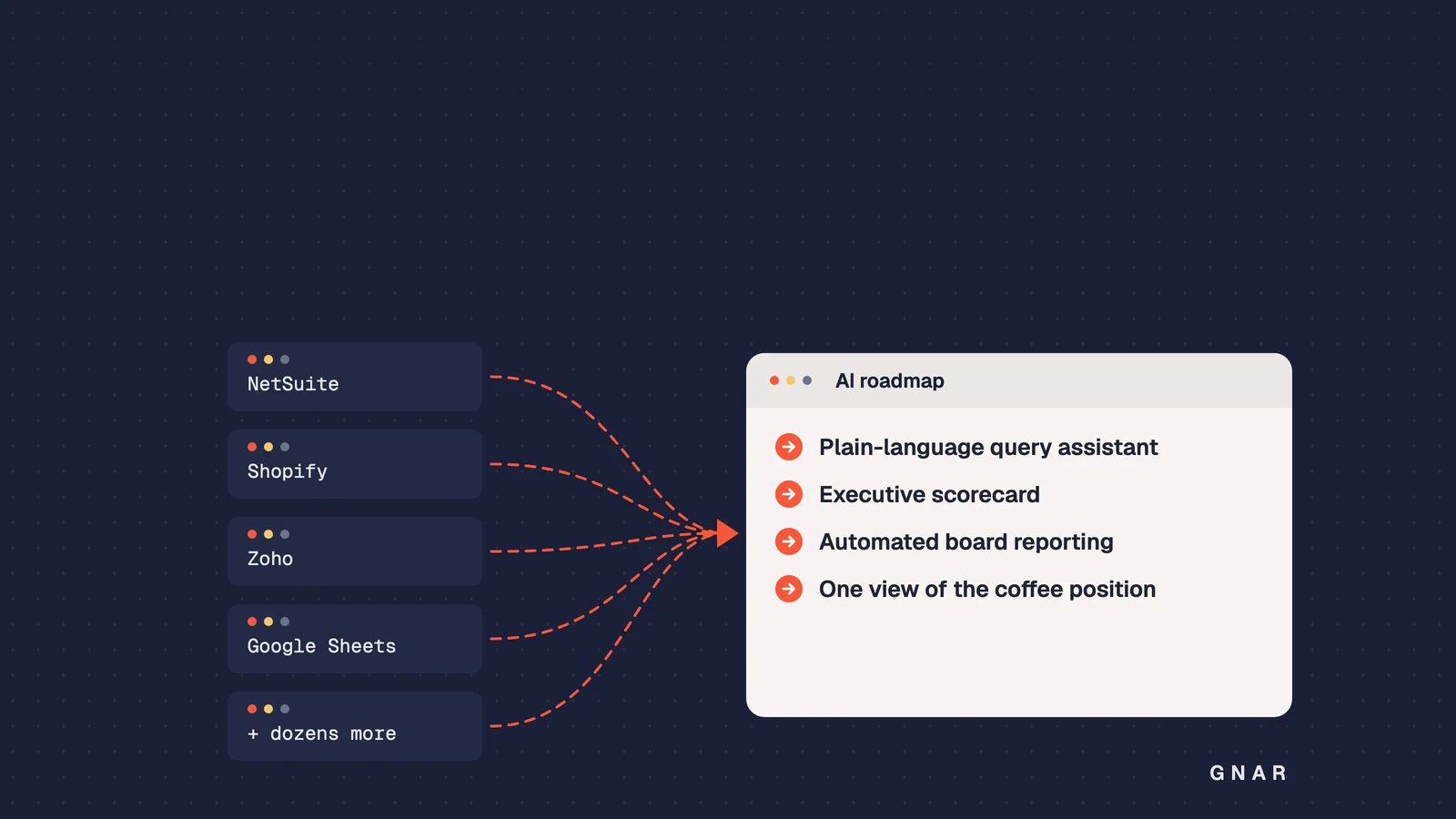
For the month-end close, the roadmap reserved AI for reconciliations and accrual worksheets and looked to NetSuite for many of the gains. Per the case study, Counter Culture runs NetSuite as its ERP and system of record, Shopify for direct-to-consumer and B2B commerce, and Zoho for account management and service. The work "found where AI could remove waste from sales, operations, and finance work, checked whether the data was ready, and laid out the order to pursue them".
The case study lists "15+ interviews with leadership, department heads, and the operators who run the day-to-day, across finance, operations, coffee procurement, sales, marketing, and data". The systems map grouped more than 60 tools by function, and "operations and finance" was one of the groups.
The case study also notes that some core reference data "was maintained in spreadsheets and entered into other systems by hand". That is manual data entry. The close finding reads: "Many of the gains come from NetSuite capabilities Counter Culture already owns, with AI reserved for reconciliations and accrual worksheets". The roadmap also found that "A handful of master-data sets were maintained in spreadsheets or kept in more than one system, which meant manual re-keying and reports that did not always match".
Every idea was scored the same way. The case study says each was scored on "financial ROI, operational efficiency gains, implementation complexity, data readiness, and cultural readiness". It adds: "Scoring counted only recoverable value, and weak data readiness capped an opportunity's score regardless of its upside".
The results split by purpose: "Of the identified projects, 27 grow revenue, 29 free up capacity, 13 cut costs, and 10 strengthen control". The first work had owners inside the company. The case study lists "34 projects ready to start and 8 already underway, led by five internal champions from IT, finance, and operations team members using Claude". The case study names three builds that depend on governed NetSuite data: "a plain-language query assistant, an executive scorecard, and automated board reporting". The findings were presented to Counter Culture's board.
Should you buy finance automation or build it on your own systems?#
As general advice, use what your ERP and your AI assistant already do before you build anything. The Counter Culture roadmap found that many of the close gains come from NetSuite capabilities the company already owns.
As general advice, the AI tools a finance team can use fall into four groups. Judge each against your three starting points:
| Kind of AI tool | Good for | Check before buying |
|---|---|---|
| AI built into the ERP | Close steps, matching, approval rules | What your license already includes |
| Finance platforms | One process, such as AP automation | Results on your own closed month |
| General assistants | Drafts, Excel models, report generation | Plan terms and data access |
| Custom builds | Work that crosses several systems | Who maintains it after launch |
Anthropic's financial services page lists three ways to deploy Claude. They are "Ready-made apps: like Claude Enterprise and Claude for Microsoft 365", "Claude Code: for engineering teams, including updating legacy systems", and "The API: for building Claude into your own trading, risk, KYC, and underwriting systems". Those examples are written for banks and insurers. As general advice, for a company like yours the API is one route for connecting AI to the ERP and the financial processes around it.
Gartner tells CFOs to "prioritize use cases based on net business value, feasibility and scalability". As general advice, the same three tests work for the buy or build choice. Gnar's guide to finding AI opportunities in your business processes covers the interviews and the scoring, and its guide to picking the first workflow narrows a ranked list to one.
What should you ask a finance AI vendor?#
Ask for proof on work like yours before you sign. These questions are general advice:
- Can you share case studies from mid market finance teams that run our ERP?
- Will you run the tool on a month we have already closed, so we can compare its output with answers we know?
- What happens to an item the tool cannot match or explain?
- Does the tool store or train on our financial data, and on which plan?
- How does it connect to our existing systems, and who maintains that connection?
Outside help is optional, and Gnar states its own limit plainly: "If your own team has the capacity and the direction, you do not need us".