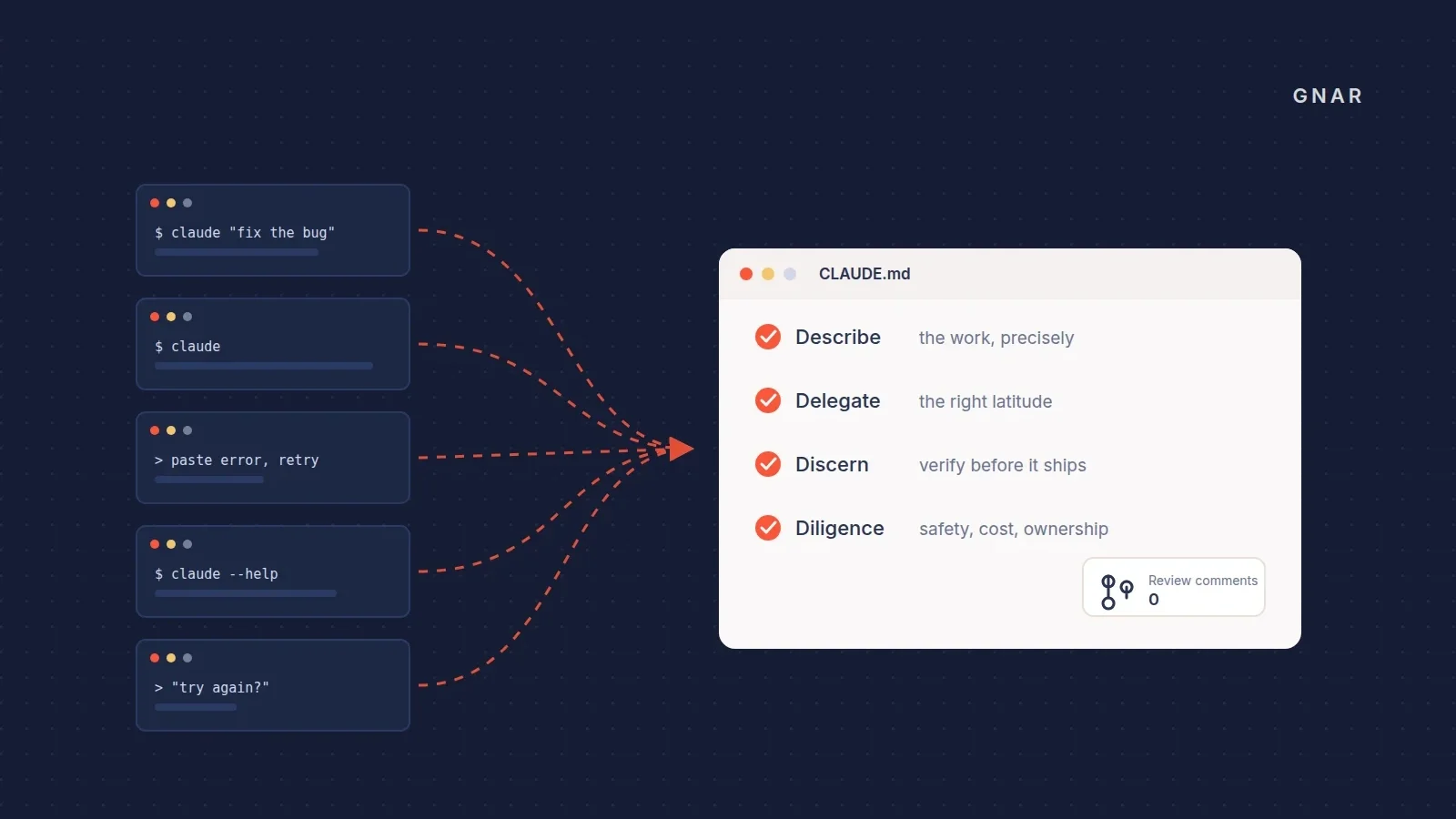
An insurer needs four things in place before it rolls out Claude. A qualified person reviews each final Claude recommendation on an underwriting, pricing, claims, coverage, cancellation or non-renewal decision. The customer gets a notice. Where permitted by law, a wholly favorable claim payment may skip the human review. Your own systems keep an audit trail. Where you use Claude Enterprise, Claude keeps one too. Each Claude use sits in your model inventory with a testing plan. And your security team has read Anthropic's SOC 2 report and ISO 27001 certificate against your own controls.
This post is for the CIO of a mid-size insurer whose CEO or board has asked if the company is ready for Claude. Underwriting, claims and compliance may all want it. Your state regulator and your auditors will want to see how it is governed. The requirements below trace to public pages. The pages are Anthropic's own policies and help center, the NAIC model bulletin on insurers' use of AI, New York's Department of Financial Services, and NIST.
The Gnar Company is a Claude Select Services Partner in Anthropic's Claude Partner Network. Its enterprise AI integration work connects Claude to the systems a company already runs, with access rules and a request log built in from the first release.
What does an insurer need before rolling out Claude?#
An insurer needs four groups of controls before Claude goes live: human review gates, audit trails, model risk management, and vendor assurance such as SOC 2 and ISO 27001. Human review gates decide which uses need a named reviewer and a customer notice. The other groups decide what you can prove afterward.
Human review gates#
- A written list of every planned Claude use that feeds an underwriting, pricing, claims, coverage, cancellation or non-renewal decision.
- A named, qualified reviewer for each use that produces a recommendation in one of those decisions. A use under the policy's exclusions needs no reviewer. Where permitted by law, a wholly favorable decision on the policy's list may skip the reviewer. The reviewer can change what Claude advises before it is used.
- Notice wording for the customer when AI helped produce advice or a decision about them.
Audit trails#
- Where you use Claude Enterprise: audit logs exported by an Owner (each export covers the past 180 days), or the Compliance API feeding your security tools.
- A record in your own claims or policy system of what the reviewer did with Claude's output.
Model risk management#
- One row in your AI inventory for each Claude use, with its purpose, its inputs and the model version.
- A test set of past files graded by your own experts, run before launch, regularly while in operation, and again before any model change.
- A dated plan for Anthropic's model retirements.
Vendor assurance#
- Anthropic's SOC 2 report and ISO 27001 certificate requested through its Trust Portal and read by your security team.
- Contract terms on audit rights, data use and cooperation with regulators.
Which public source backs each item?#
The table's sources include Anthropic's Usage Policy, help center and Trust Portal, the NAIC bulletin, New York's Circular Letter No. 7 and NIST's AI RMF. It also names the document to have in hand before launch. Anthropic's pages describe Claude. The NAIC, New York and NIST pages describe what regulators and standards bodies expect from you.
| Checklist item | Public source | Have in hand |
|---|---|---|
| Human review gate | Anthropic Usage Policy | A named reviewer for each high risk use |
| Customer notice | Anthropic Usage Policy and the NAIC bulletin | Notice wording for each letter or screen |
| Audit trail | Claude Enterprise audit logs and Compliance API | An export or a feed into security tools |
| Model inventory | NAIC bulletin and New York Circular Letter No. 7 | One inventory row per Claude use |
| Validation and drift | NAIC bulletin and NIST AI RMF | Test results graded by your experts |
| Model retirement | Anthropic model deprecations page | Retirement dates and a retest plan |
| SOC 2 and ISO 27001 | Anthropic help center and Trust Portal | Current reports read by security |
| Contract terms | NAIC bulletin | Audit and regulator cooperation clauses |
Which insurance decisions does Anthropic call high risk?#
Anthropic's Usage Policy, in the version effective November 12, 2026, lists insurance as a High-risk Area. Under insurance it names underwriting or pricing a policy and determining the outcome of a claim. It also names making a coverage, prior-authorization or medical-necessity determination, and cancelling or declining to renew a policy.
When Claude provides a recommendation in one of those areas, the policy requires two controls. First, a qualified person must meaningfully review the recommendation, with the authority to change or modify it. That review happens before the recommendation is delivered as advice or used to implement a decision. Second, the person who is the subject of the decision must be clearly told that AI was used to produce it. The policy says users do not need to identify Anthropic, Claude, or the model used.
The policy defines a qualified person as someone with the training or experience to evaluate the output in that field. Where applicable law requires a license for the underlying activity, the qualified person holds one. That person remains responsible for the accuracy and appropriateness of what is delivered or decided. The policy also says these requirements apply alongside applicable law, so they sit on top of your state's insurance rules.
The policy gives examples of exclusions. Its requirements do not apply to: "Internal drafting, research, summarization, or analysis that is not the ultimate High-risk AI Recommendation delivered." It also names "carrying out a decision a person has already made, or applying a fixed rule, formula, or algorithm where the model exercises no judgment about the individual." Another example is "business operations that do not advise or decide about a specific individual." A claims summary for an adjuster fits the internal drafting and summarization example only if it is not the final recommendation. That is the policy's own condition. It also has a list headed "Favorable Decisions." It says: "Where permitted by law, human-in-the-loop review is not required before acting on a High-risk AI Recommendation wholly favorable to the individual in the following circumstances: Paying an insurance claim. Approving coverage or prior authorization for care a clinician has ordered. Granting eligibility for a healthcare service or program. Granting or continuing a public benefit or service." For an insurer, the listed case is paying an insurance claim. For a health insurer, it is approving coverage or prior authorization for care a clinician has ordered. Favorable underwriting, pricing or renewal decisions are not on that list. The policy adds: "A partial approval, reduced amount, or approval with conditions is not considered 'wholly favorable.'" It also says: "Additional legal obligations such as disclosure may still apply."
The policy applies to anyone who submits inputs to Anthropic's products. That includes customers who reach Claude through cloud providers and authorized resellers. Buying Claude through a cloud provider or a reseller does not move an insurer outside it.
Sort every planned Claude use against those four decision types. Each use that lands on the list, and is not under the policy's exclusions, gets a named reviewer before launch. It also gets a customer notice. Where permitted by law, a wholly favorable decision on the policy's list may skip the reviewer.
Where does the human review gate go?#
The review gate goes at the point where Claude's output turns into a decision, before anything reaches the customer or the policy record. Anthropic's wording sets the timing: the review comes before the recommendation is delivered as advice or used to implement a decision. A check after the letter has gone out comes too late.
The NAIC model bulletin makes a related point from the regulator's side. It asks insurers to scale their controls to the risk of each AI System. One factor it names is "the extent to which humans are involved in the final decision-making process."
Anthropic's customer story on DXC Technology, which runs core systems for insurance carriers, describes one way to set this up. According to that story, the Claude agents in DXC's Assure platform "operate inside set authority levels, and humans own the checkpoints on calls with material, legal, or financial weight."
Four design rules make that review provable. This is general engineering advice:
- Put the approve step in the claims or policy system, so the sign-off sits next to the record it changes.
- Show the reviewer the documents Claude worked from, so the review checks evidence as well as wording.
- Record the reviewer's name, the time, and whether they kept, changed or rejected Claude's recommendation.
- Route every change to a policy or claims record through one checkpoint that checks permission first.
Gnar's enterprise AI integration page describes that last rule: AI cannot change a record directly. Every change passes one checkpoint the client controls, which checks permission first, and a person can approve it before it lands.
What should the audit trail record?#
Where you use Claude Enterprise, the audit trail for Claude has two halves. Claude Enterprise records who did what inside Claude. Your own claims and policy systems record what happened to the customer's file. The NAIC bulletin says a regulator may ask about a specific AI System and its outcomes, and that answer needs both halves.
On the Claude side, Anthropic's help center says audit logs are available for Enterprise organizations only. Owners can export all audit logs for the past 180 days. The export button does not work for Enterprise organizations that use customer-managed encryption keys. Those organizations get audit log events through the Compliance API. The export leaves out the title and content of chats and projects and includes only their unique identifiers. Primary Owners can export chat inputs and outputs through a separate data export.
The Compliance API is the programmatic route. Anthropic's docs say it gives Claude Enterprise and Claude Console customers access to the organization's Activity Feed. For Enterprise organizations it also covers chats, files and projects, plus sessions in tools such as Claude Code. Anthropic says security, legal and compliance teams use it to audit activity, retrieve or delete content, and feed events into downstream tooling.
Claude's logs stop at Claude. They cannot show what an adjuster did with a draft after it left Claude. That record has to come from your own system, and it should hold:
- The claim or policy number the output relates to.
- Which Claude use produced it, and the model version.
- The documents or records Claude was given.
- Claude's output as the reviewer saw it.
- The reviewer, the time, and whether the output was kept, changed or rejected.
- The final decision and the notice sent to the customer.
Anthropic's customer story gives DXC's version in one sentence. Its executive Bill Pieroni says: "Every action is recorded: who decided, what basis, what moment, whether it's a person or the agent." On Gnar's integration page, the request log shows who asked, what the AI looked up, and what it changed. The client's security team can review it.
How does model risk management apply to a model you did not build?#
Model risk management applies to Claude much as it applies to a rating model bought from a vendor. You inventory each use. You validate it on your own files, test it for drift while it runs, and retest it when the model changes. The NAIC bulletin says an insurer's AI program should address the AI Systems it uses, whether developed by the insurer or a third-party vendor.
Step 1: inventory each use#
Section 4 of the NAIC bulletin says a regulator may ask for inventories and descriptions of AI Systems used to make or support decisions that can result in Adverse Consumer Outcomes. New York's Circular Letter No. 7, which covers underwriting and pricing, says documentation may include "an up-to-date inventory of all AIS implemented for use, under development for implementation, or recently retired." It also asks how each one operates, its inputs, its purpose and any restrictions on use. Write one row for each Claude use, because a claims summary and an underwriting memo carry different risks.
Step 2: validate against your experts#
The NAIC bulletin says validation can take the form of "measuring performance against expert review." For Claude, that means a set of past files with the answers your senior underwriters or adjusters gave. Grade Claude's output against those answers before launch, and keep the results.
Step 3: test while it runs#
NIST's AI Risk Management Framework says AI systems should be tested before their deployment and regularly while in operation. New York asks for unfair discrimination testing before an AI system goes into production. It asks for the same testing on a regular cadence after that, and whenever material updates or changes are made. The NAIC bulletin adds a point about what gets tested. It says validation, testing and auditing should reflect the underlying components of the AI System, "whether based on Predictive Models or Generative AI."
Step 4: plan for model retirement#
Anthropic's model deprecations page says Anthropic gives customers with active deployments at least 60 days' notice before retiring a publicly released model. Requests to a model past its retirement date fail. Anthropic suggests testing applications with the new models well before the retirement date. Amazon Bedrock and Claude Models on Google Cloud (Google managed) set their own retirement schedules. Treat each model change as a material change that reruns Step 2.
The NAIC bulletin lets an insurer's program rely on a framework such as the NIST AI Risk Management Framework, Version 1.0. NIST released it on January 26, 2023, for voluntary use. Its core has four functions: govern, map, measure and manage.
Anthropic's own deployment guide for financial firms puts model risk management in the first phase. It says model risk management, SEC and FINRA alignment, and data privacy review "should run alongside access setup." That guide is written for financial firms. An insurer's version of the same line names its state insurance regulator.
What do SOC 2 and ISO 27001 cover, and what do they leave to you?#
SOC 2 and ISO 27001 cover the controls Anthropic runs on its own side. A SOC 2 report is a CPA's examination of a service organization's controls, and ISO 27001 sets requirements for an information security management system. They leave to you how your company uses Claude: which decisions it touches, who reviews it, and what your own systems record.
Anthropic's help center lists its compliance credentials for commercial products such as Claude for Work and the Anthropic API:
- SOC 2 Type I and Type II.
- ISO 27001:2022, for information security management.
- ISO/IEC 42001:2023, for AI management systems.
- A HIPAA-ready configuration, with a BAA available.
Copies of the compliance documents are requested through Anthropic's Trust Portal. The AICPA describes SOC as a suite of service offerings CPAs may provide on the controls of a service organization. Its SOC 2 guide covers controls relevant to security, availability, processing integrity, confidentiality or privacy. ISO describes ISO/IEC 27001 as the world's best-known standard for information security management systems, one that "defines requirements an ISMS must meet."
New York's regulator is clear about what stays with the insurer. Its circular letter covers AI tools used in underwriting and pricing. It says insurers retain responsibility for understanding those tools when third-party vendors developed or deployed them. They must also make sure those tools comply with the law. It also says an insurer "may not rely solely on a third-party's claim of non-discrimination."
| Question | Who answers it | Where the answer lives |
|---|---|---|
| Are Anthropic's systems secured? | Anthropic | SOC 2 report and ISO 27001 certificate |
| Does Anthropic run an AI management system? | Anthropic | ISO/IEC 42001 certificate |
| Is our data used to train models? | Anthropic | Enterprise terms and Trust Center |
| Which of our decisions use Claude? | Your company | Your AI inventory |
| Who reviewed this claim decision? | Your company | Your claims system record |
| Was Claude tested on our own files? | Your company | Your validation results |
What will a state regulator ask to see?#
In an investigation or market conduct action, a regulator in a state that adopted the NAIC model bulletin can ask to see these records: your written AI program, your inventory of AI systems, your testing records, and your diligence and contracts for third-party AI. Those requests come from Section 4 of the NAIC model bulletin, adopted by the NAIC on December 4, 2023. Each state that adopts it issues its own version, such as a bulletin or a notice.
The NAIC's implementation map, with status as of November 13, 2026, lists adopting jurisdictions that include Connecticut, Illinois, Massachusetts, New Jersey, Pennsylvania, Texas, Vermont and Wisconsin. It lists California, Colorado and New York separately, under insurance specific regulation or guidance. The map notes that it does not show whether a state's bulletin contains every element of the model. So read your own state's bulletin.
Under Section 4, a regulator may request:
- The written AI program (the bulletin calls it an AIS Program), and evidence it was adopted.
- Its scope, including any AI systems it leaves out.
- Inventories and descriptions of the AI systems used to make or support decisions that can adversely affect consumers.
- The data behind a specific model or AI system, including its source, lineage, quality and bias analysis.
- Validation, testing and auditing records, including evaluation of model drift.
- For third-party AI: due diligence, contracts, and audits of the vendor's compliance.
The bulletin places the AI program with senior management accountable to the board or a board committee. It suggests a committee drawn from units such as underwriting, claims, actuarial, compliance and legal. It also says insurers may show compliance through other means, and that its goal is not to prescribe specific practices. New York's letter expects the board and senior management to own the overall outcomes of AI used in underwriting and pricing. If your board also wants a short policy of its own, Gnar's board AI governance framework lists ten items a board can approve.
What should the contract with Anthropic or a reseller cover?#
The contract should give you audit rights or audit reports. It should require the vendor to cooperate with regulatory inquiries and pin down how your data is used and kept. The first two terms come from the NAIC bulletin's section on third-party AI systems, which says to include them "where appropriate and available."
- Audit rights, or the right to receive audit reports by qualified auditing entities.
- Cooperation with regulatory inquiries and investigations about your use of the product.
- Data use: Anthropic's Enterprise page says your prompts, data and results are not used to train its models by default. Get the terms that apply to your account in writing.
- Retention and encryption: Claude Enterprise lists custom data retention and customer-managed encryption keys.
- Model changes: on Anthropic-operated platforms, at least 60 days' notice before a publicly released model retires. If you buy through Amazon Bedrock or Claude Models on Google Cloud (Google managed), get that platform's retirement terms.
Section 4 of the bulletin also lists the contract terms a regulator may ask to see. Have your legal team check each one before signing.
Where should the first Claude use sit?#
Start with document-heavy, standard-shape work, and keep novel or high-stakes work out of the pilot. That is Anthropic's own advice in its deployment guide for financial firms. The guide says: "Pick work that's document-heavy and standard-shape." It names a claims summary as one back-office example and says: "Avoid piloting Claude on novel or high-stakes work."
Write the pilot so Claude summarizes and the adjuster decides. If the summary becomes the ultimate recommendation on a claim outcome, the use moves into the decision types Anthropic's Usage Policy lists.
The same guide says enterprise controls for SSO, SCIM, audit logs and custom data retention need to be configured before the pilot. It also names the platforms: the first-party API, Amazon Bedrock, Google Vertex AI or Microsoft Foundry. The guide says the choice is "whichever keeps Claude inside the firm's existing cloud perimeter."
As general advice, a pilot that clears the checklist has:
- One line of business and one document type.
- A reviewer who already does this work by hand.
- A test set of past files graded by that reviewer.
- Audit logs and your own decision record running from day one.
- An inventory row and a written note on what Claude may and may not do in this use.
Where does The Gnar Company fit?#
The Gnar Company builds the connections between Claude and the systems a company already runs, with access rules and a request log built in from the first release. Gnar is a Claude Select Services Partner in Anthropic's Claude Partner Network, as its enterprise AI integration page states.
The steps on Gnar's integration page line up with the checklist. In Gnar Discovery and Design, Gnar lists each system AI needs to reach, what it may see and change, and who signs off. It also flags messy data or access settings that would block it. In the build, the connectors come with access rules and a request log. Before launch, the client's security team gets the access rules and the request log to review. Where the client's system allows it, the AI only sees what the person asking can see. The connections are not tied to one model, so the next model uses the same connectors and rules. Gnar can build it in the client's own cloud account, and the client owns what gets built.
Gnar's published insurance case study is the Vermont Mutual quote platform. The engagement started with a structured evaluation of React, Vue and Angular, and Gnar recommended React. A senior Gnar engineer then joined Vermont Mutual's team as the lead React engineer. Vermont Mutual's agents got a web-based quote application, and the team keeps an agile process it now runs itself. That was embedded senior engineering. The case study describes no Claude work.
Discovery's three tiers are $15,000, $20,000 and $30,000 for two, four and six weeks. Each tier ends with a plan and a fixed price for the build, whether or not you build with The Gnar Company. Gnar's guarantee, as published: "Three commitments on every build engagement: a fixed milestone price with any overage on us, a guaranteed outcome meaning the software works as specified or we fix it, and a twelve-month bug-free warranty. It covers Discovery, Build, Forge and Maintain. It does not cover Embed. On Compass, Immerse and Integrate, ask us."