Six firms whose own pages say they build AI agents are The Gnar Company, 8th Light, Innovecs, 10Pearls, Vstorm and Biz4Group. They differ in where they start, how they test an agent and who runs it after launch. The useful way to compare them is to send each one the same real back-office job and read the answers side by side.
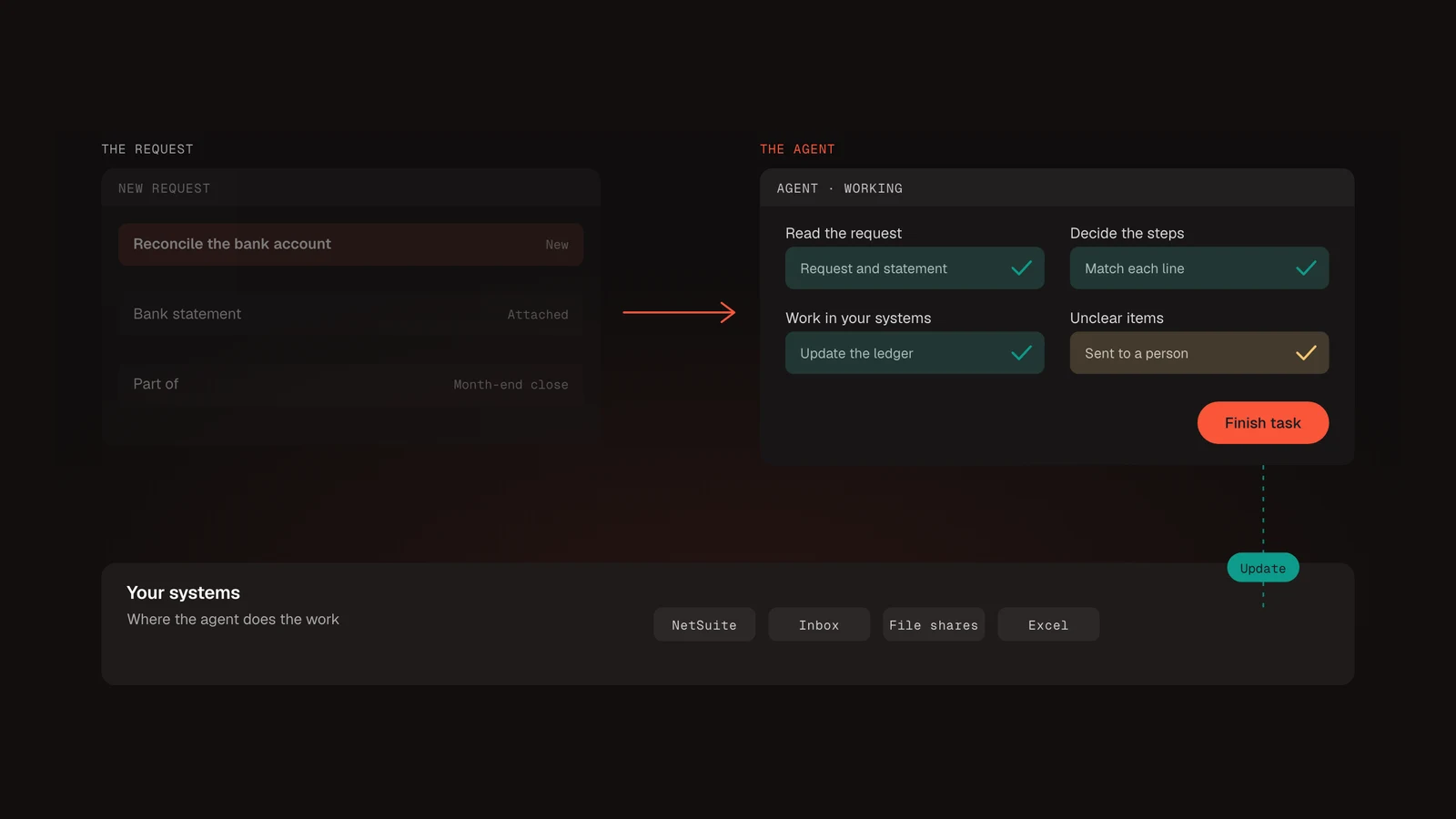
The Gnar Company builds custom AI agents for mid-sized companies. Its AI agent development page gives matching bank lines at month-end as an example of the routine finance and operations jobs its agents do. Gnar's guarantee, in its own words: Three commitments on every build engagement: a fixed milestone price with any overage on us, a guaranteed outcome meaning the software works as specified or we fix it, and a twelve-month bug-free warranty. It covers Discovery, Build, Forge and Maintain. It does not cover Embed. On Compass, Immerse and Integrate, ask us.
This guide is for a COO who wants an agent doing real work in NetSuite or a similar system. Each firm's entry quotes that firm's own page, read on November 15, 2026. Gnar wrote this guide and is one of the six, so weigh our entry with that in mind.
Which AI agent development firms should you compare?#
The six firms below all describe building AI agents on their own pages: The Gnar Company, 8th Light, Innovecs, 10Pearls, Vstorm and Biz4Group. The middle column follows each firm's own page. The last column is the question we would ask that firm on the first call.
| Firm | What its own page says it builds | Ask them |
|---|---|---|
| The Gnar Company | AI agents for mid-sized companies, many of them manufacturers and distributors on NetSuite or a similar system | Which job would you start with, and when would you tell us not to build it? |
| 8th Light | "AI from prototype to production. One workflow at a time, inside your stack." | What does your starter kit leave in our environment when you finish? |
| Innovecs | Custom AI agents for "smarter workflows connected to enterprise systems, data, and human review" | Which records can the agent change on day one? |
| 10Pearls | Agent design and development, multi-agent orchestration and human-in-the-loop systems | Which of your developers and AI experts would work on our agent? |
| Vstorm | Takes "one real workflow from strategy to a live system your team owns" | What result on a real case would make you say no? |
| Biz4Group | Delivers "enterprise-grade AI agents that automate complex workflows" | Which of your agents runs a back-office job like ours today? |
This list covers firms that build agents to order. Platforms that sell a ready-made agent belong in a different comparison, and the last section of this guide covers when to pick one instead.
What does an AI agent development company build?#
An AI agent development company builds software that takes a request, decides the steps and does the work inside your systems, sending unclear cases to a person. That makes an agent different from a chatbot, which answers questions, and from automation, which repeats the same steps every time.
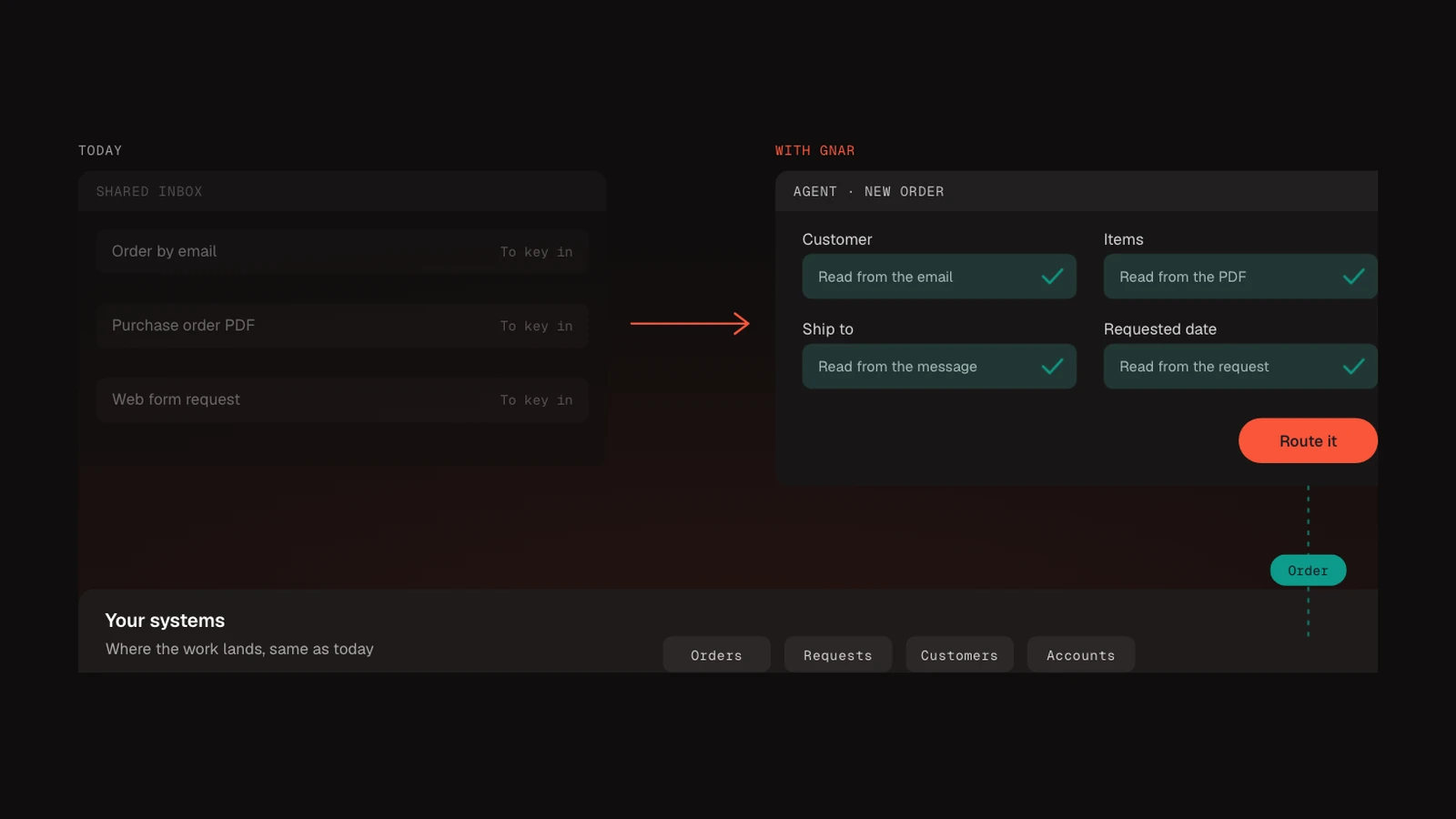
Gnar's agent page draws the line in plain words. "A chatbot answers questions. An AI agent does the work." It describes AI automation as software that "reads orders and requests in any format and enters them the same way every time," while an agent "also decides what has to happen, then does it in your systems."
Anthropic makes the same split in its December 2024 engineering post on building effective agents. "Workflows are systems where LLMs and tools are orchestrated through predefined code paths." "Agents, on the other hand, are systems where LLMs dynamically direct their own processes and tool usage, maintaining control over how they accomplish tasks." LLM stands for large language model.
The split matters when you read a firm's pitch. In a June 2025 press release, Gartner warned about "agent washing." It described this as "the rebranding of existing products, such as AI assistants, robotic process automation (RPA) and chatbots, without substantial agentic capabilities." Gartner estimates only about 130 of the thousands of agentic AI vendors are real. The same release predicted that over 40% of agentic AI projects will be canceled by the end of 2027, due to escalating costs, unclear business value or inadequate risk controls.
One plain question cuts through most pitches. For the job they would build for you, which steps does the agent decide, and which steps are fixed code? Ask it about your job by name.
The six firms, from their own pages#
Each profile below uses only what that firm's own page says, read on November 15, 2026, and ends with the question we would ask. All six describe building agents, and the order is not a ranking.
The Gnar Company#
The Gnar Company builds custom AI agents for mid-sized companies. Its page says most of those companies have small tech teams, and many are manufacturers and distributors on NetSuite or a similar system. The example job is the month-end bank reconciliation. "An agent matches the lines and updates the books. Your team handles only the lines it can't match."
Senior U.S. engineers build the agent, its connections and its tests in the client's own cloud account, such as AWS. "We test each agent on your own past cases first, so you see it work before it touches live records." The Gnar Company is a Claude Select Services Partner, which means Anthropic has vetted us to build with Claude.
Ask us which job we would start with. On the first call, Gnar says it will tell you if a product or your own team can do the job instead.
8th Light#
8th Light's agentic AI page opens with "AI from prototype to production. One workflow at a time, inside your stack." It argues that "The challenge isn't building an AI agent, it's operating one." Its Applied Agent System offer says, "We deliver a single, durable agentic workflow into production."
The firm builds on InsightMesh, which it calls "a flexible agent starter kit that is yours to keep." The page says it "Operates within your VPC or on-premise," meaning inside your own private cloud network or your own servers. It also lists "Built-in evaluation harnesses and observability."
Ask them: which parts of InsightMesh stay in your environment, and who maintains them after the engagement ends.
Innovecs#
Innovecs says it "builds custom AI agents for companies that need smarter workflows connected to enterprise systems, data, and human review." Its page lists connections to "ERP, CRM, WMS, TMS, support tools, analytics platforms, internal databases, and third-party APIs." It names "a task-specific agent for back-office work" as one kind of build.
On security, the page says Innovecs adds human review, audit trails and fallback logic for sensitive workflows, "because a fast agent still needs a brake pedal."
Ask them: which records the agent can change on day one, and which it can only read.
10Pearls#
10Pearls' agentic AI page lists agent design and development, multi-agent orchestration and human-in-the-loop systems among its services. It describes "developing efficient, auditable, and explainable HITL agentic AI systems." HITL stands for human in the loop, where a person reviews or approves the agent's work.
The page counts 1400+ developers and AI experts and 200+ enterprise clients across industries. Its last step, monitoring and optimization, says, "We monitor the behavior of agentic AI systems for drift."
Ask them: which people from that team would work on your agent, and for how long.
Vstorm#
Vstorm says, "Vstorm is an agentic AI engineering company." Its site adds, "Through the TriStorm methodology, we take one real workflow from strategy to a live system your team owns." It sums up the method this way: "We align on one workflow, prove value on a real case, then wire agents into the processes they need to run in day to day."
Its 15 or 30 minute session with the engineers promises "A straight read on feasibility, including no."
Ask them: what result on a real case would make them tell you not to build.
Biz4Group#
Biz4Group's AI agent page says, "We are an AI agent development company delivering enterprise-grade AI agents that automate complex workflows." Among the agent types it builds, it lists agents "designed for automating repetitive tasks and enhancing operational efficiency," used for "automated scheduling, workflow automation, and document processing."
Its services include "Continuous performance monitoring, fine-tuning, and retraining to ensure accuracy and efficiency."
Ask them: which of their built agents runs a back-office job like yours today, and whether you can speak to that client.
How do you test a firm with one real job?#
Send every firm the same written job, with real past cases attached, and compare what comes back. The steps below are general engineering advice. They use the month-end bank reconciliation as the example, because it is the job on Gnar's agent page.
- Describe the job as it runs today. Name the systems, such as NetSuite, the bank statement file and a shared inbox. Say who does each step and how long the close waits on it.
- Attach past cases with the right answers. Use last month's statements, plus the odd lines your team had to chase, with names removed.
- Ask which steps the agent decides and which are fixed code. This is the workflow and agent split from Anthropic's post.
- Ask what the agent will read, what it may change and what goes to a person. A good answer names the records and fields.
- Ask how the firm will prove the agent works on your cases before it touches live records, and what score counts as a pass.
- Ask who owns the code, who runs the agent after launch and what the first phase costs, in writing.
Then put the answers side by side. A firm that replies with a demo of some other job has not answered your question. A firm that tells you a product already does this job has given you a useful answer, even if it costs that firm the work.
What should an AI agent be allowed to touch?#
An agent should get only the access its job needs, a person should approve high-impact changes, and every action should be logged. The first two are the core of OWASP's guidance on Excessive Agency, entry LLM06:2025 in its list of risks for apps built on large language models.
OWASP defines Excessive Agency as "the vulnerability that enables damaging actions to be performed in response to unexpected, ambiguous or manipulated outputs from an LLM." Its fixes make a short checklist to put in front of any firm:
- Limit the tools the agent may call "to only the minimum necessary."
- "Limit the permissions that LLM extensions are granted to other systems to the minimum necessary." For a reconciliation agent, that could mean reading bank lines and ledger entries, with write access only where it records a match.
- "Utilise human-in-the-loop control to require a human to approve high-impact actions before they are taken."
- "Implement authorization in downstream systems rather than relying on an LLM to decide if an action is allowed or not."
- Log and monitor what the agent and the connected systems do. OWASP lists this among options that will not prevent Excessive Agency but can limit the damage.
Here is how the firm pages describe these controls. Gnar's page says, "You choose which changes need a person's OK, and you own the code." It adds, "Give it read-only access, and it can see records but never change them." Innovecs says it designs agents so they "can reach only the systems, files, and actions they are allowed to use." 8th Light describes "ensuring appropriate human oversight on your behalf," and 10Pearls lists human-in-the-loop systems as a service.
Ask each firm where these rules will live. They can sit in the agent's instructions, or in the permissions of the systems it connects to. OWASP's advice on authorization points to the second.
How do you know the agent works before it goes live?#
An agent is ready when it passes tests built from your own past cases, including the odd ones, and those tests run again after every change. A demo on sample data shows the idea can work. It does not show that the agent handles your exceptions.
Gnar's page describes its own practice. "We test every agent on your own past cases, including the odd ones. Each time we change it, the tests run again." It adds, "Engineers call these tests evals. They run again each time we change the agent or its AI model." And when a model is retired or you switch models, "the tests run again before the new one goes live."
The other pages describe testing in their own terms. 8th Light lists built-in evaluation harnesses. Innovecs says "AI agents need testing that goes past happy-path demos," and lists output quality, edge cases, failed requests, latency, security behavior and handoff rules among its checks. Vstorm's method includes proving value on a real case before agents are wired into daily work.
Ask every firm what the pass mark is, who agreed it, and how many of your past cases the test set holds. The way to build that test set, from picking cases to rerunning them after a model update, is laid out in our guide to getting an AI agent from demo to production.
What did Counter Culture's AI roadmap say about where AI belongs?#
Counter Culture Coffee's AI roadmap, built by The Gnar Company, found that many of the gains in a faster month-end close come from NetSuite capabilities the company already owns. For the month-end close, the case study reserves AI for reconciliations and accrual worksheets.
The case study describes the work. A senior Gnar strategist led it, with 15+ interviews of leadership, department heads and the operators who run the day to day. The team mapped every system and data flow, with NetSuite at the center. It catalogued 79 AI and automation opportunities across seven capability areas, and workflow and task automation led with 17.
Every opportunity was scored on the same five dimensions. Weak data readiness capped an opportunity's score regardless of its upside. The case study notes why: "An assistant is only as reliable as the data it reads, and it has no way to know which of two similar fields is the right one." It reports $1.5M in potential savings across the top 10 initiatives. The findings were presented to Counter Culture's board.
What it shows: a roadmap that sorted where AI fits from where the ERP can already do the job. What it does not show: an agent build. It is a planning engagement, and it is the reason we suggest asking every firm one thing. Which parts of this job can your current system already do?
What do Gnar's published prices cover?#
The Gnar Company publishes Gnar Discovery and Design at $15,000 to $30,000 and its builds at typically $150K to $300K+. With any firm, ask for the first phase as a fixed price in writing, so you can stop after it. Gnar's agent page calls this step the discovery sprint and points to the Discovery page for prices and lengths.
| Step | Published price | What you get |
|---|---|---|
| Discovery, Foundation | $15,000 for two weeks | A Milestone Project Plan and a fixed price for your build |
| Discovery, Core | $20,000 for four weeks | A Milestone Project Plan and a fixed price for your build |
| Discovery, Accelerator | $30,000 for six weeks | A Milestone Project Plan and a fixed price for your build |
| Build | Typically $150K to $300K+ | The build the plan scopes, at its milestone prices |
| Maintain (Gnar's monthly support plan) | From $1,000 a month | Hosting, monitoring, support and a standing relationship |
The Discovery page says you get that plan whether or not you build with The Gnar Company. The build range on that page covers the builds a Discovery plan scopes in general, not agents alone. The Maintain price is published on the Gnar Forge page, which says it buys hosting, monitoring, support, and a standing relationship with the person who built your app.
Someone has to describe the job, pull the past cases and check the test results. Ask each firm how many hours it expects from your people in the first phase, and from whom.
Who runs the agent after launch?#
Either your own team or the firm that built it runs the agent after launch, and your contract should name which. Each firm page describes this part in its own words:
- The Gnar Company: "We can keep it running for you and rerun the tests each time it changes. Or we hand it to your team with the docs and walkthroughs they need." The page adds, "If the agent itself has a bug, we fix it free for the first 12 months."
- 8th Light: its larger Roadmap-to-Production Build Program delivers a portfolio of workflows and sets up what it calls the AgentOps operating system to sustain them.
- Innovecs: "An AI agent is not finished the day it goes live." It supports monitoring, quality checks, performance review and tuning after launch.
- 10Pearls: it monitors agents for drift and makes changes to individual agents and to how they work together.
- Vstorm: "Every engagement ends with your team owning what runs."
- Biz4Group: its services include continuous performance monitoring, fine-tuning and retraining.
Ask two follow-up questions of each firm. Who gets the alert when the agent fails on the last day of the close? And what does running it cost each month after the build is paid for?
When should you buy a product instead of hiring a firm?#
Buy a product when one already does the job in the systems you have. Hire a firm for work that no product handles, or that a product handles only after heavy setup. Gnar's agent page says it plainly: "If a product fits your job, buy it, and we'll tell you so." It also warns, "The agent market is still young. So before you sign, test any product on your own past cases."
Anthropic's post recommends "finding the simplest solution possible, and only increasing complexity when needed," and adds, "This might mean not building agentic systems at all." In Gartner's release, analyst Anushree Verma said organizations "can start by using AI agents when decisions are needed, automation for routine workflows and assistants for simple retrieval."
A simple decision rule, as general advice:
- A product covers the job inside your current ERP. Buy it, and test it on your own past cases first.
- The steps never change and need no judgment. Automate them. Our guide to AI workflow automation for operations teams traces one emailed order through that kind of build.
- The job needs judgment inside your own systems, and no product fits. That is the work an AI agent development firm is for.
Gnar's page says it will tell you an agent isn't the fit if a product or your own team can do the job. "Same if you only need a website chatbot."