This post is for a CEO whose product roadmap is waiting on engineering roles that have been open for two months or more. The in-house vs outsourced software development choice comes down to who directs the work and who owns the outcome. After about two months, stop treating the open seat as the only plan. Keep recruiting for the permanent seats, and cover the work that only needs to get done with embedded engineers, a project handoff or a smaller scope. The decision matters because every month a roadmap item waits, the customer, board or regulator counting on it waits too.
The post covers what the hiring numbers say, what an empty seat costs, six options besides more recruiting, and when each one fits. It ends with two checklists you can use in your next meeting with your head of engineering.
The Gnar Company describes what it does as custom software built around how your operation actually works, from a firm that will tell you when not to build it. That includes adding engineers to your team when your own hiring is behind. Part of the advice below points at a firm like Gnar. Part of it says you should not hire one. Both are meant.
If you want the short version of the in-house vs outsourced software development question for your situation, read the table in the third section and the two checklists at the end. The rest explains why.
How long can an engineering role stay open?#
A role can stay open for roughly six to ten weeks and still be normal. Published benchmarks put time to fill for software and tech at 72.0 days. After that point, the seat is slower than the average for your industry, and waiting for it is a choice you are making. Past two months, start work on a second path.
The numbers come from three sources, and they measure different things. Time to fill runs from the day the job is posted to the day an offer is accepted. Time to hire runs from a candidate's first contact with you to the accepted offer. Time to fill is usually the longer number, so compare like with like.
Employ's Hiring Benchmarks Report, built on 2025 data from 6,640 Employ customers, found that time to fill averaged 63.5 days in 2025, down from 67.7 days in 2024. For software and tech companies it was 72.0 days. For mid-market companies, those with 250 to 999 employees, it was 58.1 days. Software and tech sat near the top of the industries the report lists, with manufacturing slightly higher at 72.6 days.
Gem's 2026 Recruiting Benchmarks Report looks at engineering applicants specifically. It covers data from June 2021 to May 2025, 165 million applicants and 1.2 million hires. In Gem's report, only 0.2% of engineering applicants were hired, which is 3.8 times lower than in 2021. The median time to hire in engineering was 39 days.
SmartRecruiters publishes technology benchmarks too. Its figures say technology companies have a median of 48 days to hire and a 77% offer acceptance rate. The same page says that is 26% slower than the global median across all industries.
Read these together and you get a plain picture. Hiring an engineer is slow even at companies that do it well. The pool of applicants who clear the bar is small, and it has gotten smaller since 2021. A good recruiter cannot fix that. A seat that has been open for two months is close to what the data says should happen.
A decision rule for when to stop waiting#
Use the benchmark that matches how you count. If your recruiting dashboard shows time to fill, compare it to 72.0 days. If it shows time to hire, compare it to 39 or 48 days. Then apply three questions.
- Is the role past the benchmark for your kind of company? If yes, the delay is normal, and you should not expect the next week to change it.
- Does the roadmap item behind the role have a date a customer, a regulator or a board has already seen? If yes, the work cannot wait for the hire.
- Is the role a permanent seat that needs a long-term owner, or is it a pile of work that needs to get done? If it is a pile of work, filling the seat is only one way to do it.
If the answer to the first two is yes, open a second path this week. Do not close the role. Keep recruiting for it. A second path protects the date and says nothing against your recruiters.
What does an empty seat cost the roadmap?#
An empty seat costs you the work that nobody can start, plus the work your current engineers do to cover for it. The first cost is visible on the roadmap as a late item. The second is hidden and shows up as slower delivery on everything else. Neither appears on a recruiting dashboard, so add them up yourself.
Start with the work that waits. Take the two open roles and list the roadmap items each one was meant to carry. Be specific. "The mobile app" is a label. "The order-status screen, the push notifications and the login rewrite" is a list. Next to each item, write the date someone outside engineering is counting on. That list is what the open seat is costing you today.
Then look at the internal team that covers. When two seats are empty, the software developers you do have take on the on-call hours, the code reviews, the bug fixes and the questions from the business. Each of those is small. Together they push the planned work later and tire out the people you most want to keep. This is one of the hidden costs of a long search, and it grows the longer the seat stays open.
There is a third cost that executives often miss: the interview load. Every candidate takes hours of your senior engineers' time. A search that runs for months can take a real share of the week of the very people you need building. If the search is long, ask your head of engineering how many hours per week the interviews take. That number tells you what the hiring process is costing you in delivery.
None of this means you should hire faster at any price. A rushed hire in a seat that needs long-term ownership is a costly mistake. It means you should price the delay honestly and decide which work cannot wait.
Sort the work by business needs#
This is the step that makes every later choice easier. Write down the work behind the open roles and put each item in one of two piles.
The first pile is work that needs a permanent owner. It is the core of your product, the system that runs the business, the code your company will live with for years. This pile needs someone on your payroll who will remember why the choices were made.
The second pile is work that needs to get done. It has a clear end. A new integration, a mobile app, a reporting layer, a migration off an old system. Anyone competent who works in your code and follows your process can do it, and then you can keep the result.
Most roadmaps for open roles are a mix, and the second pile is bigger than people expect. That pile is where outside help fits. The first pile is why you keep recruiting.
In-house vs outsourced software development#
In-house vs outsourced software development is a choice about who directs the work and who owns the outcome, and only partly about who is on the payroll. Your own in house team gives you the most control and the slowest start. Outside help changes the contract, the billing and what you keep. The table below compares the choices side by side.
| Option | Who directs the work | Who owns the outcome | How it is billed | What you keep when it ends |
|---|---|---|---|---|
| Keep recruiting in house | Your engineering leaders | You | Salary and benefits | The people, the code and the knowledge |
| Contractors or freelancers | You or your team | You | By the hour or by the engagement, set by the contract | The code, if the contract says it is yours; the knowledge only if it is written down |
| Embedded engineers from a firm | You, through your own workflows and tools | You | Time and materials with Gnar Embed | The code in your repository and what your team learned by working alongside |
| Hand a defined project to a firm | The firm, against requirements you agreed | The firm, to the terms of the contract | A fixed price when the plan is defined | A finished system, a build plan and the documentation |
| A fractional technical lead | The lead, with your team | You, with the lead's advice | A part-time arrangement agreed up front | Decisions, a roadmap and a plan your team can follow |
| Cut or move scope | You | You | No new spend | A smaller product and a plan for what comes later |
Read the table by the second and third columns. If you direct the work and own the outcome, you are adding hands. If the firm directs the work and owns the outcome, you are buying a result. Those are two different purchases with different risks, and mixing them up is a common way a company gets burned by a vendor.
Keep building your in house team#
An in house development team is the right long-term answer for the code that runs your business. Your own engineers hold the context, stay when projects end, and cost nothing extra when a question comes up late on a Friday. The weakness is time. As the benchmarks show, it is slow to build, and a search that ends in a bad hire is slower still.
Keep the search going for every permanent seat. Do not turn off recruiting because you found a stopgap. The stopgap buys time for the search to find the right person instead of the first available one.
Contractors or freelancers#
Contractors and freelancers can cover a narrow, well-defined gap. They work when you can describe the task in a paragraph and have someone on your team who can review the result. The risks are the ones you would expect. You carry the project management. Quality depends on one person. Your intellectual property depends on the wording of the contract, so have counsel read the clause that says who owns the code. Data security depends on what access you hand out and how you take it back.
Embedded engineers from a firm#
Embedded engineers join your in house team and work the way your team works. You set the priorities, they work in your tools, and the result lives in your code. This keeps full control with you while adding technical expertise your open roles would have supplied. The next section covers when this fits.
Hand a project to an outsourced team#
This is the outsourced development option. An outsourced development team takes a project with defined requirements, builds it and answers for the result. You give up day-to-day direction and get a clear owner. It fits a project that has a start, an end and a spec, and does not fit work that changes weekly. A later section covers when to choose it.
A fractional technical lead#
A fractional technical lead is a senior engineer or architect who works part of the week for you. This helps when the real gap is direction. If the open roles exist because nobody on your team can decide how the system should be built, a lead can make that call and write the plan. It does not add engineering hours on its own, so pair it with another option.
Cut or move scope#
Sometimes the right answer is to ship less. If the roadmap item was always a stretch and the seat is empty, moving the date or shrinking the release costs less than any outside help. This is a legitimate choice, and executives should make it on purpose instead of letting it happen by default. Write down what moves, who is told and when the item returns.
When do embedded engineers make sense?#
Embedded engineers make sense when you have the direction but not the capacity. Your leaders know what to build and can review the work, but there are not enough hands. They work as a dedicated team inside yours, adding technical expertise without a second management layer, and they leave the code in your repository. If nobody can direct them, they will not help.
Gnar Embed brings dedicated engineers into your team. According to Gnar's Embed page, they work in your workflows, tools and processes, and each engineer is assigned to just one project at a time, which is yours. The engagement can be short-term help or long-term support, and Embed is billed time and materials. That means you pay for the work done, and the scope can change as your roadmap changes.
Here is a decision rule. Embedded engineers fit when all four of these are true:
- You have a named engineering leader who can set priorities and review code.
- The work is already on your roadmap, with a repository, a backlog and a deploy process.
- The gap is hands, and the decisions about what to build are already made.
- You are still recruiting for the permanent seats and want the outside help to sit next to the hires you make.
If the first two are not true, you have a direction problem. Embedded engineers will wait for instructions that nobody gives, and you will pay for the wait.
What ezCater did#
The clearest example on Gnar's site is ezCater. ezCater runs a business catering marketplace. Gnar has provided embedded engineers to ezCater since 2019, across several ezCater engineering teams, developing new products and improving existing ones. ezCater hired for its own teams at the same time.
The problem, in the case study's words, was that ezCater was "falling behind on their growth and product roadmap goals while focusing on hiring engineers to their internal teams." That is the situation this post is about. The hiring was real and was going to continue. The roadmap could not wait for it to finish. Embedded engineers added capacity to ezCater's teams while ezCater hired.
Two details are worth noticing. First, the outside engineers worked across several teams, so they were a flexible layer that sat next to the internal teams and left them in place. Second, the arrangement has run since 2019, which tells you the model can be long-term when the need is. It does not have to be a stopgap.
What the guarantee covers#
Gnar's guarantee reads: "Three commitments on every build engagement: a fixed milestone price with any overage on us, a guaranteed outcome meaning the software works as specified or we fix it, and a twelve-month bug-free warranty. It covers Discovery, Build, Forge and Maintain. It does not cover Embed."
With Embed, your team directs the work. If you want a firm to answer for the result, that is the project handoff described next.
When should you hand off a whole project?#
Hand off a whole project when the work has defined project requirements, a clear end, and you want one party to answer for the result. It fits when you lack the direction as well as the capacity, or when the work is separate from the system your team maintains. The price of this choice is day-to-day control.
Start with the stalled project instead of the open role. Maybe it is a customer portal, a new order system or an integration with an ERP. Your in house development team cannot take it on, and a new hire would need months to be useful. A firm can take the whole thing, scope it, price it and build it.
Here is a decision rule. A project handoff fits when most of these are true:
- The project has a business reason and an end state you can describe in plain words.
- Your own engineers are busy with the permanent system and would be pulled off it.
- You do not have a leader with the time to direct day-to-day work.
- You want a price and a result in writing before work starts.
The risk is the one you already know. A vendor that does not understand your operation builds the wrong thing, on time, for the agreed price. The way to avoid that is to define the project before you commit to building it.
Discovery first#
Gnar's way of doing this starts with Gnar Discovery and Design. It costs $20,000 for four weeks or $30,000 for six, and it ends in a build plan with a fixed price on it. You do not have to build with Gnar afterward. The plan is yours, and you can take it to another firm or to your own team. That makes Discovery a way to find out what the project is before you commit to a build.
If you build with Gnar, builds typically run $150K to $300K+, and the guarantee quoted above covers Discovery and the build. For a company that has been burned by a vendor, a fixed price with the overage on the vendor is the term to look for in any proposal, from Gnar or anyone else.
Gnar puts the case for this choice in one line: "You have engineers. You just cannot point them at this." Your engineers may be good, and the open roles may be the right ones. A particular project can still sit outside what your team can take on, and that is the project to hand off.
For the longer view of when an agency makes sense, see why some companies bring on an agency instead of hiring in house. If you are unsure whether a project is ready to hand off, what Discovery covers is the place to start.
Can you mix in-house and outsourced teams?#
Yes, and most companies with open roles end up with a hybrid approach for a while. The in house software development team keeps the system that runs the business. An outsourcing partner or external team takes the work with a clear end. The mix depends on project complexity, budget constraints and how much direct control each piece of work needs.
A hybrid works when each side has a clear job. Your internal team sets the business goals, owns the architecture and reviews what comes in. The outside engineers build inside that frame. When the line between the two is fuzzy, two teams make the same decisions twice, and quality control slips through the gap.
Four choices decide whether the mix holds:
- Who owns the code. The repository belongs to your company, and every outside contributor works in it through reviewed changes.
- Who signs what. An NDA and a contract clause that assigns the intellectual property to you come before any access to your systems or customer data.
- Where the engineers sit. Many outsourcing companies sell access to a global talent pool. Ask where the people on your project are based and when their working day overlaps yours. The Gnar Company's engineers are senior and based in the U.S.
- How the culture carries over. Outside engineers who work in your tools, your standups and your review process learn your company's culture the same way a new hire does. Engineers who work out of sight and hand over finished code do not.
The software development costs of a hybrid are easier to read than they look. Salaries and benefits cover the in house team. The outside work is billed by its own contract, either time and materials or a fixed price for a defined scope. Keep the two lines separate in your budget, so you can see what each part of the roadmap costs.
What to ask before you bring in outsiders#
Before you sign with an outsourcing partner, a service provider or an individual, ask for answers in writing on who directs the work, who owns the code, how you will see progress and how the engagement ends. A service provider who answers these clearly is easy to work with. One who dodges them is telling you how the engagement will go.
Use this as a checklist. Ask each question and write down the answer.
Direction and ownership
- Who sets daily priorities, you or the firm?
- Who is accountable if the result does not work: you or the firm?
- Will the code live in a repository that you own from the first day?
- Who owns the intellectual property in everything built, and where does the contract say so?
People and access
- Who exactly will work on this, and are they assigned to your project alone? Gnar's Embed page says its engineers are assigned to one project at a time, yours. Ask any provider the same.
- What access will they need to your systems and data? Data security starts with giving the least access that works, and taking it away on the last day.
- Will the people named in the proposal be the people who show up?
Money
- How is the work billed: fixed price, time and materials, or something else? Know which risk you are carrying.
- What happens to the price if the scope changes?
- What are the hidden costs: tools, environments, a project manager, travel, change requests?
Quality and the end
- How will you see working software before the end, and how often?
- What does the handover include: documents, deploy steps, tests?
- What happens if you want to stop early?
Fit with your team
- Does the service provider work in your development process and tools, or does it expect you to adopt its own?
- Who on your side will be the single point of contact for project management?
- If your own engineers have the capacity and the direction, will the provider tell you to use them? Gnar's objection answer on this is: "Often you should use them. If your own engineers have the capacity and the direction, do it internally and we will say so on the call." A firm that says that on the first call is worth listening to.
How to keep the knowledge when help leaves#
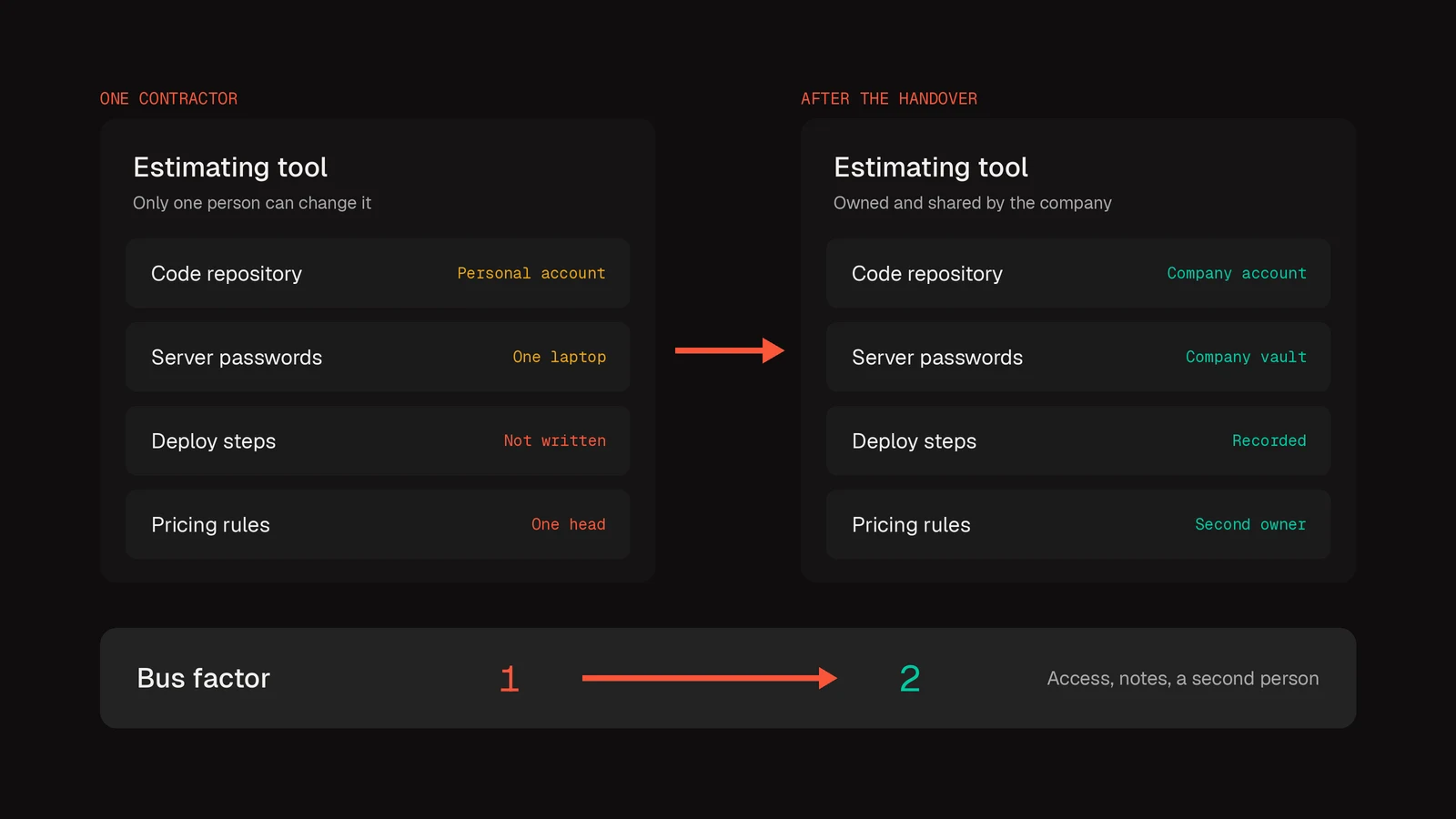
The way to keep the knowledge is to make it live in your systems from day one: the code in your repository, the decisions in writing, and your own engineers working next to the outsiders. Knowledge that stays in an outside engineer's head leaves when the contract ends. Plan for the handover at the start.
This is the same risk that appears when the only developer who knows your system leaves. The difference is that you can see an outside engagement ending on the calendar, so you can prepare. Treat the end date as a deadline for the handover.
Use this as a second checklist, and agree to it before the work starts.
Code
- All code goes into a repository your company owns, from the first commit.
- The outside team works through pull requests that your engineers can read and review.
- Environments, deploy steps and secrets are documented and held by your company.
Decisions
- Every major choice gets a short written note: what was chosen, what was rejected, and why.
- The backlog and open questions are kept in your own tracker.
- A plain-language description of how the system works is updated as the work goes on.
People
- At least one of your engineers pairs with the outside engineers on real work, every week.
- Your engineers do some of the reviews. Reading the code is how they learn it.
- Before the end, the outside engineers walk your team through the system, and your team demonstrates that it can run a deploy without help.
The last week
- Access is removed from every account the outside team used.
- A handover document names every system, every login owner and every scheduled job.
- You have written down which questions you would still need the provider to answer, and how to reach them if you do.
If your permanent hire arrives during the engagement, put them in the pairing sessions on their first day. This is one of the better uses of outside help. The new hire learns the system from engineers who have just worked in it, and the outside team has a concrete person to hand it to.
How The Gnar Company fills the gap#
The Gnar Company offers two ways to fill the gap, and Gnar Embed is the first: it adds dedicated engineers to your team, billed time and materials. Gnar Discovery and Design, followed by a build, hands a defined project to Gnar at a fixed price with the guarantee. The first suits a team with direction and not enough hands. The second suits a project nobody on your side can take on.
For Embed, the engineers work in your workflows, your tools and your processes, on one project at a time, which is yours. You can ask for short-term help or long-term support. The Embed page describes the model, and ezCater and LevelUp are named there as clients.
For a project handoff, start with Discovery. It runs $20,000 for four weeks or $30,000 for six, and it ends in a build plan with a fixed price. You can take that plan and build with anyone. If you build with Gnar, the build is typically $150K to $300K+ and the guarantee covers it.
Gnar also tells you when not to use it. If your own team has the capacity and the direction, you do not need a firm. The right first step is a call where you describe the stalled roadmap item, the two open roles and who on your team could direct outside engineers.
For a related question on the AI side of your roadmap, see fractional chief AI officer or AI consultant.
What to do this week#
Here is a plan you can run in a week without spending money.
- Pull the time to fill or time to hire for each open role and compare it to the benchmarks above.
- List the roadmap items behind each role, with the dates others are counting on.
- Sort the items into work that needs a permanent owner and work that needs to get done.
- For each item in the second pile, pick one option from the table: embedded engineers, a project handoff, a fractional lead, or a smaller scope.
- Keep recruiting for the first pile.
- Agree on the handover checklist before any outside engineer touches your code.
That is the full decision. The roles may take another month, and they may take longer. The roadmap does not have to wait for them.