The best boutique AI consulting firms for a 100 to 500 person company are the ones where the senior people you meet do the work, and where the firm builds what it recommends. Our short list for 2026: The Gnar Company, Atomic Object, HatchWorks AI, Cabin, Opinosis Analytics, Neurons Lab and Azumo. Each one fits a different situation, and the table below shows which.
We are The Gnar Company, and we are on this list. Read our entry knowing who wrote it. The facts in every other entry come from the firm's own website, checked on November 11, 2026, so you can check them yourself.
The Gnar Company runs AI strategy with a small team of senior US-based engineers and a product manager, and when the strategy is set, the same team that wrote it builds and deploys the first automation. That is the bar to check every firm on this list against: who does the work, and does the work end in running software.
This list is written for a CEO or COO at a company where software runs the business but is not the product. Think of a distributor, a manufacturer, an insurer or a logistics firm. If you sell software, other lists will serve you better.
Where do mid-size companies stand with AI?#
The Census Bureau's survey of US businesses found that 32 percent of firms with 100 to 249 employees used AI in the period ending May 3, 2026. Census also reports that 37 percent of firms with at least 250 employees used AI.
In McKinsey's State of AI 2025 survey, 88 percent of respondents said their organization uses AI regularly in at least one business function. Only about a third of respondents said their company had begun to scale it. Among respondents at companies with less than $100 million in revenue, 29 percent said they had reached the scaling stage, against nearly half of respondents at companies above $5 billion.
That gap is the reason the first engagement matters so much. A smaller company has fewer people to absorb a plan that never turns into software. The firm you hire should get one useful thing running, then help you decide what comes next.
How do the boutique AI firms compare?#
The seven firms below differ most on where the team sits, whether the firm builds, and whether it publishes a price. All facts come from each firm's own site.
| Firm | Where the team works | What the firm does | Price on its site | Fits best when |
|---|---|---|---|---|
| The Gnar Company | Senior US-based engineers, no offshore teams | AI strategy, then the same team builds the first automation | AI strategy: not published. Gnar Discovery and Design (software builds) $15,000 to $30,000; builds typically $150K to $300K+ | You run on an ERP and want strategy and the first build from one team |
| Atomic Object | Four US regions, no offshore | Custom software, with pre-project consulting that can include an AI roadmap | Projects $50k to over $1 million | You need a larger custom product from a US team on a fixed budget |
| HatchWorks AI | Atlanta, with nearshore offices in Latin America | AI strategy and roadmap through build | Not published | You want a firm that does only AI and works with nearshore engineers |
| Cabin | Charlotte, North Carolina | Strategy, design and engineering for digital products and agentic solutions | Not published | You are building an AI product and want design and engineering together |
| Opinosis Analytics | Not stated on its site | Strategy for growth-stage and mid-sized firms, then design and build when needed | Not published | You want strategy help from a small AI specialist first |
| Neurons Lab | 50+ AI engineers, architects and analysts across Europe | AI training and custom AI agents for financial services | Not published | You are a bank, insurer or other financial firm |
| Azumo | San Francisco, with a nearshore team in Latin America | Build and staffing: a dedicated team, staff augmentation or a full project, plus consulting and advisory | $499 to $899 per Delivery Unit | You already know what to build and need engineers |
The firms, one by one#
Each profile says what the firm says about itself, who it fits, and the question we would ask it on the first call.
The Gnar Company#
The Gnar Company describes itself in one line: custom software built around how your operation actually works, from a firm that will tell you when not to build it. On its AI strategy page, the team is "a small team of senior US-based engineers and a product manager," with "no offshore teams, no junior developers staffed on after a senior pitch."
The strategy engagement produces a strategy, a roadmap and a fully scoped first build. On its AI strategy page, Gnar says every opportunity is scored on ROI, implementation cost, data readiness, reasoning risk and behavior-change cost. Then the same team builds and deploys the first automation. Gnar is a Claude Select Services Partner and is rated 4.8 on Clutch.
Fits best: a company that runs on an ERP and wants AI work that fits the systems it is keeping.
Ask us: who builds the first automation. It is the same team that wrote the strategy.
Atomic Object#
Atomic Object is a custom software firm that publishes its budget range: projects usually run 3 to 18+ months, with a budget of $50k to over $1 million. Its AI development page says it only hires in its four US regions and does not offshore the project team. That page says its first phase, pre-project consulting with its managing partners, can include an AI roadmap or a plan for a specific AI project.
Fits best: a company that needs a sizable custom product, wants a US team, and likes a fixed budget with controlled scope.
Ask them: how the pre-project consulting phase is priced on its own, and whether you can stop after it.
HatchWorks AI#
HatchWorks AI does AI strategy and roadmap work through build, and calls itself "a pure-play AI partner, not a generalist firm." Its roadmap offer, called GenROI, can stand alone or lead into a larger program. The firm was founded in Atlanta in 2016, expanded nearshore into Costa Rica in 2019 and opened offices in Bogota and Medellin, Colombia, in 2023.
Fits best: a company that wants a firm focused only on AI and is comfortable with a mix of US and nearshore engineers.
Ask them: which people on the team will be in the US, which will be nearshore, and who owns the roadmap if you build elsewhere.
Cabin#
Cabin is based in Charlotte, North Carolina. It describes itself this way: "While a large consultancy is like an army, Cabin is like a special forces team." Its senior strategists, designers and engineers work with client teams to design, build and ship digital products and agentic solutions.
Fits best: a company building an AI product that needs product design as much as engineering.
Ask them: how the team hands the system over to your people, and what your team needs to run it after launch.
Opinosis Analytics#
Opinosis Analytics was founded by Dr. Kavita Ganesan. Its site says it helps "growth-stage businesses, mid-sized firms, and select enterprises identify where AI can deliver meaningful business value." When a build is needed, it helps design and develop AI systems that fit the client's workflows.
Fits best: a company that wants a strategy-first view from an AI specialist before it commits to a build.
Ask them: who builds the system when a build is needed, and whether that team is in-house.
Neurons Lab#
Neurons Lab calls itself "a boutique firm made up of small senior teams, with 50+ AI engineers, architects and analysts located across Europe." It is an AI engineering partner focused on financial services, offering AI training programs and custom AI agents.
Fits best: a bank, insurer, lender or wealth firm that wants a partner who already knows the rules of that industry.
Ask them: which time zones the team works in, and how they handle your regulator's review of the system.
Azumo#
Azumo is an AI development company in San Francisco with a nearshore team in Latin America. Its homepage lists "Dedicated team, staff augmentation, or full project build. You pick the model." It builds AI, web, mobile and data systems. It also offers consulting and advisory: strategy, architecture review and AI roadmap work without committing to delivery.
Fits best: a company that already knows what to build and needs engineers to build it.
Ask them: who on your side will direct the work, because a staffing model assumes you have someone who can.
What does a boutique AI consulting engagement cost?#
Most of the firms on this list publish no price for their AI work, and Gnar's AI strategy page lists no price. Three firms publish numbers. Gnar publishes Discovery, the fixed-price phase that scopes a software build, at $15,000 for two weeks, $20,000 for four weeks and $30,000 for six weeks. Atomic Object publishes projects of 3 to 18+ months with a budget of $50k to over $1 million. Azumo publishes software and AI development at $499 to $899 per Delivery Unit. Use them as a reference point, then ask every firm for its first phase as a fixed price in writing.
| Firm | What its site publishes |
|---|---|
| The Gnar Company | Discovery, the fixed-price phase that scopes a software build: $15,000 for two weeks, $20,000 for four weeks, $30,000 for six weeks. A build is typically $150K to $300K+. The AI strategy page lists no price. |
| Atomic Object | Projects usually run 3 to 18+ months, with a budget of $50k to over $1 million. |
| Azumo | Software and AI development at $499 to $899 per Delivery Unit. Azumo says a Delivery Unit is "a defined, testable piece of working software: a feature or sub-feature with its own acceptance criteria." |
| HatchWorks AI, Cabin, Opinosis Analytics, Neurons Lab | No price on the pages we read. |
A published price gives you a number to hold the firm to.
What a boutique engagement looked like at Counter Culture Coffee#
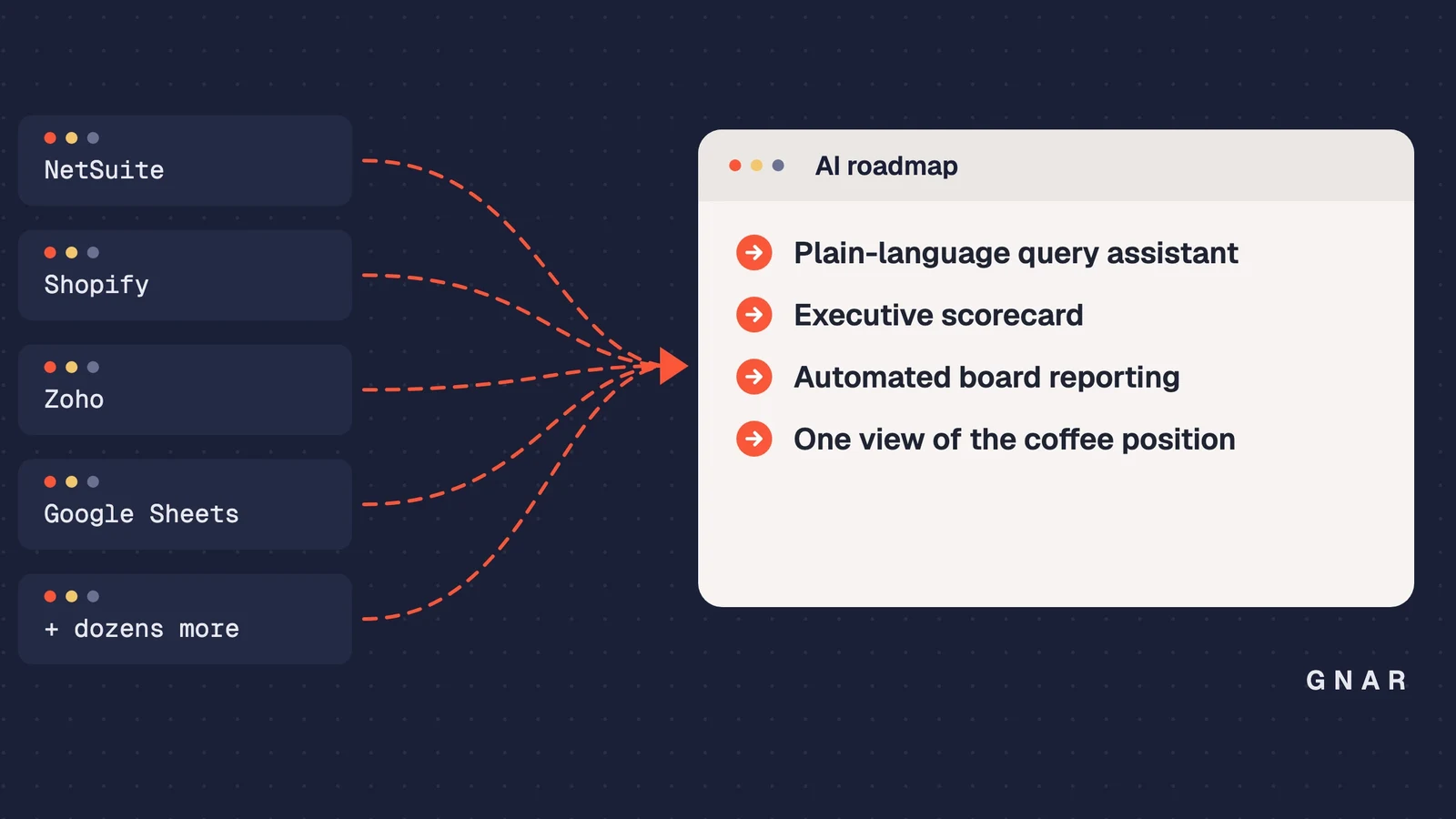
Counter Culture Coffee, a specialty coffee roaster, got a scored list of 79 AI and automation opportunities from an engagement led by a senior Gnar strategist. The company sells to wholesale partners, grocery retailers and direct customers. NetSuite is its ERP and system of record. Shopify runs its commerce, Zoho supports account management, and spreadsheets do important supporting work. Leadership wanted to know where AI would pay off and what had to be true first.
The Counter Culture engagement included weekly working sessions alongside leadership. The team ran 15+ interviews, from leadership to the operators who run the day to day, and mapped every system and data flow with NetSuite at the center. The opportunities fell across seven capability areas.
At Counter Culture, the team scored every opportunity on financial ROI, operational efficiency gains, implementation complexity, data readiness and cultural readiness. Weak data readiness capped an opportunity's score no matter how big its upside looked.
The scoring also killed an idea. Coffee procurement first looked like a market-timing opportunity. A full year of contract data showed the team was already managing that well. So the recommendation changed to a single, real-time view of the coffee position across contracts, importers and warehouses.
The result was $1.5M in potential savings across the top 10 initiatives, each with a score, an owner and a place in the sequence. Many of the gains for a faster month-end close come from NetSuite capabilities Counter Culture already owns, with AI saved for reconciliations and accrual worksheets. The company left with 34 projects ready to start and 8 already underway, led by five internal champions from IT, finance and operations. The findings went to Counter Culture's board. CEO Joe Prewett said the engagement "gave us a roadmap that we're using to flow into our 3‑year plan."
How do you check a firm before you sign?#
Check eight things: the people, where the team sits, plan or build, a named case, a fixed first price, what you keep, data readiness and when not to hire them. Run these on every firm on your short list, including us.
- Ask for names. Ask who will do the work, by name, and whether those people were on the sales call. Put the names in the statement of work.
- Where the team sits. Read the site first. Gnar and Atomic Object say their teams are US-based. HatchWorks AI and Azumo say they use nearshore engineers. Neither is wrong, but you should know before the first meeting.
- Plan or build. Ask whether the firm builds what it recommends, and who builds it. A plan that needs a second firm to build it adds a handoff and a second sales cycle.
- A named case at your size. Ask for a published case study with the client's name on it, at a company that looks like yours.
- A fixed price for the first phase. Get the price of the first phase in writing before kickoff, and ask what is not included.
- What you keep. Ask what you own if you stop after the plan. You should leave with the roadmap and a scoped first build that any team could pick up.
- Data readiness. Ask how the firm treats ideas that depend on messy data. A good answer caps those ideas until the data is fixed.
- When not to hire them. Ask when you should not hire the firm. Our answer: if your own team has the capacity and the direction, you do not need us.
Which firm fits your situation?#
A company that runs on an ERP and wants one team from strategy to the first build should look at The Gnar Company first. A company that only needs engineers should look at Azumo. The table below names the firm for every other situation.
| Your situation | Where to look first |
|---|---|
| You run on an ERP and want one team from strategy to the first build | The Gnar Company |
| You need a larger custom product from a US team on a fixed budget | Atomic Object |
| You want a firm that does only AI and are fine with nearshore engineers | HatchWorks AI |
| You are building an AI product | Cabin |
| You want a strategy-first view from an AI specialist | Opinosis Analytics |
| You are a bank, insurer or other financial firm | Neurons Lab |
| You know what to build and need engineers | Azumo |
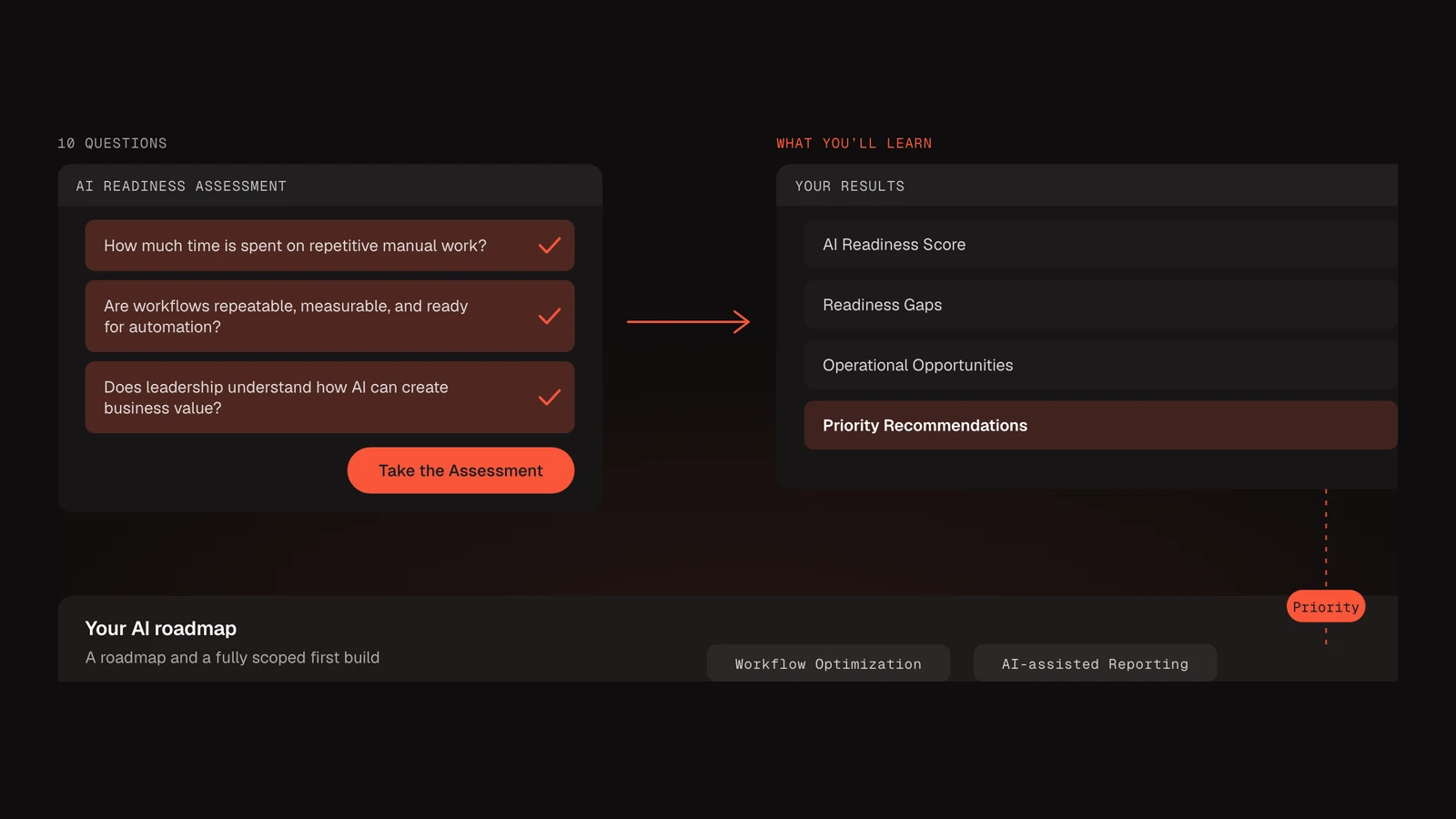
If you are not sure what you need yet, start with the AI Readiness Assessment, 10 questions on where AI can help your operation. If your board wants a plan, our post on building an AI roadmap the board will fund walks through what that plan should hold.
When you are ready to price a build, Gnar's Discovery is published at $15,000, $20,000 and $30,000 for two, four and six weeks.
Producing code is close to free now. Understanding your operation is not. Pick the firm that spends its time on the second part.