AI for insurance claims processing is already common at larger home insurers. In the NAIC's 2022 to 2023 survey of 194 larger home insurers, 104 reported advanced AI or machine learning models in use for claims, or 54%. The NAIC staff report says their subrogation and claims triage models were "mainly used as augmentation". In that use, the model suggests an answer to a person who decides. Only 2 of the 194 companies used a model to determine the settlement amount.
This guide is for a VP of Claims at a regional insurer. That VP has to pick a first claims automation project and explain it to a state examiner. The sections below walk a claim through the claims process from first notice of loss to settlement. They use the NAIC's own surveys and its model bulletin on artificial intelligence. They also use the claims settlement act that bulletin cites (Model 900) and the companion regulation (Model 902).
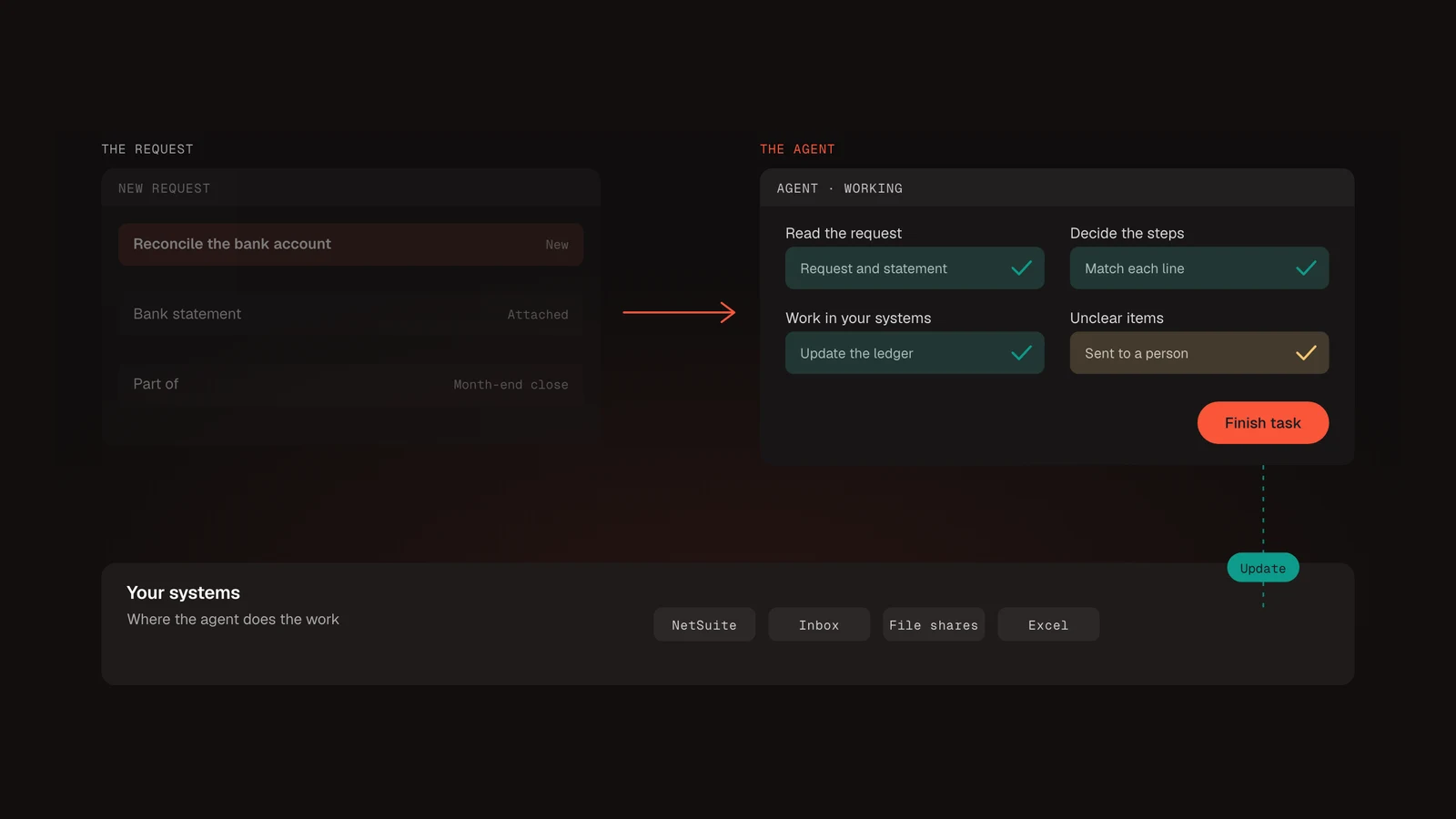
Gnar's AI automation page describes the work it builds in general terms: "Orders and requests arrive in different formats, and someone reads them and keys them in. The Gnar Company replaces those steps with agents that read, extract and route automatically". Gnar's Vermont Mutual case study covers a web quote application for insurance agents. The case study describes no claims or AI work.
How is AI for insurance claims processing used today?#
In the NAIC's home survey, insurers used AI in claims mostly for three jobs. They were subrogation, claims triage and evaluating images of loss. Claims is the area where home insurers reported the most AI use in that survey. The NAIC staff report's Table 3 shows 104 of the 194 home insurers with AI models in use for claims, or 54%. An NAIC memo dated August 10, 2023 puts claims at 54%, ahead of underwriting and marketing at 47% each, fraud detection at 42% and rating at 35%.
The survey ran under the market examination authority of ten states, including Vermont, Pennsylvania and Wisconsin. It covered insurers with at least $50 million in national homeowners premium for 2020. It counted only "more advanced" AI and machine learning models. Models such as generalized linear models were left out of the counts.
Inside insurance claims, the top uses were subrogation and claims triage, at 44 companies each, and evaluation of images of loss, at 36. In write-in answers, insurance companies added uses such as "legal bill review or automatic payment decisions" and "DocBot document classification".
Auto insurers reported different claims processing uses. The same memo compares the NAIC's private passenger auto surveys. There, the main claims use was informational resources for adjusters (96 companies). Next came claim assignment decisions (58), evaluation of images to estimate losses (55) and determining the settlement amount (50). The NAIC issued its auto report in December 2022 and its homeowners report in August 2023.
For the wider insurance industry, McKinsey published The future of AI in the insurance industry in July 2025. It says: "Driven by advancements in AI technology, leading insurers are moving from traditional predictive models to sophisticated capabilities such as multiagent systems and multistep reasoning". The same report says gen AI adds "greater understanding of unstructured data forms" to analytical AI. It says domain-level rewiring with AI has brought "a 3 to 5 percent accuracy improvement in claims".
One insurer publishes its own automation share. Lemonade's annual report on Form 10-K for 2025 says that as of December 31, 2025, its claims bot takes the first notice of loss "96% of the time" without human intervention. It says "roughly 55% of our claims were automated, resulting in instant or near-instant processing from start to finish". The same filing says the bot "triages and assigns claims he is not authorized to settle, or ones where he identifies concerns, to human claims experts". It says claims "are often paid or declined through our claims bot, AI Jim, within seconds". It adds that "in many cases the incident is also reviewed by a human before the claim is approved".
Where does AI fit from first notice of loss to settlement?#
AI appears at intake, coverage checks, triage, damage assessment, fraud referral, settlement and claimant updates. In most of these sources it advises a person. The NAIC home survey defines three levels of decision-making. Support is a model that "provides information but does not suggest a decision or action". Augmentation "suggests an answer and advises the human who is making a decision". Automation means "no human intervention on execution".
The table puts each claims processing step next to what the cited sources show. The third column is general advice on who keeps the decision.
| Claims step | What the sources show | Who decides (general advice) |
|---|---|---|
| First notice of loss and intake | Swiss Re's ClaimsGenAI tool triages documents and scans them for data | A claims handler |
| Coverage and eligibility checks | One carrier's policy library helps call center agents answer coverage questions | An adjuster |
| Claims triage and assignment | Subrogation and triage models are "mainly used as augmentation"; assignment models split evenly | A claims supervisor sets the routing rules |
| Damage assessment from photos | 71 of 120 home insurer image models, in use or under construction, support human decisions | The adjuster |
| Fraud referral | Home insurers' fraud models mostly refer claims for further investigation | An investigator |
| Settlement amount | 2 home and 50 auto insurers in NAIC surveys used models for it | An adjuster with authority |
| Approval and denial | A couple of NAIC home survey insurers were researching models; Lemonade's bot pays or declines many claims | An adjuster with authority |
| Claimant questions and status updates | In PwC's settlement program guide, AI drafts replies to claimant inquiries, with human review for complex or claimant-impacting ones | A claims handler |
Claims intake and document processing#
At intake, AI can triage claim documents and pull useful data out of them. When a First Notice of Loss arrives, Swiss Re says it can deploy ClaimsGenAI "to triage documents, scan them for useful data, and organise this information". In June 2025, Swiss Re wrote that its annual corporate insurance claims exceed 40,000. It also says a single loss incident "often results in the production of hundreds or thousands of documents, including initial notices, detailed reports, and emails".
In the NAIC home survey, insurers that listed other areas of AI use named "document processing/identification/routing" and chatbots.
Oliver Wyman's May 2025 claims article says models can be trained to "read adjuster notes, medical records and other free-form text associated with claim files". PwC published a guide to AI in claims administration in March 2026. It is written for administrators of large settlement and victim compensation programs. It says AI can pull "policy details, dates, and claimant demographics" from unstructured materials into structured data. Its controls for that data extraction include "reconciliation against source documents".
As general advice, start data extraction with the document types your adjusters key in most often. Examples are repair estimates, police reports, accident reports and medical records. Have the AI fill named fields in the claims system, and have a person check each field before the claim moves.
Coverage and eligibility checks#
AI technology can help answer coverage questions and check eligibility during claims review. As general advice, the adjuster still makes the coverage decision. McKinsey describes one carrier that built a repository of policy documents across the company. Its call center agents use it to answer questions on coverage and exclusions. In PwC's guide for settlement programs, a first-pass review checks a claim file for internal consistency, including the program's "eligibility criteria", and flags discrepancies or missing information.
As general advice, have the AI cite the policy section behind each coverage answer, and have an adjuster confirm it before the customer sees it. Model 900's list of unfair claims practices starts with "Knowingly misrepresenting to claimants and insureds relevant facts or policy provisions relating to coverages at issue".
Damage assessment from photos#
AI can read loss photos and help estimate repair costs. In the NAIC home survey, most image models supported a person who decides. Oliver Wyman's article says "Generative AI and image recognition technologies can enhance claims estimation and outcomes". It gives an auto example. After an automobile accident, image recognition can help insurers identify damaged vehicles and assess repair needs. It can also help estimate associated costs, including labor and parts. McKinsey describes AI agents working together on tasks "such as using satellite and drone imagery for damage assessment and prevention".
Most image models at home insurers came from outside vendors, according to the NAIC's staff report on the home survey. Of 120 models reported for evaluating images of loss, 89 came from third parties, or 74%.
As general advice, treat a photo estimate as information for the adjuster. Keep the vendor's model in your AI inventory. The bulletin's guidelines for an insurer's written AI program (Section 3), item 1.8, cover AI Systems built by a third-party vendor too.
Claims triage and routing#
Most insurance claims triage models in the home survey advise a person who makes the decision. The staff report found that models for claim assignment decisions are evenly used as automation and augmentation, at 27 models each. Those counts include models under construction.
PwC's guide adds a control to the triage process: clear escalation rules "so reviewers can override AI assignments when claim complexity warrants human judgment".
As general advice, routing is a reasonable workflow to test automation, because the claim still gets manual review at the desk it lands on. Routine insurance claims can follow the default route. Complex cases go to a specialist by a written rule.
Customer communication and claim status updates#
AI technology can draft replies to claimant inquiries. In PwC's guide, AI can "triage external inquiries (claimants, attorneys, other third parties), route them to the right team, and draft initial responses". Its controls include "an approved response library" and "required human review of drafted responses" for complex or claimant-impacting inquiries.
Replies and status letters both have clocks in Model 902. It asks for a reply within 15 days to pertinent communications from a claimant that reasonably suggest a response is expected. Section 7B adds a status letter. It covers a first party claim that needs more time: "If the investigation remains incomplete, the insurer shall, forty-five (45) days from the initial notification and every forty-five (45) days thereafter, send to the claimant a letter setting forth the reasons additional time is needed for investigation." Section 7 relieves the insurer of that letter in one case. The case is a reasonable basis, supported by specific information, for suspecting that the first party claimant fraudulently caused or contributed to the loss.
As general advice, drafting those Section 7B letters on schedule makes a contained first workflow. The dates are already in the claim file, and an adjuster signs each letter.
Which claims automation steps should a regional insurer try first?#
As general advice, start with data extraction from intake documents, routing, and the Section 7B status letter. Pick among them with four tests. A person makes the claim decision, and the work is high volume. The claim file can show what the AI did, and the step has a clock you already track. Each test ties to a line in a cited source.
- A person makes the claim decision. The NAIC bulletin asks insurance companies to match their controls to their own view of the risk. One factor it names is "the extent to which humans are involved in the final decision-making process".
- The work is high volume. Swiss Re says its claims volume drove "a clear recognition that we needed a step change to help our professionals manage growing caseloads".
- The claim file can show what the AI did. NAIC Model 902 asks for claim files detailed enough to reconstruct the insurer's activities on each claim (Section 4).
- The step has a clock you already track. Model 902 sets 15 days to acknowledge a claim, unless payment is made within that time. It sets 21 days after proof of loss to accept or deny a first party claim. The insurer may take more time to investigate if it notifies the claimant within that time with the reasons. It has fraud exceptions that Section 7 spells out.
PwC's guide for settlement program administrators says to "Prioritize low-risk, high-volume activities that are easier to implement". Its examples are claim intake and document triage.
As general advice, put coverage decisions and denials last, for the reasons in the human oversight section below.
How does AI help with claims fraud detection?#
AI helps insurance claims fraud detection by flagging claims for a closer look. Most referral models in the NAIC home survey advised a person who made the call. The memo says insurers used AI mostly "to refer claims for further investigation," and for that referral, most of the models augmented human decisions.
The memo also found 26 home insurers using AI or machine learning to detect organized crime rings. Swiss Re built its tool on its historical claims data: it "is built on insights from over two decades of unstructured claims data". Oliver Wyman's article says "Machine learning algorithms can help detect fraud". Swiss Re reports that in the first year after its mid-2024 deployment, ClaimsGenAI "generated over 1,000 alerts for potential irregularities, leading to multiple expert reviews".
The Coalition Against Insurance Fraud's 2022 study estimates insurance fraud at $308.6 billion annually across all lines. That total spans health care, Medicare and Medicaid, life, workers' compensation, auto theft and other lines. The study puts property and casualty fraud at $45 billion.
Model 902 has an exception to its 21-day accept or deny standard for fraud. It applies where there is "a reasonable basis supported by specific information available for review by the insurance regulatory authority". That basis must show the first party claimant fraudulently caused or contributed to the loss. The claimant must still be advised of acceptance or denial within a reasonable time for full investigation.
PwC's guide describes AI that can "highlight anomalies or patterns in claimant submissions that may indicate potential fraud or systemic risk and require human follow-up". In that guide, AI-flagged cases "undergo human investigation and secondary review".
As general advice, treat each flag as a suspicious claim to investigate. Whether it is a fraudulent claim is a finding the investigator makes. Have the fraud model store the specific information behind each flag in the claim file. Then an investigator and an examiner can both read why the claim was flagged.
Where does human oversight belong in claims processing?#
As general advice, human oversight belongs on coverage questions, denials and complex claims. Human adjusters should make each of those decisions. Model 900 and Model 902 set specific duties for denials and the explanation behind them, listed below. For complex claims, PwC's guide below lets higher-risk or exception cases go to a human reviewer. The NAIC bulletin says actions taken by insurers must not violate the state's unfair trade practices law or its unfair claims settlement practices law. That holds "regardless of the methods the Insurer used to determine or support its actions".
The NAIC's Unfair Claims Settlement Practices Act, Model 900, is a model act. The AI bulletin's template asks each state to cite its own corresponding statute or regulation. Model 900 counts a listed act as an unfair claims practice in two cases. It is committed flagrantly and in conscious disregard of the Act, or it happens often enough to indicate a general business practice. Two of the listed acts:
- "Refusing to pay claims without conducting a reasonable investigation" (Section 4F).
- "Failing in the case of claims denials or offers of compromise settlement to promptly provide a reasonable and accurate explanation of the basis for such actions" (Section 4L).
The property and casualty model regulation, Model 902, adds a rule for denials. "No insurer shall deny a claim on the grounds of a specific policy provision, condition or exclusion unless reference to such provision, condition, or exclusion is included in the denial". The denial must be in writing.
Some denials rest on a specific policy provision, condition or exclusion. For those, Model 902 asks for a written denial that refers to it. As general advice, give that job to an adjuster who can explain the decision. A model can draft the denial letter and cite the policy terms. An adjuster with authority reads the file, then signs and sends it. Swiss Re says of its own tool that "the decision-making authority remains with the people overseeing it". Oliver Wyman writes that "AI is not a replacement for claims adjustors and customer service representatives". PwC's guide says to "Mandate human review for sensitive or claimant-facing decisions".
PwC's guide also sets review by risk. Higher-risk or exception cases may go to a human as a secondary reviewer, and lower-risk claims may be monitored through sampling and quality checks. As general advice, write down which insurance claims get manual review and which get sampled, and keep that rule in the claims workflow.
What do regulators expect from AI in claims?#
In states that adopted the NAIC's AI model bulletin, regulators expect a written program for the AI Systems an insurer uses in claims. They can also ask how each one was tested, under the bulletin's Section 4 on regulatory oversight and examination. The NAIC adopted its Model Bulletin on the Use of Artificial Intelligence Systems by Insurers on December 4, 2023. Each state that adopts it issues its own version.
The bulletin expects a written "AIS Program" for "AI Systems that make, or support decisions related to regulated insurance practices". The bulletin's Section 3 lists AIS Program guidelines as numbered items. Item 1.6 says the program should address AI use across the insurance life cycle, including "claim administration and payment, and fraud detection". Item 1.8 covers AI Systems "whether developed by the Insurer or a third-party vendor". Item 1.9 calls for notice to impacted consumers "that AI Systems are in use".
Item 3.4 says validation can take the form of "measuring performance against expert review," among other methods. That is the basis for the agreement with your senior adjusters number in the pilot table below. The same section asks insurance companies to assess "the suitability of the data used to develop, train, validate and audit the model", which covers training data. PwC's guide tells programs to "use balanced training data" and test models for disparate impact. The bulletin also says its goal "is not to prescribe specific practices or to prescribe specific documentation requirements".
Vermont appears on the NAIC's implementation map as adopting the bulletin through Insurance Bulletin No. 229 on March 12, 2024 (map status as of November 13, 2026). California, Colorado and New York appear in a separate group, "Insurance Specific Regulation/Guidance". The map does not reflect a determination as to whether a state's action contains all elements of the model. So the version to read is your own state's.
What should the claim file record when AI touches a claim?#
The claim file should hold enough for an examiner to rebuild what happened on the claim, including the AI's part. Model 902 says each claim file should contain detailed documentation that permits "reconstruction of the insurer's activities relative to each claim".
Model 902 also asks that each relevant document be noted with the date received, processed or mailed. It asks that claim data be retrievable for the current year and the two preceding years. That data includes claim number, line of coverage, date of loss and date of payment. For regulatory compliance, the AI bulletin lists "Data and record retention" among the controls a written program should address. PwC's guide calls for "establishing AI and chatbot audit trails" and says programs should "maintain auditable AI decision logs".
The list below is general engineering advice built on that reconstruction test. The first item follows Model 902's date rule. The third matches the model inventories the bulletin lists in item 3.3 of its AIS Program guidelines. For each AI step, the claim file or a log tied to it should hold:
- The documents the AI read, with the date each one was received.
- What the AI produced: the extracted fields, the draft letter or the flag, with its date.
- The model and version that produced it, matching your AI inventory.
- Who reviewed the output, what they changed and when.
- The final action on the claim and who took it.
How should a VP of Claims measure an AI pilot?#
As general advice, measure a claims AI pilot with six numbers, recorded before the pilot starts and again during it. They are cycle time, acknowledgment within 15 days, decision within 21 days, agreement with your senior adjusters, touches per claim and confirmed fraud referrals. The first three use dates that Model 902 already expects a claim file to hold.
| Number | How to define it | Where the definition comes from |
|---|---|---|
| Cycle time | Days from loss to payment, denial or close | General advice, from the dates Model 902 Section 4 asks a claim file to hold |
| Acknowledgment within 15 days | Share of new claims acknowledged or paid within 15 days of notice | Model 902, Section 6 |
| Decision within 21 days | Share of first party claims accepted or denied within 21 days of proof of loss, unless the insurer needed more time and notified the claimant with the reasons, fraud cases aside | Model 902, Section 7 |
| Agreement with your senior adjusters | Share of AI outputs your senior adjusters accept unchanged on sampled files | General advice, built on item 3.4 of the NAIC bulletin's AIS Program guidelines |
| Touches per claim | Times a person opens and works the file before it closes | General advice |
| Confirmed fraud referrals | Share of AI fraud flags an investigator confirms after review | General advice |
Model 902 is an NAIC model regulation. Use the day counts in your own state's claims regulation for the second and third rows. As general advice, pick one claim type and one workflow step. Run the old process beside the new one over the same weeks so the numbers compare.
What does it take to connect AI agents to your claims system?#
As general advice, connecting AI agents to a claims system is a data integration job with three pieces. The first is read access to the claim and the policy terms. The second is a place to write results back as named fields. The third is a check before anything lands in the system of record. Oliver Wyman's article names the problem this solves. With manual processes, "the data may not be efficiently captured in structured data fields and does not make it into claims management systems". Gnar's AI automation page describes reading inputs, writing to named fields and checking before the system of record, for orders.
On that page, agents "read orders, requests and data in whatever format they come in". Order information "goes into dedicated fields instead of free text that someone has to read again". And agents "check required fields before an order reaches the system your team works in".
In the home survey, models for most claims applications were built in house. Models to evaluate images and for speech analysis tended to be developed by third parties. The bulletin asks insurance companies, where appropriate and available, to put audit rights and cooperation with regulatory inquiries into contracts with third parties (AIS Program guidelines, item 4.2). It also asks for data practices covering "data currency, lineage, quality, integrity, bias analysis and minimization, and suitability".
PwC's guide expects agentic AI to "enable autonomous agents to conduct first-pass claim reviews and execute more complex workflows". McKinsey describes gen AI agents that "provide real-time support to human agents, and suggest relevant next steps". As general advice, an AI agent that writes to the claims system also needs the same claim file record as any other claims workflow.
Where The Gnar Company fits#
The Gnar Company's published insurance case study is Vermont Mutual's quote platform. At Vermont Mutual, Gnar ran a structured evaluation of React, Vue and Angular before any code and recommended React. Then a senior Gnar engineer joined the insurer's team as the lead React engineer. The new quote application was "a build that had to integrate with existing web services, transactional databases, and third-party services".
For AI automation, Gnar's page offers two ways in: "We can build the automation and hand it off, or build alongside the people who will own it". For a first read on where AI fits, Gnar offers a free AI Readiness Assessment. In that page's words, "Our 10-question AI Readiness Assessment helps identify your organization's strengths, gaps, and opportunities so you can move forward with confidence".
On whether to hire a firm at all, Gnar's position is: "If your own team has the capacity and the direction, you do not need us".