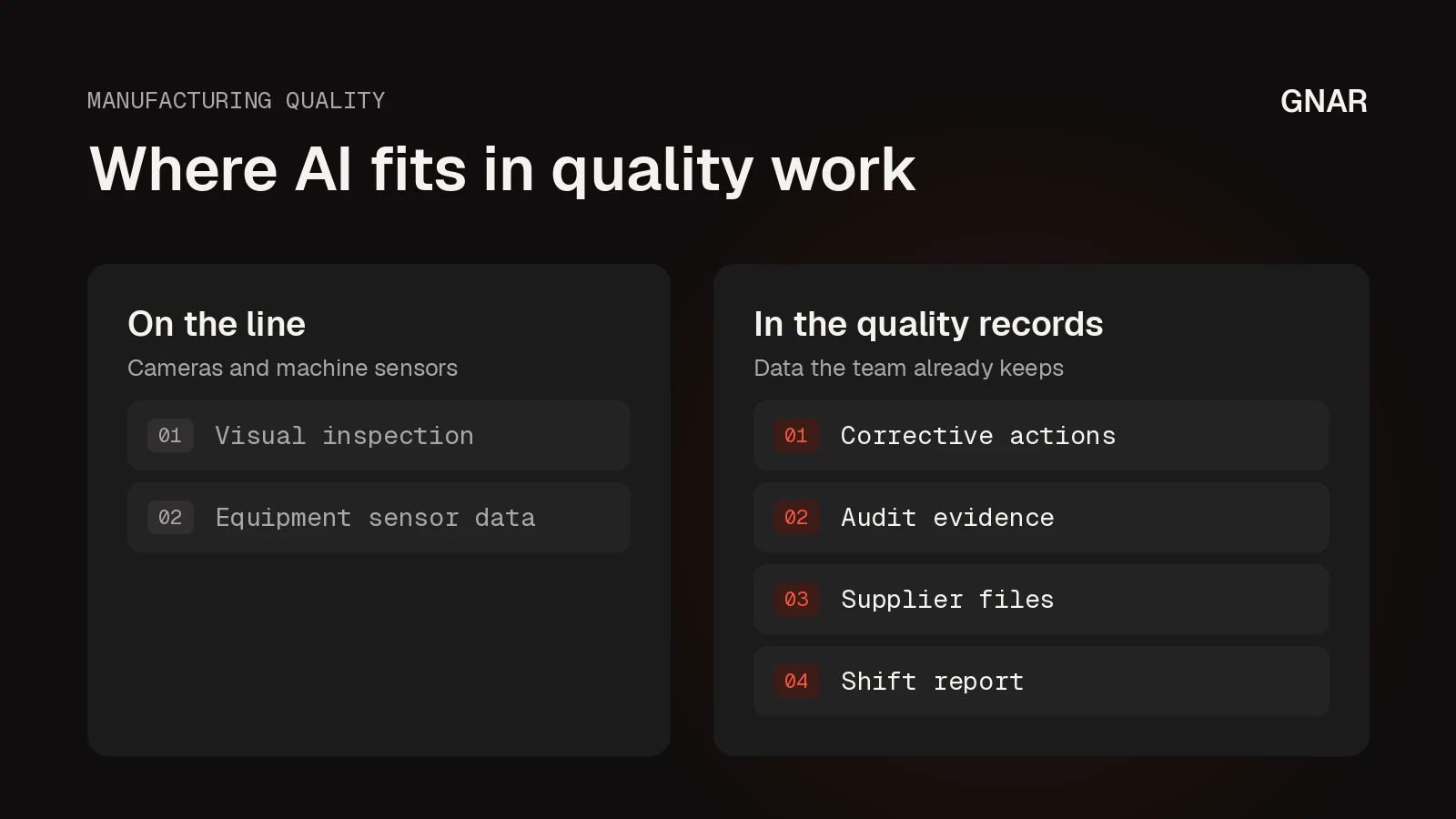
AI for quality management in manufacturing works in two places: quality control on production lines and the quality management records. On the line, artificial intelligence uses computer vision on camera images and reads sensor data to detect defects and equipment trouble. In the records, it helps with corrective actions, audit evidence and supplier files.
Quality control work on production lines needs data a plant may not collect yet. Examples are large sets of labeled defect images or a long history of sensor data. Quality management records are documents and fields the quality team already keeps. This guide is for a VP of Quality choosing where to start with AI in manufacturing quality. It covers what an ISO 9001 auditor may ask and which plant numbers show whether a pilot worked.
The Gnar Company builds custom AI agents for mid-sized companies. Their finance and operations teams do a lot of repetitive work by hand. Most have small tech teams, and many are manufacturers and distributors on NetSuite or a similar system. Gnar's AI strategy engagement ranks the starting points before anything is built. Its page says "We map your processes, score each AI idea on return and cost, and plan the first build".
How is AI in quality control used across manufacturing processes?#
Manufacturers use AI for quality work on production lines and inside the quality management system. NIST's May 2026 Manufacturing Extension Partnership page, The Rise of Artificial Intelligence (AI) in U.S. Manufacturing, cites a Manufacturing Leadership Council survey of manufacturers. In it, 24% of the manufacturers named quality operations under the heading "Where Manufacturers are Deploying AI in their Operations". The NIST page does not give the survey's year.
The same NIST page puts quality improvement at 49% of the same surveyed manufacturers. That figure is in its list of "AI’s Role Across Factory Floors".
Quality standards guidance names similar uses. A May 2026 paper from the ISO 9001 Auditing Practices Group (APG) says "Artificial intelligence systems (AI systems) are increasingly being integrated into quality management systems (QMS) processes". Its list includes "supplier evaluations, customer interactions, predictive maintenance, quality control, and process optimization".
The table sorts uses from those two sources by what each source says the AI does.
| Use | What the source says it does | Source |
|---|---|---|
| Defect detection | "Detects subtle defects or anomalies in products through pattern recognition" | NIST MEP, May 2026. |
| Predictive maintenance | "Analyzes sensor data to predict equipment failures before they happen" | NIST MEP, May 2026. |
| Production automation | "Enabling monitoring of equipment to make real-time adjustments to decrease product and process variability" | ISO 9001 APG, May 2026. |
| Document management | "Automatically extracts critical data from manuals, quality reports, and safety documentation" | NIST MEP, May 2026. |
| Supplier evaluation | "AI tools scoring or ranking supplier performance" | ISO 9001 APG, May 2026. |
| Compliance monitoring | "providing real-time alerts on potential nonconformities" | ISO 9001 APG, May 2026. |
| Shop floor help | "Assists workers with immediate troubleshooting, training, and support" | NIST MEP, May 2026. |
The first three rows work from data on production lines. They cover defect detection, predictive maintenance and real-time monitoring of equipment.
What is the difference between quality assurance and quality control?#
Quality assurance builds confidence that a product will meet its quality requirements. Quality control is the hands-on work that meets them. That is the split in ASQ's definitions. ASQ also says the two terms are often used interchangeably.
ASQ's glossary entry for quality assurance and quality control gives one definition of each. Quality assurance is "all the planned and systematic activities implemented within the quality system that can be demonstrated to provide confidence that a product or service will fulfill requirements for quality". Quality control is "the operational techniques and activities used to fulfill requirements for quality".
ASQ adds that the two terms "have many interpretations". It also says they are often "used interchangeably, referring to the actions performed to ensure the quality of a product, service or process". In the quality trilogy, as ASQ's glossary describes it, quality control means "meeting product and process goals".
Manufacturing quality management covers both. ASQ defines quality management as "Managing activities and resources of an organization to achieve objectives and prevent nonconformances".
As general advice, the line uses in this guide sit mostly on the quality control side. Visual inspection and statistical process control are quality control processes. They check product quality and production processes while the work happens. Predictive maintenance watches the equipment behind those production processes. The records uses sit mostly on the quality assurance side. Audit evidence, corrective actions and supplier qualification are planned activities that show the quality management system works.
What is AI visual inspection in quality control, and what does it need?#
AI visual inspection uses computer vision to detect defects in parts during quality control. A 2023 report prepared for the FDA says machine vision relies on large, labeled image sets. It says those are typically costly and hard to collect in industrial settings. The report also says AI can compare real-time images with reference images to assess potential defects.
Booz Allen Hamilton prepared that report for the FDA. It covers non-medical industries. It describes machine vision as technology "that uses AI, one or more vision sensors, and application-specific software to interpret visual information and analyze tasks in smart manufacturing, QC, and worker safety". It says AI adds "image-based analysis capable of comparing real-time images with reference images to assess potential defects".
The same report is plain about the limits. "Machine vision relies on large, annotated datasets to train the models, which are typically expensive and challenging to obtain in industrial environments". It also says factors within the image itself can limit performance, giving "too many similar colors" as an example.
The ISO 9001 Auditing Practices Group lists the quality control use as "Defect detection using computer vision and machine learning, providing greater speed, efficiency, and consistency than manual inspection". Its paper also has auditors ask how a company ensures "the consistency, correctness, and reliability of AI outputs".
As general advice, ask four questions before you implement AI in computer vision inspection. They apply to other quality control systems too.
- How many labeled images of each defect type does the plant have today?
- Who on the quality team labels new images when a new defect appears?
- Where does a part go when the model is unsure?
- Who decides what counts as a defect when the model and an inspector disagree?
The answers show whether the project can start now. Some projects have to begin by collecting and labeling images. As general advice, keep manual inspections running beside the model during a pilot. Compare its calls with the calls from manual inspections.
Can machine learning predict equipment failures before they happen?#
Yes, machine learning can help estimate when equipment is likely to fail. The same 2023 report prepared for the FDA says so. It describes predictive maintenance as technology that "monitors the degradation of equipment to identify the optimal time to replace the equipment prior to major deterioration or a system breakdown". The report adds: "Industry traditionally has estimated the lifespan of equipment based on historical data, but has since implemented ML models into predictive maintenance technologies to better forecast when a failure may occur and the maximum lifetime of a machine".
The report says these applications "can enhance equipment life cycle and quality, increase overall equipment effectiveness, and reduce the costs for equipment maintenance". It also lists their limits. The technology "requires broad and large datasets to train the model, which users must continuously update with recent failure and production-related data". The report adds that it "requires specialized skillsets to understand and analyze the condition monitoring data". It also says limits "may include time and expensive installation processes".
Manufacturing quality teams care because equipment health and product quality are linked. A 2020 NIST summary report of an ASME standards meeting puts it this way: "equipment health directly correlates to overall process health and product quality".
Where does statistical process control fit?#
As general advice, treat statistical process control as the quality control baseline any AI prediction model has to beat. ASQ's quality glossary defines statistical process control as "The application of statistical techniques to control a process". It defines special causes as "Causes of variation that arise because of special circumstances".
A control chart, in ASQ's words, is "A time sequenced chart with upper and lower control limits". As general advice, ask what an AI model would catch about product quality that the existing charts miss. Test it on historical data from last year before buying it.
What is a digital twin?#
A digital twin is a virtual model of a physical asset built from sensor data. The FDA report defines it as "a computer-generated virtual representation to model the state of a physical asset (e.g., machine, people, functional area, physical surroundings) using sensors".
The report says it "is used to simulate, track, design, monitor, or diagnose the physical asset". NIST's manufacturing page says digital twins allow "real-time testing, predictive maintenance, and continuous improvement without physical trial and error". As general advice, plan a digital twin's data the way you would plan predictive maintenance. The FDA definition depends on sensors.
How can AI help root cause analysis and corrective action?#
As general advice, use AI to gather the evidence and draft the corrective action record. Leave the finding of the cause to your engineers. ASQ defines root cause analysis as "The method of identifying the cause of a problem, solving it and preventing it from occurring again".
ASQ's glossary entry for root cause reads "A factor that caused a nonconformance and should be addressed with corrective action". It defines corrective action as "A solution meant to reduce or eliminate an identified problem".
These steps are general advice for where an AI tool can do the reading in a corrective action.
- Pull the history. The tool gathers past quality issues, nonconformances, complaints and corrective actions. It looks for the same part number, line or supplier.
- Draft the problem statement. It writes a first version from those records. It links each claim to the record it came from.
- Point to patterns. It helps identify patterns across the history, such as the same defect after the same changeover. Engineers then run their own root cause analysis, for example the five whys, which ASQ's glossary describes as "repeatedly asking the question, 'Why?'"
- Draft the record. It fills in the corrective action form and proposes an effectiveness check. The owner edits and approves it.
Once AI is part of the process, the APG paper asks about its mistakes too. Under Clause 10, the Auditing Practices Group paper asks whether "nonconformities or complaints involving AI system outputs" are "recorded, analyzed, and addressed". The number to watch here is corrective action closure time.
Can AI cut the days spent preparing for an audit?#
As general advice, AI can shorten the evidence gathering part of audit prep. Track audit prep days to see whether the total goes down. The audit method stays the same. The Auditing Practices Group says AI systems "do not require new auditing methods, nor a change in the audit objectives".
NIST's manufacturing page lists document management among AI uses: it "Automatically extracts critical data from manuals, quality reports, and safety documentation". As general advice, that is the audit prep job. In that job, a tool would read procedures, training records, calibration logs and past findings. It would then assemble the evidence for each requirement an auditor samples.
The same paper tells auditors what to check when AI sits inside the quality system. Before the audit, they should "Identify whether the organization uses any AI system type for any of its processes within the scope of the QMS". During it, they should obtain evidence that AI use "does not adversely affect conformity, process control, or achievement of the QMS objectives".
Two of its lines matter for any audit prep tool. Under Clause 7, it asks whether documented information addresses "data lineage, model version control, modifications or retraining, and AI-generated outputs used in decision-making". That question applies "where traceability is necessary to ensure conformity or meet applicable requirements". It also tells auditors to obtain evidence "that ISO standards and other copyrighted materials are not uploaded to AI systems, as required by ISO".
The paper notes that it "has not been subject to an endorsement process" by ISO. It is guidance for auditors. The number to watch is audit prep days.
Where do the shift handoff and daily production report fit?#
As general advice, treat the shift handoff and the daily production report as drafting jobs. AI assembles a draft from logged production data, and a supervisor checks it. It needs the data logged in a system first.
NIST's page gives an example of that first step. It says TechSolve, part of the Ohio MEP, helped Magellan Aerospace, Middletown, Inc., replace "paper-based systems with a digital production dashboard and real-time data tracking". NIST says the change "improved operational visibility, reduced rework, and streamlined quality control". NIST says the company also established "the critical data infrastructure needed to support future AI applications, such as predictive analytics and process optimization".
NIST's list of AI's roles across factory floors also has a figure for dashboards. It puts "Automated internal performance metrics and dashboards" at 41% of the same surveyed manufacturers. As general advice, a daily report draft should pull production data from three places. They are the production counts, the downtime log and the quality holds. The supervisor adds what the data does not show.
Gnar's free AI Readiness Assessment asks whether "critical business knowledge" lives "in documentation or in employees’ heads". That question fits handoffs. As general advice, write down what a good handoff contains before any software drafts one. The number to watch is supervisor hours per shift.
What does shop floor support look like?#
In this guide, shop floor support means an assistant that answers operators' questions about quality issues from the plant's own documents. NIST's page lists chatbots and virtual assistants among AI uses, with the line "Assists workers with immediate troubleshooting, training, and support through natural language interactions".
As general advice, point such an assistant only at controlled documents. Examples are current work instructions and approved procedures. Have it name the document and revision behind each answer, so an operator can check it.
Can AI help with supplier quality?#
Yes, AI can score supplier performance and monitor supplier risk. The ISO 9001 Auditing Practices Group lists both uses. It names "Supplier Evaluation: AI tools scoring or ranking supplier performance using large datasets and predictive models" and tools "monitoring supplier risks".
ASQ defines supplier quality assurance as "Confidence a supplier's product or service will fulfill its customers' needs". It defines supplier quality as "A supplier’s ability to deliver goods or services that will satisfy customers’ needs". As general advice, find the records behind that judgment first. Examples are incoming inspection results, supplier corrective action requests, certificates and on-time delivery from the ERP.
The paper also treats suppliers as parties affected by AI-driven decisions. Under Clause 4, it lists "suppliers evaluated through AI-based scoring systems" among interested parties whose needs and expectations should be understood. Under Clause 8, it asks how AI affects "supplier relations, interactions and supply chain management".
As general advice, start supplier quality assurance with qualification. The work is assembling a packet: certificates, audit results, first article results and sample history. A tool can gather and check the packet, and the supplier quality engineer approves the supplier. The number to watch is days to approve a supplier.
How should a VP of Quality measure an AI pilot?#
As general advice, measure an AI pilot in the numbers tied to its starting point. Before you implement AI, record it. Then record it the same way after. Write down its formula before the pilot begins.
The rows below are general advice. The first pass yield and OEE definitions come from the sources named in the cells. As general advice, an inspection pilot should also track how often the model and manual inspections agree. A better model can find more defects, which can lower measured first pass yield at first.
| Starting point | Number to record before | How to define it |
|---|---|---|
| Audit prep | Audit prep days | Days from the audit notice to evidence ready. |
| Corrective action | Corrective action closure time | Days from opening to verified closure. |
| Quality control inspection | First pass yield | Units entering minus defective units, divided by units entering (ASQ). |
| Shift handoff and daily report | Supervisor hours per shift | Hours spent writing the handoff and report. |
| Equipment | Overall equipment effectiveness (OEE) | Availability times performance times product quality rate (EPA). |
| Equipment | Mean time to repair | Total repair time divided by the number of repairs, with the start and stop points written down. |
| Supplier qualification | Days to approve a supplier | Days from request to approved status. |
ASQ's glossary entry for first pass yield counts units that complete a process "without being scrapped, rerun, retested, returned or diverted into an offline repair area". The EPA's page on total productive maintenance says OEE "is calculated by multiplying (each as a percentage), overall equipment availability, performance and product quality rate".
Write the formula down, because OEE is calculated in more than one way. A 2020 NIST summary report says "there are currently multiple definitions, interpretations, and calculations for OEE". It points to ISO 22400 for commonly accepted OEE calculations. As general advice, mean time to repair needs the same care. Write down where the clock starts and stops.
What does AI need from your QMS, ERP and MES?#
As general advice, give AI quality data it can read without an export, and fields whose meaning the team agrees on. NIST's page cites IBM for the common barriers. It lists them as "Data quality and availability," "High initial costs," "Skills gaps/ workforce readiness," "Data privacy and cybersecurity risks" and "Integration with legacy systems".
As general advice, look for those barriers in your own quality data. Check whether corrective actions sit in a spreadsheet or supplier files sit in email. Check whether inspection results sit in an MES that does not connect to the ERP. Gnar's custom AI agents page puts it this way: "An agent is only as good as what it reads. So the discovery sprint checks those records first, and says what needs fixing and who fixes it". The same page defines the sprint: "We map the job step by step: what the agent reads and which systems it works in. This is the discovery sprint."
The Auditing Practices Group covers data ownership too. Under Clause 5, it asks whether roles have been assigned for the AI system's lifecycle, starting with "ownership of data inputs". As general advice, name an owner for each quality data set a pilot reads before the pilot starts.
Checking the records can also change the plan. In Gnar's Counter Culture Coffee case study, coffee procurement "initially looked like a market-timing opportunity". Then "A full year of contract data showed the team was already managing that well". The recommendation shifted to "a single, real-time view of the coffee position across contracts, importers, and warehouses". That case was an AI roadmap for a coffee roaster.
What risks should a quality team plan for?#
Plan for the risks the Auditing Practices Group paper asks auditors to check. They are model drift, outputs nobody reviews, missing traceability, AI failures, uncontrolled changes, bought tools nobody evaluated and performance nobody monitors.
Each item below quotes the APG paper or NIST's AI Risk Management Framework (January 2023).
- Model drift. NIST says "AI systems may require more frequent maintenance and triggers for conducting corrective maintenance due to data, model, or concept drift". The paper asks whether risks such as "algorithmic bias, data quality issues, unintended outcomes, or model drift" are "identified, evaluated, and addressed".
- Human review. The paper asks whether the company "determined whether human review or oversight is necessary based on risk, complexity, or applicable requirements". Its examples include cases "where AI outputs influence product release decisions, safety-related determinations, or regulatory reporting". As general advice, keep a person on every product release and product quality call during a pilot.
- Traceability. Where traceability is necessary "to ensure conformity of products and services or meet applicable requirements", it asks whether traceability is kept "for decisions influenced by AI outputs".
- Failure plans. It asks for "contingency plans for AI system failures or degradation in performance, including how such events will be detected and managed".
- Change control. It asks whether "changes to AI system(s)" are "controlled to prevent unintended changes to process performance or product/service conformity".
- Bought tools. For an AI system that is "externally sourced or maintained", it asks how "the provider and the technology itself" were evaluated.
- Monitoring. It asks whether "monitoring and evaluation mechanisms" are "in place to evaluate AI system performance (e.g., accuracy, relevance, consistency)".
Where The Gnar Company fits#
The Gnar Company builds custom AI agents that work inside the systems you already use. That means NetSuite or your other ERP, your inbox and your shared files.
The agents page also states how access, logs and testing work. "You choose which records it can see and which changes need a person’s OK". "Every action it takes in your systems is logged, so you can check what it did". "The Gnar Company tests every agent on cases from your own past work, including the odd ones. Engineers call these tests evals. They run again each time we change the agent or its AI model".
As general advice, ask any AI vendor to answer the APG questions above in writing. Do it before a pilot starts.
Some quality management work needs no custom build. Gnar's agents page says: "If a product fits your job, buy it, and we’ll tell you so". Gnar also states its own limit: "If your own team has the capacity and the direction, you do not need us".