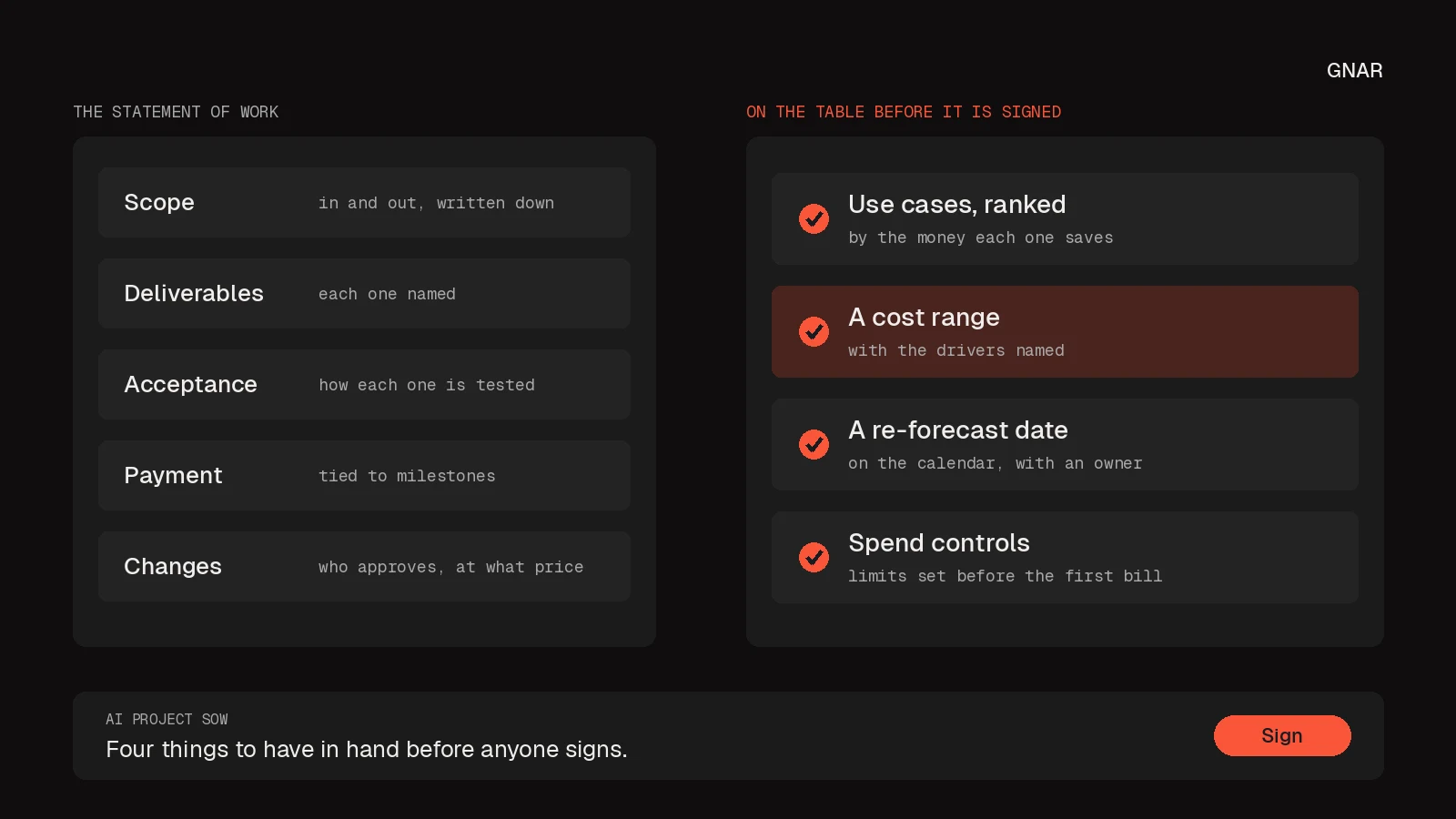
An AI project statement of work (SOW) should name the scope, the deliverables, how each deliverable is accepted, how payment ties to milestones and how changes get approved. This guide is for a CFO about to sign one. It covers what the statement of work should hold, how AI changes the cost and acceptance terms, and four things to have in hand first. It matters because an AI system built on a token-billed model API keeps costing money after the build, through usage billed per token.
As general advice, have four things in hand before you sign an AI project statement of work. They are a ranked list of use cases, a cost range with its drivers named, a re-forecast date and a spend-control design.
Gnar Discovery and Design is one way to get a fixed price for your build before you sign the build statement of work. The Gnar Company’s Discovery costs $15,000 to $30,000, depending on the tier. Each tier ends with a Milestone Project Plan and a fixed price for your build. You get that plan whether or not you build with The Gnar Company.
What is a project statement of work (SOW) for an AI consulting project?#
A project statement of work is the document that spells out one job, often under a master agreement. A 2022 Massachusetts Bar Association article on IT services contracts calls statements of work "the main technical component of these agreements". AI consulting services use the same document, with AI work as the job.
The same article lists what goes in one. "SOWs typically include deal-specific terms and detail the deliverables to be provided, the scope of work, the vendor’s performance standards, payment and deliverables schedules, and the parties’ project-specific responsibilities". The article also notes that SOWs "either incorporate the master agreement by reference or are themselves incorporated into the master agreement".
The Mass Bar article says SOWs and the other technical documents "govern the services’ implementation and the parties’ day-to-day obligations".
The scope of work is one part of the statement of work, next to the deliverables, standards and schedules. Nolo's attorney-written guide to master service agreements says the statement of work "will define the current project and include specifications like pricing, deadlines, and expected output".
In federal buying, a request for proposals (RFP) comes before the contract. The FAR's RFP section says RFPs "are used in negotiated acquisitions to communicate Government requirements to prospective contractors and to solicit proposals". The FAR's format for RFPs puts the statement of work in "Section C, Description/specifications/statement of work".
What is the difference between an MSA and a statement of work?#
The master services agreement (MSA) holds the legal terms for the whole relationship, and the statement of work (SOW) holds one project. Nolo's guide says "the MSA takes care of all the general terms and conditions that remain consistent throughout the working relationship". You need a statement of work "to define the individual scope of work and specifics for each project or action".
| Question | Master services agreement | Statement of work |
|---|---|---|
| What it covers | General terms for an ongoing relationship (Nolo) | One project's scope and specifics (Nolo) |
| How often it is agreed | Negotiated once, at the start (Nolo) | For each project, or one stage of it (Nolo) |
| Typical contents | Ownership, payment and invoices, confidentiality, termination (Nolo) | Deliverables, scope, performance standards, schedules (Mass Bar) |
Check one more line before you sign. Nolo's guide says the agreement should "spell out which agreement controls" when the MSA and the statement of work are inconsistent. As general advice, know which document wins before you rely on its payment terms or acceptance terms.
Dispute resolution terms, the rules for resolving disputes, belong in the same review. Nolo's MSA checklist includes governing law, where the contract "identifies the court system for any disputes". The Mass Bar article says venue and choice of law provisions "receive so little attention in commercial services agreements".
What are the essential elements of an effective statement of work?#
An effective statement of work (SOW) names the deliverables, the scope, the performance standards, the payment and delivery schedules and each side's responsibilities. Those five come from the Massachusetts Bar Association article. Nolo's guide adds due dates, prices, how and how often one side gets paid, who can agree to a statement of work, and how changes are made.
Use this as a checklist. The first five items come from the Mass Bar article, and the last two from Nolo's guide.
- Deliverables. The specific project deliverables, each one named, so you can tell when it has arrived (Mass Bar).
- Scope of work. The scope definition: what is in, and what is out (Mass Bar).
- Performance standards. The quality standards the service provider's work must meet (Mass Bar).
- Payment and deliverables schedules. The payment terms: when money moves (Mass Bar).
- Project-specific responsibilities. What each side must do or supply (Mass Bar). As general advice, for AI work, list the data, access and reviewers your team owes.
- Due dates, prices and signing authority. Nolo's guide says an MSA might state that SOWs "need to specify due dates, prices, how and how often one side gets paid, and who has the authority to agree to an SOW".
- A change management process. Nolo's guide says the MSA "should also describe the circumstances that allow each party to make and accept changes to SOWs".
The Mass Bar article also names a document many buyers sign beside the statement of work. "Often, parties also enter into service-level agreements, which lay out the metrics by which the vendor’s performance is measured and provide for remedies or penalties should service levels not be achieved". As general advice, if the AI system will run in production after the build, ask whether a service level agreement belongs in the set.
As general advice, name key personnel too, when the people matter to you. Gnar's Discovery page says this about its own team: "The same team that runs your discovery builds your product".
What does an AI project change in the statement of work?#
An AI project adds two things a plain software statement of work (SOW) can skip: how the model's results are tested, and how the cost of running it is planned. The US General Services Administration (GSA) guide to starting an AI project says this about project requirements when an AI pilot moves to production: "The requirements must feature the ways in which the results from the model will be evaluated, used, and updated".
As general advice, three of the GSA guide's lines are worth copying into any AI statement of work:
- On testing: "If you want testable models, you have to make that a requirement at the contracting step".
- On cost: "Different phases of AI projects require different types of solicitations and cost structures".
- On handover: it says to "include deliverables like product backlogs and open source repositories with the entire source code along with all necessary artifacts".
The guide also describes a phased path. It says "Internal or organic prototypes (exploration without vendor support) provide a great way to show value without having to commit the resources required for a production deployment". It says to use a statement of objectives (SOO) "under the Simplified Acquisition Threshold (SAT) to create a prototype or a proof of concept". The next line says "Begin to standardize as you move into a pilot".
The National Institute of Standards and Technology (NIST) adds a cost point from its AI Risk Management Framework (AI RMF). The framework itself "is intended for voluntary use". The framework's core "is composed of four functions: govern, map, measure, and manage". Its Map 3.2 asks that "Potential costs, including non-monetary costs, which result from expected or realized AI errors" be "examined and documented". As general advice, the statement of work is the place to decide who pays for those errors.
What should a CFO have before signing an AI project statement of work?#
As general advice, a CFO should have four things before signing an AI project statement of work: a ranked list of use cases, a cost range with its drivers named, a re-forecast date and a spend-control design. The first two set what you are buying and what it costs. The last two keep the cost in view after launch. The first, second and fourth are tied to public sources, and the re-forecast date is general advice.
1. A ranked list of use cases#
A ranked list of use cases shows which AI work is worth paying for, and in what order. NIST's Map 1.4 asks for part of this: "The business value or context of business use has been clearly defined". As general advice, a ranked list puts those values side by side. A statement of work for one use case is easier to judge when you can see the list it came from.
Gnar's Compass page lists that ranking as an output. The page says it hands over "Every idea ranked by the money it saves". It adds: "Each one comes with the math, so your CFO can check it". The last item it lists is "The first build, scoped at a fixed price, with its projected ROI". It also says "Building any of it is a separate decision, made later, with us or anyone else".
The Counter Culture Coffee case study shows a ranked list from an earlier engagement, which the case study calls an AI Strategy & Roadmap engagement. The Gnar Company found 79 AI and automation opportunities for the coffee roaster. "Every opportunity scored on the same five dimensions: financial ROI, operational efficiency gains, implementation complexity, data readiness, and cultural readiness". The case study reports $1.5M in potential savings across the top 10 initiatives, "each with a score, an owner, and a place in the sequence".
2. A cost range with its drivers named#
A cost range with its drivers named shows what moves the bill, so you can see a change coming. Two of its costs are the price of building it and the price of running the model once it is live. As general advice, ask whether the statement of work price includes model usage, and plan usage as its own line if it does not.
Anthropic's guide to defining success criteria names the running cost drivers. It asks about "your budget for running the model" and says to "Consider factors such as the cost for each API call, the size of the model, and the frequency of usage". Anthropic's pricing page lists prices per million tokens (MTok). Anthropic's glossary says "Tokens are the smallest individual units of a language model, and can correspond to words, subwords, characters, or even bytes".
As of November 2026, Anthropic's list prices on that page include these. Claude Sonnet 5.5 costs $2 per million input tokens and $10 per million output tokens. Claude Haiku 5.5 costs $0.10 per million input tokens and $0.50 per million output tokens, for prompts up to 100,000 tokens. The page says "All prices are in USD". It also says "The Batch API allows asynchronous processing of large volumes of requests with a 50 percent discount on both input and output tokens".
Here is an illustrative example, not a real client. An AI step reads order emails into an order system. Assume 1,000 emails a day, 30 days a month, 3,000 input tokens and 500 output tokens per email. That is 90 million input tokens and 15 million output tokens a month.
| Scenario | Arithmetic, in MTok | Monthly model cost |
|---|---|---|
| Sonnet 5.5, as above | 90 x $2 plus 15 x $10 | $330 |
| Sonnet 5.5, volume doubled | 180 x $2 plus 30 x $10 | $660 |
| Sonnet 5.5, Batch API | $330 less 50 percent | $165 |
| Haiku 5.5, as above | 90 x $0.10 plus 15 x $0.50 | $16.50 |
The table shows how each driver moves the total. The table changes three drivers: volume, the model and the processing mode. Tokens per request is a fourth driver that the table holds fixed. As general advice, use the Batch API only for work that can wait for asynchronous processing. Ask the vendor to name these drivers in the statement of work or its cost estimate, with the assumption used for each. Then you can tell a price change from a usage change.
Gnar's Build page states the build price: "The Gnar Company’s builds typically run $150K to $300K+. Each milestone carries a fixed price, agreed before work starts".
3. A re-forecast date#
A re-forecast date is a set day when someone checks real usage against the cost range and updates it, so finance can track progress. As general advice, put the date on the calendar before you sign, and name who owns it.
As general advice, pick the date by a usage milestone, such as one full month of live traffic. The first month's bill tests the volume and token assumptions in your cost range.
4. A spend-control design#
A spend-control design says which limits are set, who is alerted, and who may raise a limit. For a Claude project billed through Anthropic's API, Anthropic's rate limits page says "Spend limits set a maximum monthly cost an organization can incur for API usage". Each of Anthropic's Start, Build and Scale tiers carries a monthly spend cap.
As of November 2026, the page lists those caps as $500 for Start, $1,000 for Anthropic's Build tier and $200,000 for Scale, in USD. "Organizations on the Custom tier have no monthly spend cap; limits are arranged with their account team". The page also says "You can also set your own spend limit below your tier’s cap to control costs".
Anthropic's workspaces page covers limits for each workspace. It says workspace spend limits "Cap monthly spending for a workspace". It also says "If Anthropic bills your organization directly, you can also set up email alerts for when spending reaches an amount you choose". It adds "You cannot set spend limits on the Default Workspace". And the rate limits page says "Organization-wide limits always apply, even if workspace limits add up to more".
When usage reaches a limit you set, the rate limits page says requests return an error, and "Raise or remove the limit to restore access sooner". As general advice, write down who gets the alert and who may raise the limit before the AI step goes live.
How should acceptance criteria work for an AI deliverable?#
In an AI statement of work (SOW), acceptance criteria for a deliverable should be measurable, tied to a named test set, and checked during a set test period. AI output can vary from run to run. Anthropic's glossary says "Even with temperature set to 0, the results will not be fully deterministic, and identical inputs might produce different outputs across API calls". As general advice, write acceptance as a threshold the output must meet across a test set, because one perfect answer proves little.
Anthropic's guidance says good success criteria are specific, measurable, achievable and relevant. Its example names a score, a test set and a baseline. The model "should achieve an F1 score of at least 0.85" on a held-out test set "of 10,000 diverse Twitter posts," which is "a 5% improvement over the current baseline". That example is Anthropic's, for a sentiment model.
The GSA guide describes levels of testing for AI work. At the system level it asks whether the model introduces "additional latency or errors". NIST's Measure 2.3 asks that performance criteria be "demonstrated for conditions similar to deployment setting(s)". As general advice, build the acceptance test set from real past cases, such as last quarter's emails or orders.
The timing of acceptance matters as much as the test. The Mass Bar article describes a composite dispute in which the master agreement required the vendor to notify the customer when a service was implemented. That notice "would trigger a period for the customer to test the service and either accept it or reject it". Sending the notice was a condition of the vendor's right to invoice, and the vendor never sent it.
Gnar's Discovery and Build pages both carry this line about the outcome: "We define success in writing. The software works the way we agreed, or we fix it free".
What should an AI statement of work say about data, oversight and security?#
An AI statement of work (SOW) should say how the data is checked, who reviews the model's output, how security and compliance are handled, and how the system is watched after launch. NIST names each of these in its AI RMF core and in its Generative AI Profile, NIST AI 600-1. NIST calls the profile "a companion resource to the AI RMF".
The profile explains why AI output needs its own tests. It lists confabulation as a risk and defines it as "The production of confidently stated but erroneous or false content". Anthropic's guidance asks a related question about any model. If a user asks the same question twice, it asks "how important is it that they get semantically similar answers".
The third column is general advice on what the statement of work can name.
| Topic | NIST line | What the statement of work can name |
|---|---|---|
| Data | Map 2.3: "data collection and selection" | Who supplies the data and who checks its quality |
| Assumptions | AI 600-1: document "Assumptions and limitations" and "Data provenance" | The assumptions behind the cost range and the test set |
| Compliance | Govern 1.1: "Legal and regulatory requirements involving AI are understood, managed, and documented" | Which laws and policies the system must meet |
| Privacy and security | AI 600-1 lists "Data Privacy" and "Information Security" among its risks | Where data is stored and who can reach it |
| Oversight | Map 3.5: "Processes for human oversight are defined, assessed, and documented" | Who reviews output, and how often |
| Explanation | Measure 2.9: "The AI model is explained, validated, and documented" | What the vendor writes down about the model |
| Bias | Measure 2.11: "Fairness and bias" are "evaluated and results are documented" | Which bias tests run before acceptance |
| Monitoring | Manage 4.1: "Post-deployment AI system monitoring plans are implemented" | Who watches the system after launch |
| Contingency | Govern 6.2: contingency processes for "failures or incidents in third-party data or AI systems deemed to be high-risk" | The contingency plans if the model or its data fails |
| Outside parties | Map 4.1: "risks of infringement of a third party’s intellectual property or other rights" | Who carries the risk from outside data or software |
NIST also covers who does the reviewing. Its Measure 1.3 asks that "Internal experts who did not serve as front-line developers for the system and/or independent assessors are involved in regular assessments and updates". As general advice, the statement of work should say which tests people grade.
Fixed price or time and materials: which statement of work type fits?#
A fixed price fits when the work can be estimated, and time and materials fits when it cannot. For an AI project, as general advice, that points to buying the uncertain part first and fixing the build price once the work can be estimated. A performance work statement (PWS) and a statement of objectives are ways of writing the work. These terms come from the Federal Acquisition Regulation (FAR). The Federal Acquisition Regulations System, which includes the FAR, "is established for the codification and publication of uniform policies and procedures for acquisition by all executive agencies" in the US government.
| Type | What the FAR or GSA says | When the source says to use it |
|---|---|---|
| Firm fixed price | Price "not subject to any adjustment" for the contractor's costs (FAR 16.202-1) | One listed case: uncertainties can be costed and the contractor accepts a firm fixed price (FAR 16.202-2) |
| Time and materials | "No positive profit incentive" for cost control (FAR 16.601) | Only when the work cannot be estimated accurately (FAR 16.601) |
| Level of effort | A set level of effort over a stated period, for a fixed amount (FAR 16.207-1) | For work that "can be stated only in general terms" (FAR 16.207-1) |
| Performance work statement | Work described by "the required results" (FAR 37.602) | When "you have clear specifications" (GSA) |
| Statement of objectives | The buyer sets goals and the offeror proposes the work statement (FAR 37.602) | When "less certain of a solution’s path" (GSA) |
The FAR also ranks the kinds of requirements documents. Its order of precedence puts "Performance-oriented documents (e.g., a PWS or SOO)", meaning a performance work statement or a statement of objectives, ahead of "Detailed design-oriented documents".
The FAR's firm fixed price section says that type "places upon the contractor maximum risk and full responsibility for all costs and resulting profit or loss".
As general advice, buy the uncertain part first in a short, scoped engagement. The FAR's fixed price application section names one case where that type is suitable: "Performance uncertainties can be identified and reasonable estimates of their cost impact can be made, and the contractor is willing to accept a firm fixed price representing assumption of the risks involved".
On Gnar's pages, the build price comes out of Discovery. The Discovery page says "Every Discovery engagement ends with a Milestone Project Plan that breaks your build into clear phases, each with a fixed price". It adds "Most clients move into our Build phase, where the same senior team that ran your discovery builds your product". Its price commitment reads: "No risk of your project cost ballooning and ruining your budget. Any overages are on us".
How should contract management handle scope changes on an AI project?#
Contract management should handle scope changes through a written change management process that both sides agreed to before the work started. Nolo's guide says the MSA should "describe the circumstances that allow each party to make and accept changes to SOWs". As general advice, agree that process at signing, so scope creep has a set path.
As general advice, record each change in a signed change order with the new price and dates. Write three things into the change management process: who may request a change, the approval process for it, and how its price is set. Count the AI cost drivers too. A change that raises volume or swaps the model moves the running cost, even when the build price stays the same.
Read the remedy clauses that sit beside the change process. The Mass Bar article says "Vendor form agreements therefore often include a right-to-cure provision, allowing the vendor to avoid being in breach by repairing or replacing any non-conforming deliverables". It warns that a customer can agree to a broad, exclusive right to cure "and then be stuck waiting for the vendor to repair or replace its deliverable".
Who owns the code, data and outputs when the work ends?#
The contract decides who owns the code, data and outputs, so write ownership down before work starts. Nolo's guide says the ownership section "should say who owns these rights". It adds that the section "should also predetermine the rights in any work produced and any data output associated with the services being performed".
The same section covers what existed before. Nolo says it "should do the same for any documents, data, or materials that existed before the parties signed the MSA". As general advice, on an AI project list your data, your prompts and any evaluation sets your team built.
For its modernization work, Gnar's legacy software modernization page answers the ownership question. "The codebase is yours, in your own repository, with written notes so your team or another firm can take it over".
How do you write a statement of work, step by step?#
Write the statement of work (SOW) from the result you need, then add how it is tested, priced and changed. The FAR's performance work statement section gives a useful order, written for federal buyers. Its list is for a statement of objectives, which offerors use to write the work statement, and the FAR adds that "the SOO does not become part of the contract". Each step below names its source.
- State the purpose and project scope. Under FAR 37.602, a statement of objectives must include at least the "Purpose," the "Scope or mission," the "Period and place of performance" and the "Background".
- Set the project objectives. The same list includes "Performance objectives, i.e., required results". FAR 37.602 says to describe the work by "the required results" rather than by how it is done or "the number of hours to be provided".
- Set measurable standards. FAR 37.602 says to "Enable assessment of work performance against measurable performance standards".
- Name the operating constraints. The same FAR list ends with "Any operating constraints". As general advice, for AI work that can include data limits and spend limits.
- Add acceptance, payment terms and changes. As general advice, take these from the sections above: the test and test period, payment terms tied to key milestones, and the change process.
As general advice, a statement of work (SOW) template gives you the headings, and the steps above fill them with your project's numbers.
What are some examples of AI projects and AI tools?#
Gnar's Compass page lists four places where AI saves money in companies like yours. They are "Reading orders from emails into your system," "Flagging the right day to buy," "Matching invoices to orders" and "Building the month-end report". The GSA guide gives examples of tools that use AI as part of another product.
Its examples "include email providers that use AI in their spam filters, search engines that use AI to provide more relevant search results, language translation APIs that use AI for natural language understanding, and business intelligence tools that use AI to provide quick analytics".
An illustrative AI project statement of work#
Here is an illustrative outline for the first of the Compass examples: an AI step that reads order emails and enters the lines into an order system. It is not a real client or a Gnar project.
| Statement of work section | Illustrative entry |
|---|---|
| Purpose (project overview) | Enter order lines from customer emails into the order system |
| Scope, in | Emails to one orders inbox, in English, with standard line items |
| Scope, out | Phone orders, scanned faxes, pricing exceptions |
| Deliverables | The working step, its test set, source code, runbook |
| Acceptance | Accuracy threshold on a held-out set of past emails, agreed in writing |
| Test period | A fixed number of business days after the vendor's notice |
| Running cost | Drivers named: emails per day, tokens per email, model |
| Spend control | Workspace spend limit, alert owner, who may raise it |
| Re-forecast | One month after go-live, owned by finance |
| Changes | Written change order with new price and dates |
| Ownership | Code, prompts and test sets owned by the buyer |
If a row is blank in the statement of work you are about to sign, that is the question to send back.
What does Gnar hand over before a build statement of work is signed?#
Gnar's Discovery hands over research, design and a fixed price for the build before the build statement of work is signed. The Discovery page says "You get user research, interactive prototypes, technical architecture, and a milestone-by-milestone build plan with a guaranteed price, all before development begins".
The page also says "You’re also free to take your deliverables to an internal team or another partner". Gnar's guide to the software discovery phase lists six things a discovery phase should end with, from interviews to a build plan with a fixed price.
For AI work that starts with where AI pays off, the Compass page starts its list with "A map of how the work gets done," then the ranked ideas and the priced first build quoted above. Neither page lists a re-forecast date or a spend-control design. Those two are yours to set before the signature.