
A modernization build with The Gnar Company typically costs $150K to $300K+, at a milestone price fixed before the build starts. That price comes out of Gnar Discovery and Design, which is published at $20,000 or $30,000 depending on the tier you pick. Discovery ends with a build plan and a guaranteed price. The plan is yours even if Gnar does not do the build. Once the new system is live, support through Maintain starts at $1,000 a month, and you can skip it. This post is for the CEO of a US mid-market company who is budgeting to replace or rebuild software from another era. It covers legacy application modernization cost line by line, what moves the number, and how to get a fixed price before the build starts. It matters because large IT projects run 45 percent over budget on average, according to McKinsey and the University of Oxford, and a budget set from a guess is the easiest one to miss.
Most ranges you find online for legacy software modernization are one vendor's own estimate. They swing wide because scope swings wide, and no two legacy systems are alike. A number is only useful if it says what it covers, so every price below comes with what it buys.
The first line item with a price is Discovery. You pay for it before the build, and it turns the scope into a number you can hold a firm to. The rest of this post explains why that order works, what drives the build range, what the old system costs you while you wait, and how to write the budget line.
What does legacy application modernization cost?#
Legacy application modernization cost at The Gnar Company has four published parts. A source code audit comes first and has no fee. Discovery and Design follows, at $20,000 for four weeks or $30,000 for six weeks. The build typically costs $150K to $300K+ at a fixed milestone price. Optional support through Maintain starts at $1,000 a month. Each part has its own price, and you can stop after any one of them.
| Line item | Published price | What it buys |
|---|---|---|
| Source code audit | No fee, after a non-disclosure agreement | A plain-English read from senior US engineers on whether to keep, fix or rebuild the code, with the worst problems first |
| Discovery, Core | $20,000 for four weeks | Research, design, technical architecture and a Milestone Project Plan with a fixed price |
| Discovery, Accelerator | $30,000 for six weeks | The same end product as Core, a Milestone Project Plan with a fixed price, over six weeks |
| Build | Typically $150K to $300K+ | The new system, at a milestone price fixed before the build starts, with any overage on us |
| Maintain | From $1,000 a month | Hosting, monitoring, support and the same person who built it, and you can skip it |
The plus sign matters. It means some builds run past $300K, and Discovery is where your system gets its own number. The build range comes out of Discovery, not the other way around, so you will not see a single price for modernizing legacy software on the page of any firm that quotes honestly.
The audit is the cheapest way to start. The Gnar Company reads your existing code in a free source code audit after it signs a non-disclosure agreement, and the audit can come back saying your code is in reasonable shape. You can use the findings with Gnar or without.
Why do published price ranges vary so much?#
Published ranges vary because "modernization" can mean very different kinds of work. This post uses seven labels, each a different modernization approach, from least to most disruptive: encapsulate, rehost, replatform, refactor, rearchitect, rebuild and replace. Wrapping one of your legacy applications in a new interface is a small project. Replacing it is a new system. One range cannot price both, and a range that tries is not telling you much.
The table gives a plain meaning for each option. The meanings are general, and firms use the words differently, so ask any firm what it means by each one.
| Option | Plain meaning | Where the money goes |
|---|---|---|
| Encapsulate | Wrap the old system so other software can reach it | The wrapper and the connections to it |
| Rehost | Move the same system onto different servers or into the cloud, without code changes | Moving, testing and cutover |
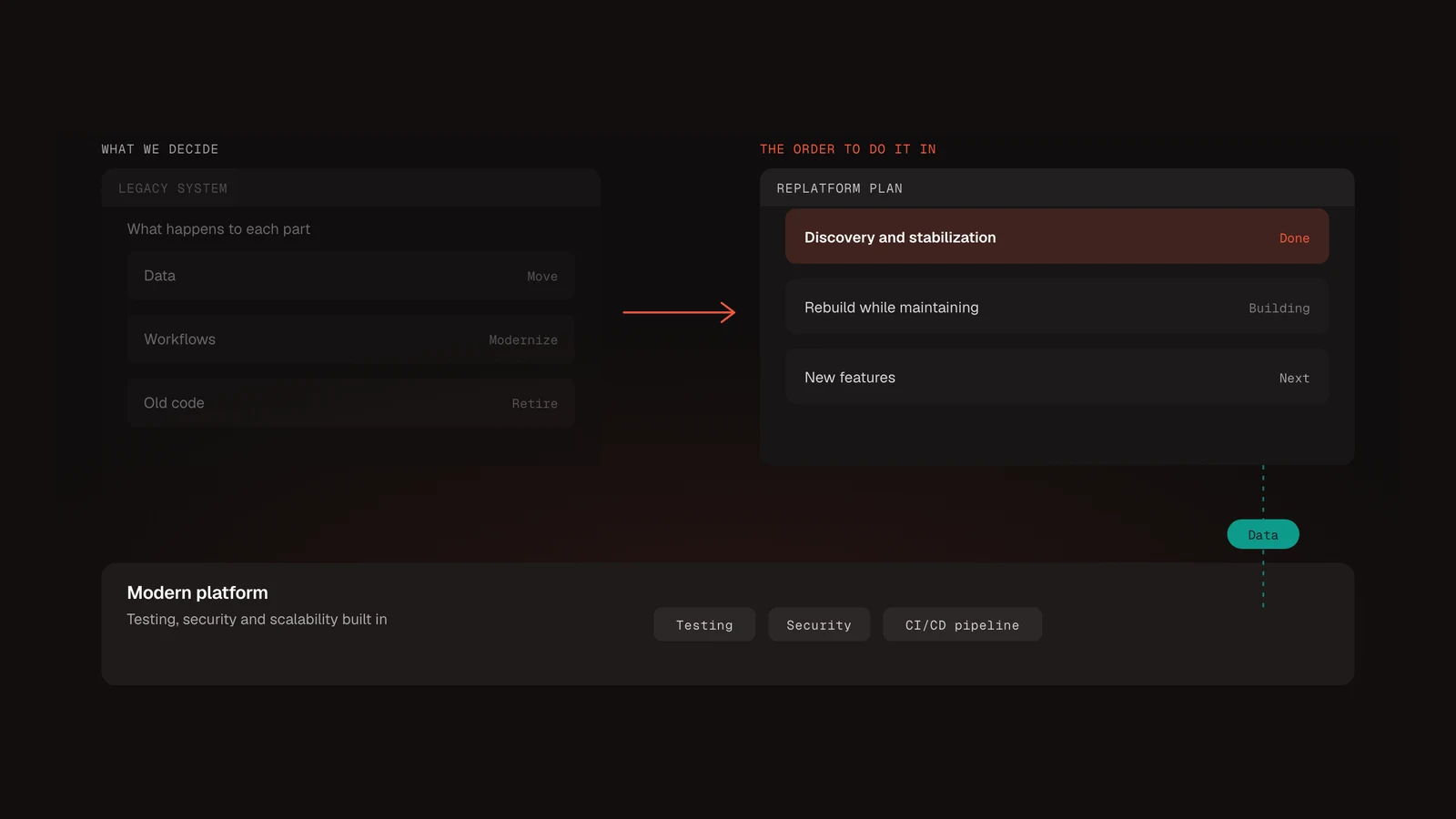
| Replatform | Move the system onto a modern platform | Data, workflows and the new platform |
| Refactor | Clean up the code without changing what it does | Engineer time inside the old code |
| Rearchitect | Change how the system is put together, often by breaking a monolithic architecture into smaller services | Redesign, then the rebuild of each part |
| Rebuild | Write the system again for the same purpose | New code, tests and data migration |
| Replace | Retire it for something else | The new system and the move to it |
At The Gnar Company, the replatform page means something specific for legacy systems. When the old stack cannot be saved, or a vendor is forcing the move, Gnar rebuilds on modern infrastructure, "with the same milestone pricing and guarantee as a custom build." When the existing code can carry the work, Gnar stabilizes it and builds on top of it, and the audit says which case you are in. The path gets decided during Discovery, based on the system's architecture, how reachable its data is, the vendor's lifecycle, and where the business is headed. Our post on replatform, refactor or rebuild walks through how to choose.
Ranges also vary for plainer reasons. A range may be sized for a company ten times your size. It may leave out data migration, testing or support. It may be an estimate from a firm that has not read your code. Ask for the line items behind any range, and ask what is excluded.
What drives the price of a replatform?#
Seven things set the price of replatforming legacy applications at any firm. Together they add up to system complexity, which is what pushes the price up. They are how many workflows the system runs, how much data has to move, how many other systems it talks to, how many kinds of users it has, what rules the business must follow, whether old and new run side by side, and how much of the old logic is written down. This list is general engineering advice. It is not a Gnar price sheet.
- Number of workflows. A workflow is something your team does every day, like entering an order or approving a claim. Count them before you talk to a firm. A system with six workflows and a system with sixty are different projects, even if both are called an ERP.
- Data migration. The data usually outlives the screens. Data migration covers how many years of records you keep, how clean they are, and whether the same field meant different things in different years. Data migration complexity raises cost through mapping, cleanup and testing. The Gnar Company's replatform page says it will "map the system, its data and its workflows, then move what the business still needs."
- Integrations. Most legacy systems talk to other systems, such as a warehouse system, a payment tool or a partner's feed. Each connection is its own piece of work and its own test. The Gnar Company describes its modernization work as integrating with legacy systems, synchronizing data, and building role-based interfaces on top of systems that can't be taken offline.
- Users and roles. A sales rep, a warehouse lead and an auditor need different screens and different permissions. More roles mean more design and more testing.
- Compliance. If the system holds records you must keep, or must show to an auditor, the new system has to prove the same things. Ask which reports and audit trails are required.
- Running old and new together. Gnar's replatform page says, "The old system keeps running while its replacement takes shape." That protects the business, and it means two systems to keep consistent until the cutover.
- Undocumented logic. Old code often holds business logic that nobody wrote down. Someone has to find it, and finding it is real work. Many legacy systems also have few automated tests, so checking the new system takes more work. In a codebase audit, Gnar reverse-engineers the logic where the documentation is missing.
Technical debt shows up in this list as cost. It is the reason a change that should take an afternoon needs a week of reading, and it is why the audit comes before the price. The replatforming page shows how Gnar decides what to move, what to modernize and what to retire, so the new platform does not inherit the old problems from outdated frameworks and older programming languages.
Can you get a fixed price for modernization?#
Yes, you can get a fixed price once the scope is mapped, and not before. A fixed price on a system nobody has mapped is a guess with a contract around it. As general advice, fixed pricing suits work with a clear scope. The way to clear scope is a paid scoping step. At The Gnar Company that step is Discovery, and it ends with a Milestone Project Plan, a fixed price for the build and the path forward when the right modernization approach is still unclear.
The Gnar Company's replatforming page puts it this way: "A quote without discovery is a guess, and guesses are how modernizations run over budget." A client said the same thing after the fact: "I wish we would have spent more time in discovery and requirements mapping up front."
What do you get for $20,000 or $30,000 depending on the tier? Per the Discovery page, the deliverables are:
- Stakeholder and user interviews that ground the plan in real behavior and business goals.
- A technical architecture blueprint, covering the tech stack, the system design and the recommended third-party services.
- Interactive prototypes of your key workflows that your team can click through.
- Design comps, which are mockups of the screens.
- A Milestone Project Plan, with a fixed price on each milestone, so the full build cost is known before you commit.
Our guide to what a software discovery phase should include covers the same ground for any firm, so you can check a competing proposal against it.
The price comes with terms. The Gnar Company's guarantee reads: "Three commitments on every build engagement: a fixed milestone price with any overage on us, a guaranteed outcome meaning the software works as specified or we fix it, and a twelve-month bug-free warranty."
You are not locked in. The plan and its guaranteed price are yours whether or not you build with Gnar. If another firm comes in lower, you can hand it the plan and ask what it would change.
Fixed price or time and materials?#
Fixed price gives you a number before work starts, and the firm holds it. Time and materials bills the hours, so the final cost is harder to predict. Time and materials leaves room to change direction, and a fixed price leaves less. Which one fits depends on how well the scope is known when you sign.
| Question | Fixed price | Time and materials |
|---|---|---|
| What do you know on day one? | The price of each milestone | The hourly rate, not the total |
| What happens when scope changes? | The scope is renegotiated, so map it first | The bill follows the hours |
| Who carries an overrun? | The firm, if the contract says so | Usually you |
| When does it fit? | Scope is mapped and the outcome is clear | Scope is unknown and you want to learn as you go |
| Main risk | A thin scope that leaves out real work | A total that keeps growing |
Both models are general and the details live in the contract. At The Gnar Company, a fixed milestone price means any overage is on Gnar. We used to argue for time and materials. Our post why we price by milestone explains why The Gnar Company now sets a fixed price on each build milestone.
Because fixed price leaves less room for changes, it only works on a mapped scope. That is the job Discovery does. Skip it and you have to choose between a fixed price that hides risk and an open bill that hides cost.
What is the cost of legacy systems you keep?#
The cost of legacy systems you keep is mostly the cost of running them, and it rarely shows up as a project. The GAO reports that the federal government spends over $100 billion on IT each year, and most of it goes to operating and maintaining existing systems. Those include aging legacy systems that are costly to maintain and vulnerable to hackers.
The GAO's July 2025 report (GAO-25-107795) names the 11 federal legacy systems most in need of modernization out of 69 it reviewed. Eight use outdated languages, four have unsupported hardware or software, and seven run with known cybersecurity vulnerabilities. Two Treasury systems run on COBOL and Assembly, with a dwindling number of people who can support them.
You are not the federal government, and these are federal numbers. Our reading is that the pattern holds for any company running legacy software and other outdated systems. When fewer people know the language, the people who do cost more and are harder to replace. When the vendor stops patching outdated software, security risks become your cost. A legacy app also gets more expensive over time when unsupported tools force workarounds and slow every change. Ask what your own system costs in each of these:
- Licenses, hosting and vendor support fees.
- Outside help, such as a contractor who knows the system.
- Staff time spent on workarounds, such as the spreadsheets built around the system.
- Maintenance costs for fixes that take a week because nobody can read the code.
- The risk of an outage or a breach, which you can estimate with your insurer or your own incident history.
Waiting has a price too, though not a clean one. McKinsey and Oxford studied large IT projects and found they run 45 percent over budget on average and deliver 56 percent less value than predicted. They also found that every additional year adds 15 percent to cost overruns. That study is about the length of projects, not the cost of waiting, so do not read it as a yearly fee for delay. Read it as a reason to run modernization projects in phases with a mapped scope, because a long open-ended program is where overruns grow.
Maintenance costs after launch#
After launch, maintenance costs at The Gnar Company start at $1,000 a month through Maintain, and you can skip it. Maintain covers hosting, monitoring, support and the same person who built it. The Gnar Company's modernization page describes it as ongoing support and feature work on the modernized system, on a pre-negotiated monthly retainer. Optional, never required.
The warranty is a separate thing. For a full year after delivery, The Gnar Company repairs any non-conforming code at no charge. The warranty covers code that does not work as specified. New work and ongoing operational support are handled separately through Maintain.
For your own budget, split the after-launch line in two:
- Fixing what is broken. This is the warranty period, and it should cost nothing for code that does not work as agreed.
- Running and improving the system. Hosting, monitoring, small updates and new functions. Price these as a monthly line, not a surprise.
Ask every firm the same question: if a bug shows up in month eight, who pays? Get the answer in writing, in the contract, before the build starts.
A worked example: the AARP Foundation replatform#
The AARP Foundation replatform shows what the work looks like, though not what it cost, because the case study does not publish a price. The Gnar Company rebuilt 14 tools on React and Ruby on Rails, moving the work onto modern systems for the AARP Foundation's Property Tax-Aide program. On average, the rebuilt tools take 40% fewer clicks to complete an application.
The case study is a replatform of the tools that help seniors save on property taxes. Gnar built them and maintains them. Read it against the cost drivers above:
- Workflows. Fourteen tools means fourteen sets of workflows to map and rebuild. That count is the first thing that moves a build range.
- Users. The people filling in those applications and the people helping them are different roles, and each needs screens that fit.
- Running old and new together. Replatforming legacy applications means the existing tools keep working while their replacements take shape. Gnar's replatform page describes that order of work. A phased rollout supports business continuity and avoids changes that could affect critical operations.
This is why a firm cannot name your price from a phone call. The same words, "replatform the tools," could mean four tools or forty. The count of workflows is a fact about your system, and only a read of your system finds it.
How to budget to modernize legacy applications#
Budget legacy application modernization in five lines: an audit, Discovery, a build range, support and the cost of the old system while you build. Shape it around your business processes, not only the technical scope. Fill the build line as a range until Discovery returns a fixed milestone price. The checklist below puts The Gnar Company's published prices next to each line, so you have real numbers to start from.
- Line 1, the audit. Ask for a source code audit before you spend anything. At Gnar it has no fee, and it can come back saying your code is in reasonable shape.
- Line 2, Discovery. Budget $20,000 or $30,000 depending on the tier, for the plan with a fixed price. Keep the plan even if you do not hire the firm that wrote it.
- Line 3, the build. Hold a range until the plan arrives. Gnar's builds typically run $150K to $300K+, and your system's number comes from Discovery.
- Line 4, support. Add a monthly line for hosting, monitoring and fixes. Maintain starts at $1,000 a month, and you can skip it.
- Line 5, the old system. Keep the current system's running costs in the budget until cutover. Old and new run side by side for a time.
Then ask every firm you talk to five questions:
- What is in the price, and what is out?
- Is the price fixed per milestone, and who pays if a milestone runs over?
- What does the warranty cover, and for how long?
- Do I keep the plan if I do not hire you?
- What does support cost after launch, and is it optional?
If a firm cannot answer all five before you sign, you are being asked to take its risk on your own budget. These are the checks that fixed-price modernization buyers should run on any proposal, ours included.
Ask for the code audit. No fee, and it can come back saying your codebase is in reasonable shape.