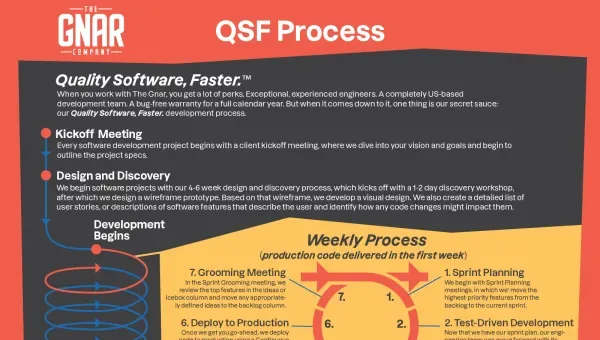
Thanks to our decades of enterprise-level software engineering experience and deep product development expertise, we have evolved a development process that enables us to successfully deliver high-quality code at a breakneck pace that we call the Quality Software, Faster process (QSF).
Here's how we do it:
Kickoff Meeting#
Every software development project should begin with a kickoff meeting for all stakeholders to get everyone on the same page. The goal is to dive into your vision and goals and begin to outline the project specs.
Design and Discovery#
We begin software projects with our 4-6 week design and discovery process which kicks off with a 1-2-day discovery workshop. In the workshop, we'll work with you to identify the most salient information before designing a wireframe prototype that outlines your product's content areas and pages.
After the workshop, design a wireframe prototype that outlines the content areas and pages of your application, and which allows iteration and exploration without the distraction of a high-fidelity visual design or costly development.
Based on the wireframes, next develop a visual design for your app, which will be used as a guide as the final features and pages of your application are developed. We also suggest creating a detailed list of user stories, or descriptions of software features that describe the user and identify how any code changes might impact them.
We've built several review checkpoints into the process, which allow you to provide feedback and make any necessary UX and UI adjustments.
Learn more about The Gnar's Design and Discovery services.
What does Gnar Discovery and Design deliver?#
Gnar Discovery and Design hands over four named deliverables: User Research, a Technical Architecture Blueprint, Interactive Prototypes and a Guaranteed-Price Build Plan. The Gnar Company also writes the product requirements "during product discovery and requirements work", its UI/UX design page says. The Discovery page states the reason in one line: "The most expensive mistake in software is building the wrong product." It goes on: "Discovery gives your team the research, design, and technical architecture to build the right thing before a dollar is spent on development."
Here is what the four deliverables cover, and the written requirements, in the words of The Gnar Company's own pages.
| Deliverable | What The Gnar Company's page says |
|---|---|
| User Research | "Stakeholder and user interviews that ground every decision in real behavior, not assumptions." |
| Technical Architecture Blueprint | "Tech stack, system design, and recommended third-party services." |
| Interactive Prototypes | "Clickable models of your key workflows that your team and stakeholders can experience firsthand." |
| Guaranteed-Price Build Plan | "A milestone-by-milestone plan with a fixed price for your Build phase." |
| Written requirements | "The written requirements list your goals, what the software must do, who will use it and what it will not do." |
The Guaranteed-Price Build Plan and the Milestone Project Plan are one plan under two names. The Discovery page puts both in the same step. It calls the Guaranteed-Price Build Plan "A milestone-by-milestone plan with a fixed price for your Build phase." The page also says "Every Discovery engagement ends with a Milestone Project Plan that breaks your build into clear phases, each with a fixed price."
The deliverables stay with the client. The Discovery page says: "You’re also free to take your deliverables to an internal team or another partner." The UI/UX design page says the same of the requirements: "Any team can build from them."
Which design work comes before the build?#
Three pieces of design work come before the build. This post's process names a wireframe and a visual design, and the Discovery page adds a clickable prototype. A wireframe outlines "the content areas and pages of your application" without "a high-fidelity visual design". A visual design is made "Based on the wireframes" and used "as a guide" for the final pages. A clickable prototype includes "high-fidelity designs, user flows, and interactive elements that simulate the final product". The Discovery page says it is something "that you can use for testing, presentations, and stakeholder reviews". In 2016, the UX research firm Nielsen Norman Group (NN/g) wrote that wireframes are "a great way of showing layout, but they don't describe interaction well."
The table below sets those three artifacts against The Gnar Company's own words.
| Design artifact | What it covers | What it is for |
|---|---|---|
| Wireframe prototype | Outlines "the content areas and pages of your application" | Allows "iteration and exploration without the distraction of a high-fidelity visual design or costly development" |
| Visual design | Made "Based on the wireframes" | Used "as a guide" as the final pages are developed |
| Clickable prototype | "high-fidelity designs, user flows, and interactive elements that simulate the final product" | "testing, presentations, and stakeholder reviews" |
NN/g's 2016 prototype guide counts "a black-and-white sketch or wireframe" as low fidelity. It also says "Designers feel less wedded to low-fidelity prototypes."
Each one comes before code for a reason the NN/g prototype guide states plainly: "Ripping up code is very expensive. Ripping up a prototype is not, especially if it’s just a piece of paper." The Discovery page makes the same point about its clickable models: "Catch problems at the cheapest possible moment."
How is the build priced after discovery?#
The Gnar Company sets a fixed price for each milestone of the build when Discovery ends, before the build starts. Its How We Work page says "Discovery ends with a plan that splits your build into milestones, each with a fixed price."
The same page gives the usual range for the build: "Typically $150K to $300K+. Your exact price comes out of Discovery, fixed per milestone."
It also sets hourly billing beside Gnar's fixed price.
| Question | Billed by the hour | Gnar's fixed price |
|---|---|---|
| If the build takes longer | You pay for the extra hours. | The overage is on us. |
| Before you sign, you see | An estimate. | A fixed price for each milestone. |
| You know the final cost | When the work is done. | Before the build starts, for the agreed work. |
The page says why the price can hold: "We can promise that because we set the price after Discovery, once the work is agreed." Its FAQ describes the other model: "Time and materials bills you for every hour, so the final number is unknown until the work is done."
Next, development begins.
Software Development with The Gnar#
We typically work in weekly sprints, so we can learn quickly and adapt priorities as the project progresses. We borrow the term "sprint" from the Agile Product Development framework and define it as chunks of planned time, typically 1-2 weeks, to complete development work. One important benefit of working with Gnar is that the engineers on your team work solely for your team, so they can immerse themselves fully in each sprint of your project.
First, we'll work with you to populate the project board with user stories and features, set up any required accounts and continuous integration, and schedule Sprint Planning and Backlog Grooming meetings in advance. Then, our software development process occurs in seven steps.
1. Sprint Planning#
We begin with Sprint Planning meetings, in which we'll move the highest-priority features from the backlog to the current sprint.
Before we move the highest-priority features into the sprint's backlog, we assign a level of complexity, which we refer to as a "Story Point", to each ticket. This allows us to track work and understand the team's capacity over time, measured in Story Points, for each Sprint. It also allows us to communicate the complexity of each ticket in the Sprint to other stakeholders and members of the product team.
2. Test-Driven Development#
Now that we have a sprint plan, the engineering team can move forward with its agile, test-driven development work. In test-driven development, each new feature includes writing a test (in code) to assert the behavior of the feature. Including a test, and not just focusing on implementation, ensures that the developer stays committed to the requirements of the feature.
The tests also help future proof the feature: tests written for the feature now, help easily catch any future development that break it. This not only reduces the development time to market but it also reduces software bugs by 40 to 90%!
3. Peer Code Review#
An integral part of our development process is the Pull Request (PR), which allows our engineers to alert others to changes they've made to the codebase. Upon receiving a Pull Request, Gnar engineers review the proposed changes, and discuss them with the team before the codebase is updated. We've found that frequent PR reviews keep the internal and external teams aligned and engaged and enable managers to proactively identify potential issues.
4. Run Automated Tests via Continuous Deployment#
Once a feature is successfully developed and PR reviews are conducted, code is verified by an automated build that runs automated tests via Continuous Deployment to identify any issues before deployment.
5. QA Test on Staging Site#
Once those tests pass, the code is deployed to a staging site. This allows you to complete a QA Test on Staging, where you will have the opportunity to review and approve the feature before it goes live.
6. Deploy to Production#
Once our team gets the go-ahead from the Approvers, we deploy code to production using a Continuous Deployment methodology, a strategy that helps engineers focus their efforts on shipping features and getting your high-quality software live as quickly as possible.
7. Sprint Grooming Meeting#
Toward the end of the sprint, we have a Sprint Grooming meeting, in which we'll review the top features in the Ideas or Icebox column and move any appropriately defined ideas to the backlog column. We review the highest-priority tickets for the upcoming sprint to ensure the development team understands and adequately schedules the requirements during Sprint Planning. We'll also confirm the priorities of the remaining features in the backlog.
What happens when priorities change mid-build?#
Small, agreed changes fit inside the fixed price, and a bigger change, like a new feature, gets sized first. If a bigger change turns out small once it is sized, The Gnar Company absorbs it. If it turns out bigger, Gnar prices it as new work. For new work, the client decides whether to add it, and the price of the work already agreed does not move.
This post, from March 2025, says the team works so it can "adapt priorities as the project progresses," a value the 2001 Manifesto for Agile Software Development names as "Responding to change over following a plan." The How We Work page sets out what a change costs on a fixed-price build, in three cases:
- A small, agreed adjustment. "At The Gnar Company, small, agreed adjustments fit inside the fixed price."
- A bigger change that turns out small. "A bigger change, like a new feature, gets sized first. If it's small, we absorb it."
- A bigger change that turns out bigger. "If it's bigger, we price it as new work and you decide whether to add it."
The answer ends: "The price of the work you already agreed to doesn't move, and any overage on it is on us."
Project Launch#
Once the product is launched the job doesn't end. When a product is in use, you will continually identify areas where it could be improved, add them into future sprints and iterate the product as new features are released.
What happens after launch?#
After launch, the code belongs to the client, and the client chooses who runs it. The Gnar Company's How We Work page offers these options: the client's own team, The Gnar Company, or Gnar Maintain.
This post, from March 2025, says "Once the product is launched the job doesn't end." The How We Work page says who can do that job: "The code is yours. Run it with us or without us." Its FAQ on life after launch lists the options:
- Your team takes over. "Your own team can take over with our support and knowledge transfer." The page adds: "We write it all down so your team can take over."
- The Gnar Company keeps building. The same answer offers the other path: "or we keep building it with you."
- Gnar Maintain runs it. "Gnar Maintain covers hosting, monitoring and support, from the same person who built it. From $1,000 a month." The Maintain step on the page also lists "We apply security patches and software updates" and "We reorder priorities as your needs change."
The same FAQ answer adds: "Either way, you're covered by our 12-month bug-free warranty." It spells out the terms: "For a full year after launch, we fix any code that doesn't work the way we agreed, at no charge."