Many companies start with optimism. They choose a software agency that promises to deliver fast, high-quality work. But often, the project ends with broken code, delays, and a team that disappears after launching a half-functioning product.
This situation is common. Tech projects across industries routinely suffer long development delays and expensive cost overruns. 70% of digital transformations fail to meet their objectives, with software projects commonly experiencing delays and cost overruns (BCG, 2024).
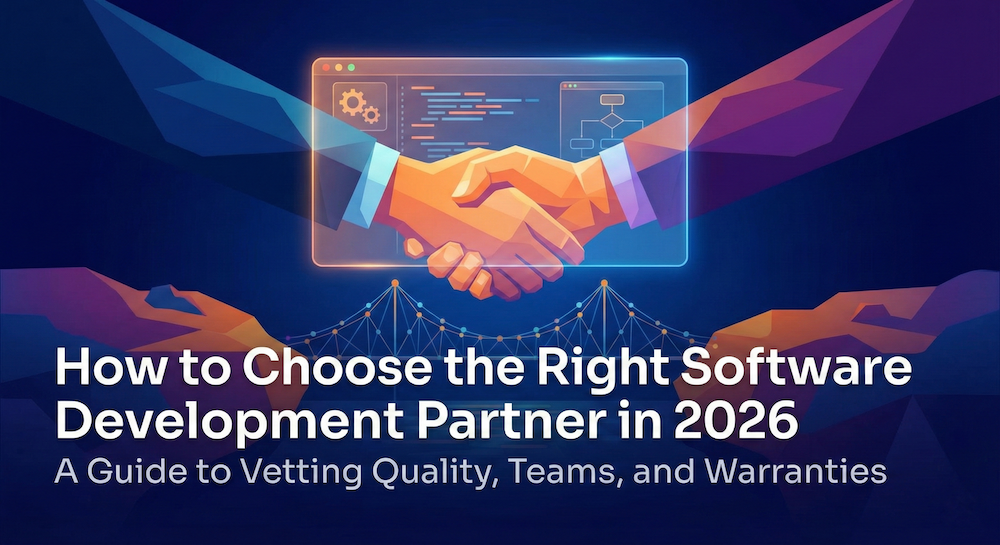
A software development partner is not just a vendor. It is a team that collaborates closely with your company to design, build, and maintain custom software. The goal is to support your team without adding the cost and complexity of hiring full-time engineers.
Unlike traditional outsourcing, a software development partnership shares responsibility for the outcome. They align with your goals, communicate clearly, and integrate with your internal team.
This article explains when to bring in a software development partner, how to evaluate options, and what to avoid when making that decision.
Understanding When You Need a Software Development Partner
You need a software development partner when your internal team cannot meet product demands due to capacity constraints, missing expertise, or tight timelines. Studies show 39% of projects fail due to changing requirements and 35% fail due to unclear objectives (TeamStage, 2024).
Common signals that indicate it's time to bring in a partner:
- Your team is at full capacity. 66% of software projects fail due to resource constraints and competing priorities (Jobera, 2025). New projects get delayed or sidelined.
- The required expertise is missing. Some projects involve technologies your team hasn't worked with such as artificial intelligence, native mobile apps, or complex third-party integrations.
- You are building something new or complex: Launching a new product or testing a new market requires faster development and tighter feedback loops.
- Hiring full-time is too slow: Recruiting and onboarding takes months. A software development partner can deliver production-quality code in weeks.
- Previous work created risk: A former partner may have left behind unstable software requiring code audits, stabilization, and rework.
Each of these conditions signals a gap that an external team can help fill.
Key Criteria for Evaluating Software Development Partners
Not all software development partners operate in the same way. Some are skilled at marketing but do not deliver reliable results. Others apply proven processes and deliver high-quality software consistently.
Technical Expertise and Experience
Start by examining whether the partner has direct experience with the technologies your project requires. Experience with similar project complexity, size, and business goals is also important. The team includes senior-level engineers who write production-ready code, not just junior developers managed remotely.
Questions to ask:
- What is your team's experience with [specific technology or framework]?
- Can you share projects that match our technical needs?
- Who on your team will be writing the code?
Engineering practices like test-driven development and automated test coverage are indicators of a mature development process. Teams based in the U.S. often offer more consistent quality due to timezone alignment and shared communication practices.
Communication and Cultural Fit
Even highly skilled teams can fail if communication is unclear or inconsistent. Cultural fit refers to whether the partner's working style matches your organization's way of operating.
Key factors to examine:
- Same-timezone working hours for real-time communication
- Proactive updates about risks or issues
- Transparency in reporting progress, code quality, and blockers
Collaborative practices are more effective than transactional ones in long-term partnerships.
Project Management and Timeline Control
Project delays from scope changes are common risks. Statistics for 2025 suggest that scope creep and shifting requirements affect the majority of projects and are strongly associated with cost and schedule overruns (Jobera, 2025). Partners with effective project management practices work with clear milestones, consistent check-ins, and tools for tracking progress.
Partners offering guarantees on both outcomes and pricing help maintain accountability and reduce risk of overages.
References and Past Projects
Previous work can show how a partner performs over time. Look for case studies and testimonials that include specific outcomes, not general statements. Long-term client relationships are indicators of consistent delivery.
Items to review:
- Testimonials citing measurable results
- Projects that match your industry or technical requirements
- Clients who have worked with the partner on multiple engagements
- Willingness to connect you with past clients for reference
Lack of detail in case studies or hesitation to share client references may indicate performance issues.
Avoiding Common Pitfalls in a Software Development Partnership
Even with careful planning, software development partnerships can fail. These failures often result from predictable issues that can be identified early.
Scope Creep and Hidden Costs
Scope creep occurs when new features or changes are added to a project after work has already started. These changes are usually not part of the original agreement and can cause budget increases and missed deadlines, creating significant risk for organizations investing in software initiatives (PM 360, 2025).
To prevent scope creep:
- Clear project requirements: Define what is included in scope before the work begins.
- Change request process: Track additions and their impact on cost and timeline.
- Guaranteed pricing models: The partner absorbs any cost overages, so clients are not responsible for unexpected costs.
Lack of Proper Quality Assurance
When features are released without proper testing, software often contains bugs. These bugs can lead to system instability, user complaints, and increased repair costs. This issue is known as technical debt—short-term shortcuts that create long-term problems.
Effective quality assurance practices include:
- Automated tests: Detect errors before software is released.
- Peer code reviews: Senior engineers review each other's work to maintain quality standards.
- Continuous integration: Tools automatically test all new code to find issues early.
Partners who offer bug-free warranties often have strong quality control processes in place during development.
Inconsistent Team Composition
In some cases, the team that sells the project is not the team that builds it. This is called the "bait and switch" problem. It can lead to poor code quality, missed requirements, and slow progress.
To avoid the "bait and switch" problem, verify:
- Team continuity: The people introduced during planning are the same people who build the product.
- Senior involvement: Senior engineers write production code, not just oversee junior staff.
- Timezone alignment: Onshore teams reduce delays and improve communication. Synchronous collaboration leads to faster problem-solving (CIO, 2025).
How AI and Senior Teams Impact Quality and Speed
AI-assisted development refers to the use of artificial intelligence tools to help software engineers write, test, and manage code more efficiently. These tools do not replace engineers. Instead, they support experienced developers in completing tasks faster and with greater precision.
For example, AI can generate the first draft of a code structure. Senior engineers then review and improve that code to verify it meets performance, security, and readability standards.
Testing is another area where AI tools assist. Automated testing tools can quickly identify bugs in the code. However, the overall testing strategy—including what to test and how to handle edge cases—is still created and maintained by skilled developers.
According to recent large‑scale developer surveys, a majority of teams using AI‑assisted workflows report noticeable time savings and higher productivity on coding tasks, with many developers saying these tools reduce task time and save at least several hours per week (Stack Overflow, 2025). AI tools help reduce repetitive tasks, allowing senior engineers to focus on complex problem-solving and architecture design.
Ensuring Cost Transparency and Risk Mitigation
Software development costs can change during a project. When costs are unknown or unpredictable, it creates uncertainty, especially for decision-makers responsible for budgets, resulting in only 1 out of every 14 software projects being delivered on time and budget (Runn, 2025).
There are three common pricing models:
- Fixed-price contracts: The partner delivers a specific scope for a set price. Provides cost certainty but requires clearly defined requirements.
- Time and materials: Billing based on actual hours worked. Allows flexibility but does not provide predictable total cost.
- Guaranteed pricing with overage protection: The partner commits to a price and absorbs any cost overruns. Provides high certainty while allowing flexibility for changes.
Some software development partners also offer outcome guarantees. This means if the software does not work as described, they are responsible for fixing it without charging additional fees. These guarantees shift the risk from the client to the partner.
Navigating Long-Term Support and Bug-Free Guarantees
After software is launched, it still requires attention. Long-term success depends not just on the launch, but on how the software is supported after release.
Post-launch support includes several key responsibilities:
- Bug fixes: If errors appear from the original development work, the partner fixes them without charging extra.
- Performance monitoring: Tracking how software runs and finding problems before they cause damage.
- Technical support and documentation: Enables your internal team to understand and maintain the software independently.
Very few software development partners offer bug-free warranties. These warranties promise that if the delivered code has any defects, the partner will fix them for free over a specific period, often 12 months. This warranty applies only to bugs, not to future feature requests or changes unrelated to the original scope.
To be valid, the warranty terms usually define what counts as a bug. For example, a bug might be defined as a function that does not work the way it was originally written to work. The warranty also includes timelines for addressing bugs. Critical bugs, such as those that stop the software from working, may be fixed within 24 hours. Less serious bugs may follow a different timeline. Warranty work is not billed hourly. It is covered by the original agreement.
Partners that offer these types of warranties often follow strict processes to avoid defects during development.
Moving Forward With a Reliable Software Development Partnership
Choosing a software development partner involves evaluating several specific factors. The decisions made at this point can impact project timelines, budgets, and long-term software quality.
When evaluating partners, assess these factors:
- Technical expertise: Familiarity with your technology stack and senior-level engineers writing code.
- Team composition: Confirm the sales team matches the delivery team. U.S.-based developers improve collaboration.
- Communication fit: Work style, responsiveness, and timezone overlap for real-time collaboration.
- Project management discipline: How the partner tracks progress, handles changes, and stays aligned to goals.
- Pricing transparency: Clear understanding of charges, change management, and any guarantees.
- Past projects and references: Verify ability to deliver similar work and how they responded to problems.
- Quality assurance: Test coverage, peer reviews, and automated testing environments.
If the goal is to engage a software development partner with guaranteed outcomes, pricing, and a bug-free warranty, supported by U.S.-based senior engineers, more information is available.
Contact us to start your custom software project or discuss your product development needs.
Frequently Asked Questions About Choosing Software Development Partners
What Is the Typical Timeline for Starting Work With a Software Development Partner?
Most software development partners begin work within a few weeks after contracts are signed, though some can start writing production code within days if requirements are clearly documented.
How Can I Verify a Software Development Partner's Bug-Free Warranty Is Legitimate?
Read the written warranty terms before signing. Look for clear bug definitions, warranty duration, and confirmation that warranty work has no hourly billing.
What Happens if My Project Requirements Change During Development?
Changes to project requirements are usually handled through a change request process that documents the change, estimates its impact on timeline and budget, and gets approval before continuing.
Does Working With a Software Development Partner in the Same Timezone Make a Difference?
Same-timezone partners enable real-time collaboration, reducing communication delays and resolving issues faster than waiting 12+ hours for responses.
How Many Engineers Are Typically Assigned to a Software Development Project?
Most projects involve 2 to 6 team members, which may include developers, designers, and project managers, though team experience and consistency matter more than the number of people.

Mike is Co-Founder of The Gnar Company, a Boston-based software development agency where he leads project delivery for clients like Whoop, Kolide (acquired by 1Password), LevelUp (acquired by GrubHub), Qeepsake (feaured on Shark Tank), and AARP. With over a decade of experience building impactful software solutions for startups, SMBs, and enterprise clients, Mike brings an unconventional perspective having transitioned from professional lacrosse to software engineering, applying an athlete's mindset of obsessive preparation and relentless iteration to every project. As AI reshapes software development, Mike has become a leading practitioner of agentic development, leveraging the latest AI-assisted practices to deliver high-quality, production-ready code in a fraction of the time traditionally required.